Skip to content
World War II: A Military and Social History
Original price was: $69.99.$14.99Current price is: $14.99.
Engross yourself in a comprehensive overview of the single largest event in human history with this 30‑lecture course by an Ivy League professor. The series treats World War II both as a series of military campaigns and as a social catastrophe: origins and diplomacy in the 1930s, operational history across Europe and the Pacific, the Holocaust and racial policy, strategic bombing and the atomic decision, home‑front mobilization, and the war’s human and geopolitical costs.
Course Overview
Engross yourself in a comprehensive overview of the single largest event in human history with this 30‑lecture course by an Ivy League professor. The series treats World War II both as a series of military campaigns and as a social catastrophe: origins and diplomacy in the 1930s, operational history across Europe and the Pacific, the Holocaust and racial policy, strategic bombing and the atomic decision, home‑front mobilization, and the war’s human and geopolitical costs.
Course Details
- Course No.: 810
- Format: 30 recorded lectures (approx. 25–36 minutes each)
- Focus: diplomatic origins, operational and campaign history, air and naval warfare, the Holocaust and Nazi racial policy, social and economic mobilization, veterans and memory, and the war’s global political consequences
Video Lectures (organized)
01: The Origins of the Second World War — 33 min
Overview of the war’s historical importance and the international failures (Treaty of Versailles, interwar system) that set the stage for global conflict.
02: Hitler’s Challenge to the International System, 1933–1936 — 30 min
Rise of Nazism, Hitler’s revisionist foreign policy, and how rhetoric and ideology informed early German moves.
03: The Failure of the International System — 32 min
Why France, Britain, the USSR, and the U.S. failed to check German aggression in the 1930s; crises of 1938–39.
04: The Coming of War — 32 min
The Munich crisis, the Nazi‑Soviet pact, and the steps that made war in 1939 practically inevitable.
05: Blitzkrieg — 31 min
Nature of Blitzkrieg as a combined economic, diplomatic, and military method; its application in Poland (1939).
06: The German Offensive in the West — 33 min
Fall of France and Dunkirk: planning, execution, and the strategic shock of the 1940 Western campaign.
07: “Their Finest Hour” — Britain Alone — 30 min
Britain’s preparations and strategy to resist invasion and Churchill’s leadership in 1940–41.
08: The Battle of Britain — 30 min
The RAF vs. the Luftwaffe: objectives, operational dynamics, and the battle for air supremacy that thwarted invasion.
09: Hitler Moves East — 30 min
Operation Barbarossa: ideological imperatives, strategic goals, and the grand gamble against the USSR.
10: The Germans Before Moscow — 30 min
Logistics, weather, and Soviet resilience that stalled German advance in late 1941 and set conditions for a protracted Eastern War.
11: The War in Asia — 31 min
Japan’s trajectory from 1937 invasion of China to the expansionist strategies that collided with Western interests.
12: The Japanese Gamble — 31 min
Pearl Harbor and the Pacific opening—planning, intelligence failures, and the diplomatic collapse between Tokyo and Washington.
13: The Height of Japanese Power — 31 min
Japanese territorial gains across Southeast Asia and the early limits of Allied response, concluding with U.S. counteractions.
14: Turning the Tide in the Pacific — Midway and Guadalcanal — 30 min
Midway’s carrier victory and Guadalcanal’s first major land defeat for Japan—two pivotal actions reversing Japanese momentum.
15: The War in North Africa — 32 min
Campaigns in Libya, Egypt, and Tunisia; strategic debates among the Allies and Axis; Montgomery, Rommel, and control of the Mediterranean.
16: War in the Mediterranean — The Invasions of Sicily and Italy — 30 min
Allied amphibious operations, Anzio and Monte Cassino, and the political-strategic implications for the European timetable.
17: Stalingrad — The Turning Point on the Eastern Front — 29 min
Urban combat, encirclement, and the decisive reversal of German fortunes that began the Soviet westward push.
18: Eisenhower and Operation Overlord — 29 min
Planning, inter‑Allied politics, command arrangements, and the operational choices behind D‑Day.
19: D‑Day to Paris — 29 min
Normandy landings, the bocage fighting, breakout, and the liberation of Paris—operational chronology and consequences.
20: Operation Market Garden and the Battle of the Bulge — 28 min
Allied risks in Holland, reasons for Market Garden’s failure, and Germany’s Ardennes counteroffensive as a last strategic gasp.
21: Advance Across the Pacific — 27 min
MacArthur and Nimitz strategies, island hopping, and the differing operational approaches to reach Japan.
22: Turning Point in the Southwest Pacific — Leyte Gulf and the Philippines — 26 min
Leyte Gulf’s decisive naval action, kamikaze introduction, and the strategic restoration of the Philippines to Allied control.
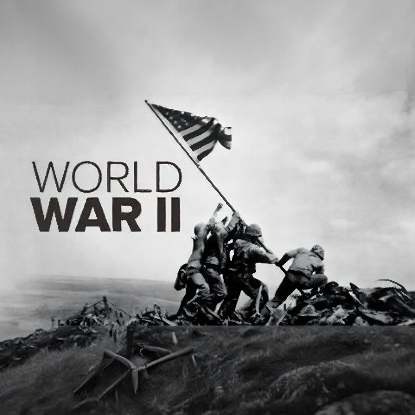
23: The Final Drive for Japan — Iwo Jima, Okinawa, and Fire‑Bombing Tokyo — 32 min
Bloodiest late‑war battles, civilian devastation from incendiary bombing, and the mounting cost of invasion plans.
24: War in the Air — 34 min
Evolution of strategic bombing doctrine, Allied and Axis air campaigns, moral debates, effectiveness, and postwar implications.
25: Hitler’s New Order in Europe — 36 min
Nazi racial ideology in practice: progression from discrimination and persecution to the Holocaust and genocide in occupied territories.
26: “The Man’s Army” — 30 min
U.S. mobilization and force creation: training, organization, and the social transformation of mass military service.
27: Daily Life, Culture, and Society in Wartime — 32 min
Home‑front mobilization, “Arsenal of Democracy” industrial conversion, women in war industries, and social tensions.
28: The Race for Berlin — 31 min
Allied and Soviet advances in 1944–45, strategic choices about Berlin, and the political consequences of occupation zones.
29: Truman, the Bomb, and the End of the War in the Pacific — 28 min
Decision to use atomic weapons: military, political, and moral considerations; Japan’s surrender and the war’s end.
30: The Costs of War — 25 min
Final appraisal of wartime human and material costs, demographic and moral consequences, and how the war reshaped the postwar world order.
Related products