Skip to content
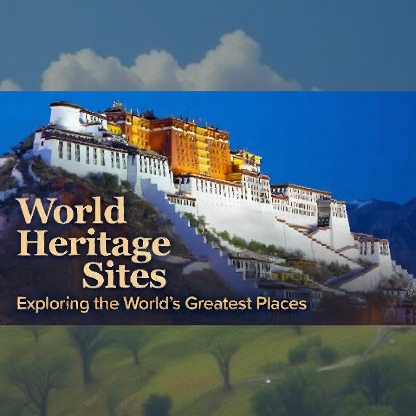
World Heritage Sites: Exploring the World’s Greatest Places
Original price was: $39.99.$8.99Current price is: $8.99.
Encounter some of the most astounding treasures of our world, both man-made and natural, in this tour of UNESCO World Heritage sites.
Overview
Encounter some of the most astounding treasures of our world, both man-made and natural, in this tour of UNESCO World Heritage sites.
Since 1972, the United Nations Educational, Scientific and Cultural Organization (UNESCO) has named World Heritage Sites across the globe, marking locations of cultural and natural interest that are of significant value to humanity.
In World Heritage Sites: Exploring the World’s Greatest Places, Professor Justin M. Jacobs, a celebrated historian, takes you on a lavish, personally selected tour of 24 of the most outstanding UNESCO World Heritage Sites.
In the 24 illustrated lectures of the course, you’ll discover world-famous sites such as India’s Taj Mahal, the Acropolis of Athens, and Egypt’s Thebes (modern Luxor). Additionally, you’ll uncover others that are less familiar yet equally extraordinary, including:
- Angkor Wat—One of the world’s most superlative temples, deep in the jungles of Cambodia, stunningly decorated with epic friezes of Hindu gods and legends.
- Teotihuacán—The grandest city of ancient Mesoamerica, whose temples, pyramids, and palaces rivaled those of both Egypt and Rome.
- Virunga National Park—One of Africa’s premier national parks, featuring fabulous landscapes, dormant volcanoes, rich biodiversity, and its most famous resident, the remarkable mountain gorilla.
- Sacred Sites of Tibet—Highlighting the iconic Potala Palace, traditional seat of the Dalai Lamas, and the Jokhang Temple, the most sacred temple in the Tibetan world.
- China’s Mogao Grottoes—Along a transport route of the ancient Silk Road, 500 man-made caves that hold a breathtaking array of Buddhist paintings and sculptures, plus a vast trove of Buddhist literature and texts.
- Persepolis—Majestic capital of ancient Persia’s Achaemenid Empire, containing monumental gateways, palaces, stairways, and audience halls, and whose glorious art pays homage to the many peoples that undergirded its realm.
In World Heritage Sites: Exploring the World’s Greatest Places, you’ll discover and enjoy learning about 24 of the greatest wonders of our planet and of human culture.
Course Structure
01: Paleolithic Cave Art of Spain and France
In this first lecture, discover the oldest paintings in the world, in the extraordinary cave art of Altamira, Lascaux, and Chauvet. Explore details of the imagery, principally depicting large animals, taking in the richness and sophistication of the artwork. Contemplate the mysteries of what the paintings mean and how they show us the cognitive tools on which human civilization was built.
Duration: 30 min
02: The Taj Mahal of Agra
The Taj Mahal is widely considered one of the world’s most beautiful buildings and an enduring symbol of love. Learn about the builder of the Taj, the Mughal emperor Shah Jahan, and his beloved wife Mumtaz Mahal, for whom it was built. Study the stunning features of this incredible funerary monument, as it serves as an architectural expression of the culture and politics of Shah Jahan’s empire.
Duration: 29 min
03: Australia’s Great Barrier Reef
The Great Barrier Reef is one of the world’s natural wonders, drawing travelers to its shimmering, multicolored coral reefs, teeming with fascinating marine life. Relive the dramatic discovery of the Reef in 1768, and learn about its complex, layered ecosystem, the largest structure ever built by living organisms. Witness the huge diversity of its wildlife and assess man-made dangers to the Reef.
Duration: 29 min
04: The Mogao Grottoes and Manuscripts
The Mogao Grottoes are a series of nearly 500 caves, dug out of cliffs in the desert of northwestern China, containing one of the most dazzling collections of Buddhist art anywhere in the world. Learn how the caves were created and see the sublime statues and lush paintings within them. Also take account of the legendary depository of Buddhist literature and historical texts within Cave 17.
Duration: 28 min
05: Persepolis, the Great Persian Capital
The citadel of Persepolis was the capital of the Achaemenid Empire for nearly 200 years. Take the measure of the vast empire of the builders of the complex, the kings Darius I and Xerxes. Explore the palace, taking in its Gate of All Nations, monumental stairways, and superb friezes. Sample some of the many inscriptions and texts found at the site, which reveal fascinating glimpses of those who lived there.
Duration: 31 min
06: Easter Island and the Moai
The extraordinary moai, the colossal statues of Easter Island, are a testament to human innovation and resilience. Begin with the amazing story of how this exceedingly remote island was colonized by Polynesian seafarers and how they subsisted there. Study the building techniques of the great statues, how they were transported across the island, and what they mean within the island’s culture.
Duration: 29 min
07: Canada’s Rocky Mountains
The Canadian Rocky Mountain Parks contain an astonishing spectrum of mountain ranges, ice fields, glaciers, pristine lakes, archaeological sites, and a superabundance of plant and animal life. Learn the natural history of the region and its settlement. Explore highlights such as the Burgess Shale; the Columbia Icefield; and other phenomenal features of Jasper, Banff, and Yoho national parks.
Duration: 30 min
08: Teotihuacán, Largest City of Mesoamerica
Teotihuacán, one of the most sophisticated cities of the ancient world, sits northeast of Mexico City. With no written records, assess what archaeologists have deduced about the city’s people and their cosmology. Visit the imposing Sun and Moon Pyramids, Temple of the Feathered Serpent, and other monuments. Also, study the remarkable art objects and colossal statues found at the site.
Duration: 29 min
09: Samarkand, Crossroads of Central Asia
Samarkand, among the oldest and greatest cities of Central Asia, contains a wealth of historical and cultural treasures. Trace the history of this fascinating icon of the Silk Road, and the Islamic transformation of the region. Take in the splendor of Samarkand’s monuments, highlighting the glorious Bibi Khanum mosque, the Gur-i Emir tomb, and the spectacular madrassahs of the Registan.
Duration: 30 min
10: Ancient Egyptian Thebes
Thebes, modern-day Luxor, is an archaeological treasure trove, representing the height of ancient Egyptian wealth and power. Begin at the extraordinary temple complexes of Karnak and Luxor, which held huge religious and political significance. Then visit the memorial temples that glorified individual monarchs and, finally, see the Valley of the Kings, the site of more than 60 royal tombs.
Duration: 30 min
11: The Forbidden City of Beijing
The majestic palace complex called The Forbidden City was the primary residence for 24 Chinese emperors over a period of 500 years. Track its history during the Ming and Qing dynasties, and study its elaborate mix of residential palaces, religious shrines, pavilions, gardens, and administrative buildings. Visualize a day in the life of the Qianlong Emperor within the palace precincts.
Duration: 29 min
12: Mount Fuji, the Symbol of Japan
Mount Fuji was granted World Heritage Site status in recognition of its deep association with Japanese history and culture. Take the measure of this iconic picturesque mountain and learn about its presence in Japanese religion, poetry, and folklore, as well as its tradition as a pilgrimage site. Take note of its depiction in art and its role in the definition of the modern Japanese nation.
Duration: 30 min
13: Timbuktu, Islam’s Center by the Sahara
Beginning in the 16th century, the Malian trading city of Timbuktu became a center of learning, literature, and Islamic knowledge, famous throughout the Muslim world. Follow the great flourishing of intellectual culture there, as seen in hundreds of thousands of ancient Arabic manuscripts that remain from the era, now preserved in libraries and attracting international attention from scholars.
Duration: 31 min
14: The Ruins of Pompeii and Herculaneum
Pompeii and Herculaneum were famously buried in 79 AD by the eruption of Mount Vesuvius, leaving two ancient Roman cities frozen in time. At Herculaneum, assess the treasures discovered at the Villa di Papyri. Then see how the mansions, streets, and bathhouses of Pompeii bring daily Roman life viscerally alive, through preserved artifacts and vestiges that rarely survive in the historical record.
Duration: 28 min
15: Virunga National Park, Gorilla Sanctuary
Virunga is one of Africa’s great national parks, home to a vast spectrum of wildlife. Learn about the most extraordinary of large primates, the mountain gorilla, which is only found here. Take in the stunning beauty of Virunga’s forests, string of dormant volcanoes, and biodiversity. And take account of the poignant political situation in the region, as it affects the park’s future.
Duration: 30 min
16: Angkor Wat, the Great Khmer Temple
The jungles of Cambodia are home to the largest religious monument in the world: the massive temple complex of Angkor Wat. Grasp how the culture of Hinduism and Sanskrit influenced the Khmer people and the building of the temple. Tour the temple’s courtyards, galleries, towers, and the exquisite decoration of friezes evoking Hindu gods and legends, unmatched in Southeast Asia.
Duration: 30 min
17: Earliest China: Yinxu and the Oracle Bones
The site of Yinxu contains the remains of the earliest Chinese dynasty: the Shang. Among Yinxu’s astonishing features, learn about the mysterious “oracle bones,” inscribed ox bones used in divination to obtain information from the netherworld. Then visit the vast royal necropolis, with sumptuous tombs containing bronze and jade treasures, and which bear evidence of substantial human sacrifice.
Duration: 30 min
18: The Inca Estate of Machu Picchu
Delve into the culture of the Inca, within which the sky palace of Machu Picchu functioned as a royal retreat. Take in the topography of the site and how the Inca integrated the estate with the landscape. View the royal residences and religious structures, and note the masterful stonework, hydraulic engineering, and the breathtaking setting that mark this beloved symbol of Peru.
Duration: 28 min
19: Iceland’s Great Assembly at Thingvellir
Thingvellir marks the site of the Althing, an Icelandic open-air parliament that met for more than 300 years. Relive the story of the settling of Iceland, and the phenomenon of the Althing, which allowed the islanders to resolve local grievances and disputes. Study the procedures and methodology of this unique medium of conflict resolution, an intangible yet deeply significant cultural tradition.
Duration: 30 min
20: Afghanistan’s Lost Bamiyan Buddhas
The Bamiyan Buddhas, destroyed in 2001 by the Taliban, bore witness to a remarkable Buddhist kingdom that flourished between the 6th and 9th centuries. Study the features of these mammoth statues, the unusual techniques of their construction, and their extraordinary adornments. Visualize the culture, rituals, and splendor that characterized this little-known trading crossroads.
Duration: 30 min
21: The Acropolis of Athens
The glorious Acropolis, beloved symbol of ancient Greece, has a complex and unusual history. Trace how the site came into being and evolved. Study the iconic structures of the Propylaea, the Erechtheion, and the Parthenon, and their decoration. Then follow the Parthenon’s Roman conversion into a Christian church, and the Acropolis’s later fortunes under other empires and civilizations.
Duration: 30 min
22: Tibet’s Potala Palace and Jokhang Temple
These beloved monuments are the most sacred sites of Tibetan Buddhism. Learn how Buddhism came to Tibet as you explore the Jokhang Temple complex, its Great Courtyard, Central Inner Sanctum, and traditional rituals. Continue with the vast Potala Palace, the highest palace in the world, and grasp its political and religious significance as the seat of the Dalai Lamas.
Duration: 29 min
23: Palmyra, Oasis in the Syrian Desert
The desert site of Palmyra flourished as a caravan crossroads for 250 years, giving rise to a diverse and fascinating culture and economy. View the extraordinary architecture of the city, from its Roman monuments, Great Colonnade and Tetrapylon to its Babylonian-inspired temples of Bel and Baalshamin. And trace its colorful history, ending with the site’s tragic destruction by ISIS in 2015.
Duration: 30 min
24: The Redwood Forests of California
Known throughout the world as marvels of nature, the California redwoods are the world’s tallest trees, able to reach the age of 2,000 and beyond. Learn about the features of these amazing giants, the conditions for their growth, and the surprising ecosystems that exist in their upper canopies. Finish with the remarkable story of their contact with humanity, and how they came to be protected.
Duration: 35 min
Related products