Skip to content
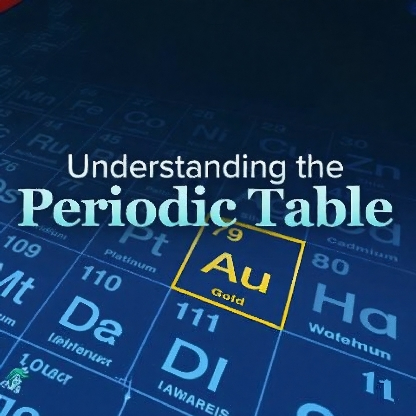
Understanding the Periodic Table
Original price was: $39.99.$7.99Current price is: $7.99.
Explore the periodic table from arsenic to zinc and everything in between. While many people have studied and worked with the periodic table in the past, their familiarity is often surface level. With a deeper dive, the table becomes a more sophisticated and, ultimately, a more useful tool. In Understanding the Periodic Table, delve into the famous columns and rows that have come to define the field of chemistry with Ron B. Davis Jr. of Georgetown University as your expert guide.
Course Overview
Explore the periodic table from arsenic to zinc and everything in between. While many people have studied and worked with the periodic table in the past, their familiarity is often surface level. With a deeper dive, the table becomes a more sophisticated and, ultimately, a more useful tool. In Understanding the Periodic Table, delve into the famous columns and rows that have come to define the field of chemistry with Ron B. Davis Jr. of Georgetown University as your expert guide.
A science lecturer with over 10 years of teaching experience, Ron is able to distill difficult material into digestible, comprehensive lessons that even novice students can understand. In 24 detailed lessons that mix lecture-style learning with hands-on experiments and lab demonstrations, refine your portrait of the periodic table.
Begin the course with an overview. What did the earliest version of the periodic table look like, and how has it changed over time? In what ways does it organize and group elements? What role do subatomic particles play? And what do the table’s groups, blocks, columns, and rows actually reveal? Answer these questions and more in Understanding the Periodic Table.
Course Lectures
01: The Periodic Table: Our Menu of Matter
Human beings have interacted with elements since prehistoric times. Yet large-scale efforts to organize these elements did not come about until the 19th century.
Duration: 31 min
02: From Triads to Tables and the Role of Protons
The periodic table was a collaborative effort that spanned centuries. Learn about debates surrounding the classification and categorization of elements.
Duration: 29 min
03: How Electrons Shape the Table
What gives the modern periodic table its distinctive shape? Understand the relationship between an atom’s nucleus and its electrons.
Duration: 31 min
04: Periodic Trends in Element Properties
What constitutes a “group” of elements? Are neighboring groups similar in some way?
Duration: 29 min
05: The Origin and Distribution of the Elements
Grasp how just three elements—hydrogen, helium, and lithium—combined to create new, heavier elements through nuclear fusion.
Duration: 30 min
06: Elements Break Down: Radiation and Fission
Familiarize yourself with the processes of transmutation, radiation, and nuclear fission that can radically alter elements and their behaviors.
Duration: 30 min
07: First-Row Opposites: Hydrogen and Helium
What do hydrogen and helium have in common? How do they differ?
Duration: 32 min
08: Sodium, Potassium, and the Alkali Metals
Focus on the elusive elements that make up the first column and major group of the periodic table.
Duration: 33 min
09: Magnesium, Calcium, and the Alkaline Earths
Explore the characteristics of group two metals like calcium, strontium, and barium.
Duration: 32 min
10: Enormous Variety on the Table’s Right Side
Get acquainted with the metals, metalloids, and nonmetals of the p-block, a collection of diverse elements.
Duration: 33 min
11: Noble Gases: The “Lazy” Unreactive Elements
Explore the history behind noble gases and understand their basic properties and behaviors.
Duration: 30 min
12: Halogens: The Most Reactive Nonmetals
Group 17 contains some of the most reactive elements on the periodic table.
Duration: 30 min
13: Why Oxygen and Nitrogen Are Irreplaceable
Discover the behaviors and subatomic structures of oxygen and nitrogen.
Duration: 34 min
14: Complexity of Carbon, Sulfur, and Phosphorus
Explore the subatomic peculiarities and behaviors of carbon, phosphorus, sulfur, and selenium.
Duration: 33 min
15: Silicon and the Metalloid Diagonal
What specific properties do metalloids share with metals, and how do they behave like nonmetals?
Duration: 31 min
16: Aluminum, Tin, Lead, and Other Weak Metals
Get to know the “weak” metals and why they behave the way they do.
Duration: 31 min
17: The Table’s Great Divide: Transition Metals
Take an introductory tour of the d-block metals from the poisonous to the ultra-dense.
Duration: 31 min
18: Colorful and Durable Early Transition Metals
Consider the distinct geometries of early transition metals and their everyday uses.
Duration: 30 min
19: Magnets and Catalysts of the Middle Transition
Learn about the history, fundamentals, and uses of the periodic table’s precious metals.
Duration: 29 min
20: From Coins to Toxins: Copper to Mercury
Explore the special subatomic qualities that made these metals hard to categorize.
Duration: 29 min
21: Rare-Earth Elements: Surprisingly Abundant
Learn how rare-earth elements and the “lanthanide contraction” trend spurred substantial technological advancements.
Duration: 31 min
22: Nuclear Fuel: Thorium, Uranium, and Plutonium
At the very bottom of the periodic table, you will find some of its most radioactive and unstable elements.
Duration: 30 min
23: Creating the Transplutonic Elements
Continue your exploration of the bottom of the table by focusing on the finding, features, and functions of the transplutonic elements.
Duration: 30 min
24: Superheavy Atoms and the Transfermium Wars
Delve into the so-called “superheavy” elements and the contentious history behind row seven of the periodic table.
Duration: 34 min
Related products



Courses