Skip to content
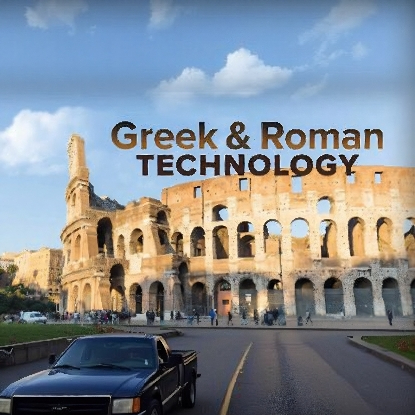
Understanding Greek and Roman Technology
Original price was: $49.99.$9.99Current price is: $9.99.
Expand your knowledge of Greek and Roman civilization with this in-depth study of their innovative technologies and feats of engineering. In 24 lavishly illustrated lectures, Dr. Stephen Ressler (civil engineer and former West Point professor) shows how classical technologies—from stone masonry and concrete to aqueducts, machines, and ships—enabled durable cities, monumental architecture, and engineering solutions often unsurpassed for centuries.
Understanding Greek and Roman Technology
Course Overview
Expand your knowledge of Greek and Roman civilization with this in-depth study of their innovative technologies and feats of engineering. In 24 lavishly illustrated lectures, Dr. Stephen Ressler (civil engineer and former West Point professor) shows how classical technologies—from stone masonry and concrete to aqueducts, machines, and ships—enabled durable cities, monumental architecture, and engineering solutions often unsurpassed for centuries.
Course Details
- Course No.: 1132
- Instructor: Dr. Stephen Ressler
- Format: 24 recorded lectures, richly illustrated
- Typical lecture length: ~27–35 minutes
- Focus: materials, construction methods, infrastructure (roads, water systems, baths), machines (cranes, pumps, mills, war engines), ships, and the modern legacy of classical technology
Video Lectures (organized)
01: Technology in the Classical World — 32 min
Introduction to the course and the technological edge of the classical world (e.g., Salamis); preview of major topics and a standout device.
02: The Substance of Technology — Materials — 29 min
Overview of engineering materials (stone, wood, clay, copper, bronze, iron) and basic mechanics (tension vs. compression) that shaped designs.
03: From Quarry to Temple — Building in Stone — 30 min
Follow a block of stone from quarry extraction through transport and precision fitting in Greek temple walls.
04: Stone Masonry Perfected — The Greek Temple — 29 min
Examine Greek temple design principles, structural logic, consistency across sites, and architectural limits.
05: From Temple to Basilica — Timber Roof Systems — 31 min
Reconstruct how ancient timber roofs were engineered to cover large interior spaces and their evolution into basilica roofs.
06: Construction Revolution — Arches and Concrete — 35 min
How the arch addresses stone’s tensile weakness and how Roman concrete and bricks revolutionized monumental building.
07: Construction in Transition — The Colosseum — 30 min
Study the Colosseum’s geometry and its mix of traditional and cutting-edge Roman construction techniques.
08: The Genesis of a New Imperial Architecture — 35 min
Nero’s Golden House and Trajan’s Market as examples of vaulted, domed, and asymmetrical imperial Roman spaces.
09: The Most Celebrated Edifice — The Pantheon — 27 min
Detailed analysis of the Pantheon’s hybrid Greek–Roman features and the engineering genius of its dome.
10: Cities by Design — The Rise of Urban Planning — 27 min
Origins of planned cities (e.g., Piraeus) and Roman surveying techniques used to lay out urban grids and infrastructure.
11: Connecting the Empire — Roads and Bridges — 35 min
Roman road-building systems, milestones, way-stations, triumphal architecture, and the long-lived bridges network.
12: From Source to City — Water Supply Systems — 28 min
Compare Greek inverted siphons and Roman arcaded aqueducts; why Romans often preferred aqueduct bridges.
13: Engineering a Roman Aqueduct — 29 min
Design exercise: locating sources, choosing profiles and aqueduct types, and assembling the water supply system.
14: Go with the Flow — Urban Water Distribution — 27 min
How water moved from aqueducts into towers, fountains, baths, homes, and sewers; discussion of lead piping concerns.
15: Paradigm and Paragon — Imperial Roman Baths — 29 min
Case study of the Baths of Caracalla: program, construction phases, and the engineering behind complex bath systems.
16: Harnessing Animal Power — Land Transportation — 31 min
Machines for land transport: wheel-and-axle technology, wagon sophistication, and use of animal power.
17: Leveraging Human Power — Construction Cranes — 31 min
Classical cranes’ components and mechanical advantage; theories on lifting large stone drums and construction techniques.
18: Lifting Water with Human Power — 31 min
Pumps and lifting devices (Archimedes’ screw, piston pumps, waterwheels) and tradeoffs among flow, lift height, and labor.
19: Milling Grain with Water Power — 29 min
Roman waterwheels (undershot, overshot, vertical-shaft) and their adoption for efficient grain milling.
20: Machines at War — Siege Towers and Rams — 31 min
Siege technology as an engine of innovation: design and use of towers, rams, and famous sieges that drove machine development.
21: Machines at War — Evolution of the Catapult — 34 min
Development from hand-crossbows to large artillery (including the palintonon) and their tactical and engineering evolution.
22: Machines at Sea — Ancient Ships — 34 min
Greek and Roman naval engineering, ship design advances, and the maritime technologies that supported trade and warfare.
23: Reconstructing the Greek Trireme — 33 min
Evidence-based reconstruction of the trireme: three banks of oars, hull design, and operational demands of ancient naval craft.
24: The Modern Legacy of Ancient Technology — 33 min
Synthesize the course: lasting influences of classical roads, aqueducts, concrete, structural forms, and engineering principles on later history and modern practice.
Related products