Skip to content
The U.S. and the Middle East: 1914 to 9/11
Original price was: $49.99.$9.99Current price is: $9.99.
At the dawn of World War I, the United States was seen as a benign rising power in the Middle East. By September 11, 2001, the perception had drastically changed. This course explores how this transformation occurred through 24 lectures, offering insights into the complex factors that shaped U.S.-Middle Eastern relations.
The U.S. and the Middle East: 1914 to 9/11
Gain perspective and understanding on a troubled region with this course that provides a narrative history and analysis of U.S. political involvement in the Middle East.
Overview Course No. 8593
At the dawn of World War I, the United States was seen as a benign rising power in the Middle East. By September 11, 2001, the perception had drastically changed. This course explores how this transformation occurred through 24 lectures, offering insights into the complex factors that shaped U.S.-Middle Eastern relations.
Video Lectures
01: A Meeting of Two Worlds
Introduction to themes of increasing American power and mutual antagonism, setting the stage for World War I.
- Duration: 34 min
02: Wilson & the Breakup of the Ottoman Empire
Explore how Wilson’s view of national self-determination influenced postwar Middle East settlements.
- Duration: 32 min
03: The Interwar Period
Analyze American interests shifting towards Saudi Arabian oil and active American Zionism.
- Duration: 30 min
04: U.S. & the Middle East During World War II
Understand how WWII altered American perceptions of the Middle East’s geopolitical significance.
- Duration: 29 min
05: Origins of the Cold War in the Middle East
Examine Cold War crises that led to the Truman Doctrine and U.S.-Saudi relations.
- Duration: 29 min
06: Truman & the Creation of Israel
Look at the consequences of Truman’s support for Israel and its impact on U.S.-Arab relations.
- Duration: 30 min
07: Eisenhower, the Cold War & the Middle East
Assess Eisenhower’s responses to Middle Eastern nationalism, including the Mossadeq overthrow.
- Duration: 31 min
08: The Suez Crisis & Arab Nationalism
Investigate the Suez Crisis and how the U.S. became the leading Western power in the Middle East.
- Duration: 30 min
09: Kennedy-Engaging Middle Eastern Nationalism
Study Kennedy’s policy shift and its initial success followed by challenges for his successor.
- Duration: 32 min
10: Johnson-Taking Sides
See how Johnson openly sided in Middle Eastern policy areas, forsaking Kennedy’s balancing act.
- Duration: 31 min
11: The Six-Day War
Dive into the 1967 war and its profound effects on the Middle East’s political landscape.
- Duration: 32 min
12: The Nixon Doctrine & the Middle East
Understand Nixon’s regional strategy and Israel’s rising role as an American ally.
- Duration: 32 min
13: The Yom Kippur War & Kissinger’s Diplomacy
Analyze Kissinger’s diplomatic strategies during and after the 1973 war.
- Duration: 31 min
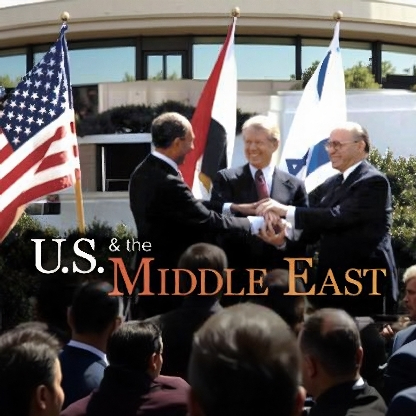
14: Carter & Camp David
Examine Carter’s role in the Camp David Accords and its divergent interpretations.
- Duration: 32 min
15: The Iranian Revolution & the Hostage Crisis
Learn about the revolution against the U.S.-backed shah and the prolonged hostage crisis.
- Duration: 28 min
16: Era of Limits-Energy Crises of the 1970s
Examine the oil shocks of the 1970s and their impact on both the West and oil-producing nations.
- Duration: 31 min
17: The Soviet Invasion of Afghanistan
Explore the effects of the Soviet invasion on U.S. policy and bin Laden’s rise.
- Duration: 31 min
18: Reagan & the Middle East
Review Reagan’s policies against militant Islam, including key events like the Beirut barracks bombing.
- Duration: 32 min
19: The First Palestinian Intifada
Detail the American response to the Palestinian uprising and its role in peace processes.
- Duration: 30 min
20: The Gulf War
Analyze the implications of the Iraqi invasion of Kuwait and Operation Desert Storm.
- Duration: 31 min
21: The Rise & Fall of the Oslo Peace Process
Examine the Israeli-PLO talks and reasons behind the failure of the Oslo Accords.
- Duration: 32 min
22: The United States & the Kurds
Trace the history of U.S. relations with the Kurds and their impact on regional involvement.
- Duration: 31 min
23: The United States & Osama bin Laden
Follow bin Laden’s ascent and the U.S.’s response leading up to 9/11.
- Duration: 31 min
24: September 11 & Its Aftermath
Conclude with the events of 9/11, their aftermath, and the future direction of U.S. policy.
- Duration: 31 min
Related products



Courses