Skip to content
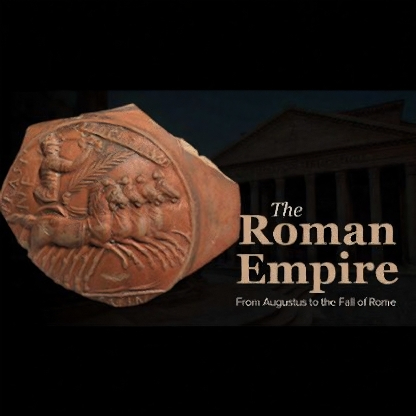
The Roman Empire: From Augustus to The Fall of Rome
Original price was: $49.99.$9.99Current price is: $9.99.
Follow a renowned history professor as he uncovers five hundred years of the Roman Empire. When Octavian, who took the title of Augustus as the first emperor of Rome, defeated Mark Antony to become the sole ruler of the Roman world, it was a major turning point in Western civilization. Not only did his decades-long rule completely transform the old Roman Republic into the Roman Empire, but it also profoundly shaped the culture and history of our world today.
Overview
Course No. 3344
Follow a renowned history professor as he uncovers five hundred years of the Roman Empire. When Octavian, who took the title of Augustus as the first emperor of Rome, defeated Mark Antony to become the sole ruler of the Roman world, it was a major turning point in Western civilization. Not only did his decades-long rule completely transform the old Roman Republic into the Roman Empire, but it also profoundly shaped the culture and history of our world today.
The Roman Empire: From Augustus to the Fall of Rome traces this breathtaking history from the empire’s foundation to its Golden Age in the 2nd century CE through a series of ever-worsening crises until its ultimate collapse. Taught by Professor Gregory S. Aldrete of the University of Wisconsin–Green Bay, these 24 captivating lectures offer you the chance to experience this story like never before.
You’ll examine the major events and familiar figures of the Roman Empire, from Caligula and Nero to Marcus Aurelius and Constantine. You’ll also look beyond the famous figures and delve deeply into the lives of ordinary Roman citizens. Read the messages they scribbled on walls as graffiti, examine what life was really like for average city-dwellers and the hazards they faced, spend a day at the chariot races, and explore some of the city’s engineering marvels.
We cannot truly understand ourselves unless we comprehend the vital influences of Rome on the modern world—and the lessons the empire can still teach us. The Roman Empire: From Augustus to the Fall of Rome is an excellent guide to one of the most important periods in world history.
Course Outline
01: Dawn of the Roman Empire
Your course opens by setting the stage for Rome’s transition from a Republic to an Empire. Octavian, overlooking the Ionian Sea after the ferocious Battle of Actium, has just secured victory in a civil war against Mark Antony. He will soon achieve what Julius Caesar could not: one-man rule over Rome. Delve into this major turning point in world history.
Duration: 35 min
02: Augustus, the First Emperor
Meet the man who became Rome’s first emperor: Octavian, who took the title of Augustus, was relatively short and sickly, but clever and astute. His great political innovation—taking the title Augustus, gaining control of the military, and ruling Rome without inspiring his own assassination—is one of history’s most astonishing feats.
Duration: 32 min
03: Tiberius and Caligula
Augustus may have been a tremendous emperor, but he failed in one key area: choosing a successor. After an almost comical series of events, he secured a male heir (a son of his wife’s by a previous marriage) to take the throne. Witness the debacle of Roman leadership under Tiberius and then Caligula.
Duration: 32 min
04: Claudius and Nero
The succession after Caligula continued to be a problem for the Roman Empire. Claudius, though physically challenged, was a good administrator. Nero, however, was depraved and self-aggrandizing, and nearly bankrupted the empire. Trace the strange, sad, and bloody story of their rule.
Duration: 31 min
05: The Flavian Emperors and Roman Bath Culture
Following Nero, a quick series of emperors took power, ultimately ending with Vespasian, the first in the line of Flavian family emperors. After reviewing the story of these emperors, their accomplishments, and their shortcomings, Professor Aldrete offers insight into Roman bath culture and what it meant for the city.
Duration: 31 min
06: The Five Good Emperors
Round out your survey of the early Roman emperors with a look at the rulers of the 2nd century, including Trajan, Hadrian, and Marcus Aurelius. Get to know their stories; their approach to ruling; and their achievements, such as Trajan’s military conquests and Marcus Aurelius’s philosophical meditations.
Duration: 33 min
07: Hazards of Life in Ancient Rome: The Five Fs
You might think of Rome as a grand city filled with shining marble and peopled with decadent-toga-clad citizens. In reality, the city was a swampy, stinking, disease-ridden mess with filth in the streets and a fire nearly every night in one of its buildings. See what life would have been like for Rome’s ordinary citizens.
Duration: 31 min
08: Roman Art and Architecture
Two of the great legacies of the Roman Empire are its art and architecture. You will reflect on the Etruscan and Greek influences on Roman portraits and sculptures, see how Augustus used art as propaganda, and learn about some of the many architectural and engineering innovations—including the Pantheon and the aqueducts.
Duration: 32 min
09: Roman Literature
Roman literature had its roots in Greek influences, but by the time of the Empire, Roman writers had come into their own. The works you will study include the fiery rhetoric of Cicero; the poetry of Horace and Ovid; and Virgil’s epic about Rome’s founding, the Aeneid. You’ll also review histories, technical works, and writings on Christianity.
Duration: 32 min
10: The Ordinary Roman Speaks: Graffiti
The traditional understanding of Rome was based on accounts by upper-class males, who wrote the primary sources historians relied on for generations. More recent historians have looked at new sources to gain a fuller sense of the city’s history. You will examine graffiti preserved at Pompeii in order to hear directly from everyday Romans.
Duration: 31 min
11: Final Words: Burial and Tombstone Epitaphs
Continue your study of everyday Romans with a look at the epitaphs on their tombstones. While elaborate tombs were reserved for the very rich, people of all social classes had their thoughts and stories inscribed on tombstones. You will also explore how the Romans buried their dead.
Duration: 30 min
12: From Commodus to Caracalla
Marcus Aurelius may have been a wise philosopher, but he didn’t act wisely when appointing his son Commodus as heir; who turned out to be a throwback to the megalomania of Caligula and Nero. Emperor Septimius Severus provided a short period of stability, but his son, Caracalla, was yet another unbalanced ruler.
Duration: 32 min
13: The Crisis of the 3rd Century
The empire hit a low point with Elagabalus, who was arguably the worst Roman emperor of all—which is saying quite a lot. Then Rome teetered on the brink of total collapse due to a deadly combination of civil war, barbarian invasions, economic collapse, and natural disasters.
Duration: 31 min
14: Diocletian and Late 3rd-Century Reforms
Just when the Roman Empire seemed on the verge of collapse, a series of hard-headed, practical emperors managed to rescue it. Follow the astonishing story of how these men, led by the reformer Diocletian, drove back the barbarians and stabilized the faltering Empire.
Duration: 32 min
15: Early Christianity and the Rise of Constantine
Stability never lasted long in the Roman Empire. At the dawn of the 4th century, Christianity emerged as a major world force—made manifest by Constantine’s dramatic and unexpected conversion. Find out how and why Christianity developed and spread, and the role it played in subsequent political events.
Duration: 32 min
16: Constantine and His Successors
Take a closer look at Constantine and explore his motivations for converting to Christianity. Learn about the Arian Controversy and the Council of Nicaea, which codified key aspects of Christian theology. Then see why Constantine founded a new capital city at Byzantium, and the state of the empire at the end of his life.
Duration: 32 min
17: Gladiators and Beast Hunts
Gladiators dominate today’s popular imagination when it comes to ancient Rome—and indeed, the Romans loved their spectacles and sports. As you will find out here, gladiator combat was only one of many popular entertainments in the empire. Find out who the gladiators were and what their lives were like. Then turn to another popular contest: the beast hunt.
Duration: 32 min
18: Chariot Racing, Spectacles, and Theater
Although gladiators dominate Hollywood films, chariot racing was actually the most popular sport in the Roman Empire. Go inside the Circus Maximus and learn about the factions and teams of chariot racers. Then shift your attention to the world of the theater, where plays, mimes, and music entertained the masses.
Duration: 32 min
19: The Roman Army
No survey of the Roman Empire would be complete without a detailed look at one of its most central institutions: the military. Take a look at the organization of Rome’s fighting forces. See what kind of equipment soldiers were outfitted with, how they trained, and what joining the military meant for farm boys in the provinces.
Duration: 32 min
20: Barbarians Overwhelm the Western Empire
Administration is only half the battle in maintaining a tremendous empire. You also have to defend the borders, and from the 3rd to the 5th centuries, Rome experienced an increasing wave of invasions by outsiders. Here, Professor Aldrete introduces you to the Huns, the Visigoths, the Vandals, and other invaders who penetrated Rome’s borders and plundered the empire.
Duration: 31 min
21: The Byzantine Empire
While the western half of the Roman Empire had clearly collapsed by the end of the 5th century, the eastern Romans in the Byzantine Empire flourished for another thousand years. Visit the world of Constantinople, meet fascinating figures such as Justinian and Theodora, and see what made the Byzantine Empire so successful.
Duration: 32 min
22: When and Why Did the Roman Empire Fall?
Generations of historians have struggled over—and disagreed about—the fundamental questions of when and why the Roman Empire fell. This lecture critically evaluates a wide range of possible answers to these complex and enduring questions.
Duration: 32 min
23: Late Antiquity: A New Historical Era
Traditionally, historians have viewed the years 200 to 600 as a time of collapse and stagnation, the end of Rome and the arrival of the “Dark Ages.” Recent historians have taken another look at this era and seen a time of invigorating change, a vibrant mingling of cultures, and an exciting transition between antiquity and the Middle Ages.
Duration: 34 min
24: Echoes of Rome
In this final lecture, consider the legacy of the Roman Empire, which influences us in innumerable ways, from our language to our legal codes. Because history is ultimately about people, Professor Aldrete closes with a few final voices to keep everyday Romans alive, and a reflection on what they might tell us today.
Duration: 38 min
Related products

Courses