Skip to content
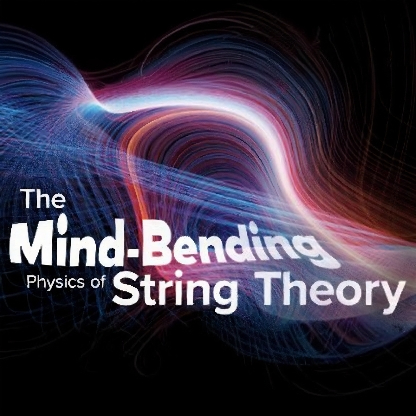
The Mind-Bending Physics of String Theory
Original price was: $24.99.$6.99Current price is: $6.99.
Take a wild ride with a noted expert through extra dimensions, black holes, inflating universes, and other marvels of string theory. String theory is the most promising candidate for a “theory of everything”—a set of ideas that unifies all of physics and describes reality at the largest and smallest scales. String theory takes scientists to truly bizarre places—to six-dimensional shapes billions of times smaller than a proton, to the uncharted interiors of black holes, and to the rapidly expanding universe a fraction of a second after the Big Bang.
Overview
Course No. 10430
Take a wild ride with a noted expert through extra dimensions, black holes, inflating universes, and other marvels of string theory. String theory is the most promising candidate for a “theory of everything”—a set of ideas that unifies all of physics and describes reality at the largest and smallest scales. String theory takes scientists to truly bizarre places—to six-dimensional shapes billions of times smaller than a proton, to the uncharted interiors of black holes, and to the rapidly expanding universe a fraction of a second after the Big Bang.
These 12 lectures are a deep dive into string theory for anyone eager to learn what it’s all about: how tiny vibrating strings account for all the particles in particle physics, what led researchers to postulate 10 dimensions instead of the three plus time in our daily lives, and why we can’t perceive these “compactified” regions of space.
The course is taught by Professor Shamit Kachru of the Stanford Institute for Theoretical Physics. A prominent string theorist, Dr. Kachru explains the unsolved questions that gave birth to string theory in the 1970s, its evolution into a quantum theory of gravity, the disparate versions of the theory, its major thinkers, and objections and alternatives to string theory. The lectures are generously illustrated with animations and graphics to make the ideas clear, as viewers venture across time, space, and unseen dimensions.
Video Lectures
01: What Led to String Theory?
After a quick review of 20th-century physics, Professor Kachru introduces the concept of unimaginably minute strings. These appear to solve longstanding problems in quantum mechanics and achieve Einstein’s dream of a quantum theory of gravity. Learn why string theory predicts extra dimensions of space—10 in total, according to some models. Then explore the startling implications.
Duration: 25 min
02: The Hidden Dimensions of the Universe
Delve deeper into string theory by probing the geometries of the extra dimensions. In the simplest cases, these could be curled into tiny circles. Also explore branes, analogous to two-dimensional membranes. See how elementary particles are a reflection of underlying string states, and learn what “spherical cows” have to do with the unifying principle of supersymmetry.
Duration: 22 min
03: Strings, Branes, and the Standard Model
The Standard Model of particle physics accounts for the fundamental particles and forces of the universe, apart from gravity. Use the framework developed so far in the course to construct a streamlined version of the Standard Model. Key concepts include D-branes (which connect open strings), scalar fields (generated by D-branes), and superpartners (a byproduct of supersymmetry).
Duration: 24 min
04: Oscillating Strings and Supersymmetry
In the Standard Model, oscillating strings are still a dream since they create particles beyond the reach of current particle accelerators. But what would happen if scientists could dial up the energy to produce highly excited strings? Draw on the work of Indian mathematician Srinivasa Ramanujan to count the almost limitless string states for a given energy level. Then see something bizarre happen.
Duration: 21 min
05: How String Theory Explains Black Holes
Investigate the physics of black holes, focusing on their entropy, a measure of disorder that is proportional to the black hole’s event horizon—or its “point of no return.” Find that string theory can explain this property, providing a tool to study one of the most puzzling objects in the universe. As in Lecture 2, utilize a spherical cow model and supersymmetry.
Duration: 20 min
06: How Strings Imply a Holographic Universe
Dive into the mystery of a black hole’s event horizon through the medium of hyperbolic art. Utilize the concept of anti-de Sitter space in conjunction with the holographic principle to probe the peculiar properties of this region. Discover how Argentine theorist Juan Maldacena harnessed these concepts, along with string theory, to enhance our understanding of quantum gravity.
Duration: 18 min
07: The Origin of the Universe
Shift from the study of black holes to the problem of the Big Bang. Both phenomena involve singularities, where matter is infinitely dense, and the known laws of physics break down. How did the universe get from a point-like singularity to a vast, geometrically “flat” realm, filled with the particles and fields of the Standard Model? See how a theory called cosmic inflation accounts for this fact.
Duration: 18 min
08: Strings and Inflation
Continue your investigation of the aftermath of the Big Bang. Analyze the evidence for a mysterious “dark” energy that is causing the expansion of the universe to accelerate. Then apply string theory to this phenomenon as well as to cosmic inflation. Although the answers are not yet definitive, string theory provides a powerful theoretical tool for understanding the earliest instant of the universe.
Duration: 24 min
09: The Many Avatars of String Theory
Step back to inspect the simplest features of string theory. Professor Kachru has already shown that string theories are well suited to 10 space-time dimensions. But why is this, and how many separate string theories are possible in 10 dimensions? To address these questions, appeal to the spherical cow approach introduced earlier. Also, see how supergravity theories fit into this framework.
Duration: 19 min
10: Duality: Which String Theory Is Fundamental?
Explore a key feature of modern theoretical physics: the equivalence between apparently dissimilar theories, a property known as duality. Probe a pair of examples in string theory: type IIA and heterotic theories. Markedly different, they can nonetheless be shown to be mathematically equivalent under certain conditions, suggesting that a more fundamental theory underlies them.
Duration: 19 min
11: Finding Evidence for String Theory
The energies needed to prove the existence of strings are far beyond today’s research tools. Is it even possible to test the theory? Learn how resourceful physicists have come up with several indirect methods of inferring the reality of strings. Hunt for the extra dimensions required by the theory, and search for the hypothesized cosmic strings left over from the era of cosmological inflation.
Duration: 20 min
12: Emergence: Can We Test String Theory?
Why has it been so hard to verify or disprove string theory? Close the course by looking at other cases in physics where what researchers saw in an experiment and what they got as an underlying theory were vastly different. String theory has already been enormously productive in particle physics, cosmology, and mathematics. The theory is beautiful and powerful—and it may even be right!
Duration: 24 min
Related products