Skip to content
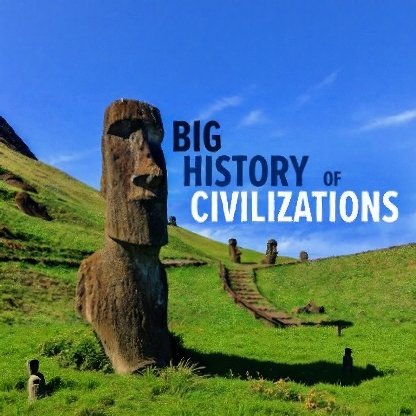
The Big History of Civilizations
Original price was: $69.99.$14.99Current price is: $14.99.
Course No. 8060 — Use the multidisciplinary approach of “big history” to trace the story of human civilizations from our emergence as a species through the agricultural and industrial revolutions and into the modern and future eras. Taught by Professor Craig G. Benjamin (Grand Valley State University), this 36-lecture course highlights large-scale patterns, crucial innovations, and cross-regional connections that shaped the human past.
The Big History of Civilizations
Overview
Course No. 8060 — Use the multidisciplinary approach of “big history” to trace the story of human civilizations from our emergence as a species through the agricultural and industrial revolutions and into the modern and future eras. Taught by Professor Craig G. Benjamin (Grand Valley State University), this 36-lecture course highlights large-scale patterns, crucial innovations, and cross-regional connections that shaped the human past.
Course Description
Big history combines archaeology, biology, climatology, economics, and traditional historical methods to see long-term trends and global linkages. The Big History of Civilizations applies this perspective to understand how cities, states, religions, trade networks, technologies, and environment interacted to produce the diversity of civilizations across Afro‑Eurasia, the Americas, Africa, Australia, and the Pacific. Through case studies (e.g., Mesopotamia, Egypt, China, the Indus, Greece, Rome, the Mongols), comparative regional surveys, and forward-looking lectures on modernity and the Anthropocene, Professor Benjamin offers tools to answer large questions—What makes us human? Where did we come from? Where might we go?
Instructor
Professor Craig G. Benjamin — Grand Valley State University
Lecture List
- A Tale of Two Ancient Cities
- Description: Jericho and Anau—what made these early cities successful and how they introduce Big History themes.
- Duration: 30 min
- The Rise of Humanity
- Description: Origins of Homo sapiens; biological, anthropological, and linguistic perspectives on what makes us human.
- Duration: 29 min
- Foraging in the Old Stone Age
- Description: The Paleolithic lifeways—family dynamics, migration, climate effects, and human adaptation.
- Duration: 31 min
- Origins of Agriculture
- Description: Causes and consequences of the agricultural revolution: climate, population, and innovation.
- Duration: 31 min
- Power, Cities, and States
- Description: Rise of cities and the emergence of political power and state institutions after agriculture.
- Duration: 30 min
- The Era of Agrarian Civilizations
- Description: Large-scale trends across 3,200 BCE–1750 CE; growth limits and structural barriers of agrarian states.
- Duration: 30 min
- Innovations of Mesopotamia
- Description: Sumerian achievements examined with linguistics, genetics, archaeology, and climatology.
- Duration: 31 min
- The Downfall of Sumer
- Description: Post-Sumerian imperial dynamics—Babylonians, Hittites, Assyrians—and environmental impacts.
- Duration: 31 min
- Egypt: Divine Rule in the Black Land
- Description: Environmental foundations of Egyptian power and insights from modern scientific research.
- Duration: 30 min
- Society and Culture of Egypt
- Description: Egyptian urban life, trade, hieroglyphics, religion, and long-term cultural influence.
- Duration: 31 min
- Early Mediterranean Civilizations
- Description: Phoenicians, Hebrews, Minoans, Mycenaeans—trade, exchange, and cultural foundations in the Mediterranean.
- Duration: 30 min
- Mysteries of the Indus Valley
- Description: Harappa and Mohenjo-Daro—urban planning, technology, and unresolved questions of the Indus civilization.
- Duration: 30 min
- South Asian Civilizations and Beliefs
- Description: Rise of Hinduism and Buddhism; political and social organizations through the Mauryan period.
- Duration: 30 min
- China: Born in Isolation
- Description: Geographic isolation and the emergence of Shang and Zhou institutions and culture.
- Duration: 29 min
- China’s Dynasties and Influence
- Description: From the Warring States to Qin and Han—legal codes, paper, printing, and long-term Chinese contributions.
- Duration: 29 min
- The Importance of the Nomads
- Description: Steppe pastoralists, horse culture, and their influence on neighboring sedentary civilizations.
- Duration: 30 min
- Oxus Civilization and Powerful Persia
- Description: Central Asian Oxus and Persian imperial dynamics—climate, social complexity, and innovations.
- Duration: 30 min
- Greece in Its Golden Age
- Description: Geography, city-states (Athens, Sparta), and political experiments that shaped Greek success.
- Duration: 30 min
- Greek Gods, Philosophy, and Science
- Description: Greek culture—myth, philosophy, and scientific inquiry and their enduring influence.
- Duration: 29 min
- Alexander’s Conquests and Hellenism
- Description: Alexander’s campaigns, Hellenistic cultural diffusion, and economic expansion.
- Duration: 29 min
- Building the Roman Republic
- Description: Rome’s transformation from city-state to Mediterranean power; leaders and institutional development.
- Duration: 29 min
- Triumphs and Flaws of Imperial Rome
- Description: Augustan golden age, imperial propaganda, crises, and the emergence of Christianity.
- Duration: 29 min
- New Ideas along the Silk Road
- Description: Transmission of goods and ideas (arts, religion, technologies) across Eurasia via Silk Roads.
- Duration: 30 min
- Chaos and Consolidation in Eurasia
- Description: Third–sixth century crises—collapse of Han and Roman administrations and divergent regional outcomes.
- Duration: 30 min
- Islamic Expansion and Rule
- Description: Origins and early expansion of Islam, Sunni–Shia split, and the Islamic Golden Age’s impact.
- Duration: 30 min
- Legacy of the Mongols
- Description: Mongol conquests, Pax Mongolica, and long-term cultural and institutional consequences.
- Duration: 29 min
- North American Peoples and Tribes
- Description: Settlement of North America and regional societies—Hopewell, Pueblo, Iroquois, Chinook, and others.
- Duration: 29 min
- Agrarian Civilizations of Mesoamerica
- Description: Geography and cultures of Mesoamerica—Olmecs, Maya, Aztecs—and regional development.
- Duration: 29 min
- Culture and Empire in South America
- Description: Andean civilizations—Nazca, Mochica, Inca—and their ecological and social adaptations.
- Duration: 29 min
- African Kingdoms and Trade
- Description: Sub-Saharan polities (Ghana, Mali), Bantu and Swahili developments, and transregional trade networks.
- Duration: 30 min
- Lifeways of Australia and the Pacific
- Description: Aboriginal Australia and Pacific chiefdoms—colonization patterns and seafaring societies.
- Duration: 31 min
- The Advent of Global Commerce
- Description: The Malthusian cycle (500–1750 CE), climate, population growth, and the rise of long-distance trade and exploration.
- Duration: 30 min
- The Industrial Revolution and Modernity
- Description: Coal, steam, and industrialization—why Britain led and how railroads and factories transformed societies.
- Duration: 30 min
- The Transformative 20th and 21st Centuries
- Description: Nationalism, global capitalism, technological acceleration, population growth, and entry into the Anthropocene.
- Duration: 30 min
- Civilization, the Biosphere, and Tomorrow
- Description: Scenarios for the near future—energy, climate, population, and societal adaptation to 2100.
- Duration: 29 min
- Civilizations of the Distant Future
- Description: Long-term futures (2600, 3100+): speculative scenarios drawn from futurists and science fiction on civilization trajectories.
- Duration: 31 min
Learning Objectives
- Apply big‑history methods to compare civilizations across time and space.
- Explain key transitions: foraging→agriculture, cities→states, agrarian→industrial societies.
- Identify major drivers of long‑term change (environment, technology, trade, ideology).
- Assess global interconnections (e.g., Silk Road, Mongol networks, Atlantic exchange).
- Use interdisciplinary evidence to interpret past and imagine plausible futures for civilization.
Target Audience
Learners interested in world history, interdisciplinary approaches, environmental history, archaeology, anthropology, and anyone seeking a wide-angle understanding of human civilization.
Related products





Courses