Skip to content
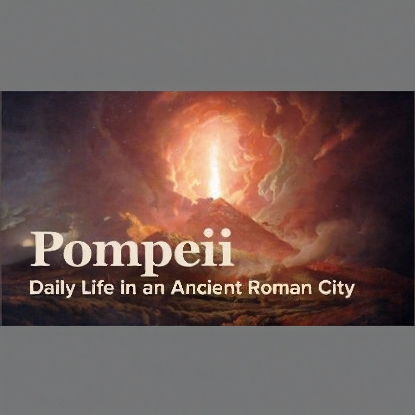
Pompeii: Daily Life in an Ancient Roman City
Original price was: $49.99.$9.99Current price is: $9.99.
Course No. 3742 — Explore a fabled city frozen in time and buried for centuries to gain a riveting, unprecedented view of everyday life in 1st-century Roman Pompeii. This 24-lecture course by Professor Steven L. Tuck examines domestic life, industry, politics, religion, disasters, and the long shadow of Vesuvius.
Overview
Course No. 3742 — Explore a fabled city frozen in time and buried for centuries to gain a riveting, unprecedented view of everyday life in 1st-century Roman Pompeii. This 24-lecture course by Professor Steven L. Tuck examines domestic life, industry, politics, religion, disasters, and the long shadow of Vesuvius.
Course Description
While the eruption of Vesuvius is dramatic, Pompeii’s greatest value to historians is the detailed record it preserves of ordinary life across social classes—aristocrats, merchants, slaves, artisans, and magistrates—stopped mid-action and preserved in sediment. Through archaeological evidence, ancient texts, and close readings of buildings, paintings, and artifacts, Professor Tuck reconstructs commerce, agriculture, social rituals, political life, industry, and responses to catastrophe. Over 24 lectures you will walk Pompeian streets, visit villas and workshops, and witness the events before, during, and after the A.D. 79 eruption.
Instructor
Professor Steven L. Tuck — Miami University
Lecture List
- Reflections on and of Pompeii
- Description: Introduction to the course and why Pompeii’s remains offer more than a story of catastrophe.
- Duration: 33 min
- Geology and Geography on the Bay of Naples
- Description: The geological forces and regional geography that shaped Pompeii and its neighbors.
- Duration: 30 min
- The Rediscovery of Vesuvian Lands
- Description: The history of Pompeii’s rediscovery and excavation from the 1500s to modern archaeology.
- Duration: 29 min
- Etruscan Pompeii—5th Century B.C.
- Description: Pompeii’s early Etruscan history and cultural formation before Roman dominance.
- Duration: 30 min
- Samnite Pompeii—2nd Century B.C.
- Description: Samnite conquest and how it redefined and expanded the city prior to Roman colonization.
- Duration: 29 min
- Building the Roman Colony—80 B.C.
- Description: Pompeii’s transformation into a Roman colony and a magistrates’ tour of the city.
- Duration: 28 min
- Villa of the Papyri and Life with Piso
- Description: A visit to the grand Villa of the Papyri to explore elite domestic culture and literary life.
- Duration: 29 min
- Marriage and Mysteries—Rites of Dionysus
- Description: The role of marriage rites and Dionysian initiation in Pompeian women’s lives.
- Duration: 29 min
- Eumachia, Public Priestess
- Description: The life, role, and public influence of a powerful Pompeian priestess.
- Duration: 29 min
- A Female Slave in Pompeii
- Description: A day in the life of a slave girl (Chryseis) to illuminate the experiences of Pompeii’s lowest ranks.
- Duration: 28 min
- Governing in the 1st Century A.D.
- Description: How civic administration worked—duoviri, aediles, and municipal responsibilities.
- Duration: 29 min
- Games and Competition for Offices
- Description: The politics of public spectacle and how gladiatorial games were used for social advancement.
- Duration: 31 min
- Riot in the Amphitheater—A.D. 59
- Description: The causes, events, and consequences of the major amphitheater riot that shook Pompeian life.
- Duration: 30 min
- The House of the Tragic Poet
- Description: Tour of a well-known house, its inhabitants, and how domestic design reflects social identity.
- Duration: 28 min
- Pompeii’s Wool Industry
- Description: Inside a fullonica (cloth workshop) to study methods, tools, and the textile economy.
- Duration: 29 min
- Pompeii’s Wine and Vineyards
- Description: Vine cultivation, wine production, and storage practices learned from preserved farms and manuals.
- Duration: 29 min
- Earthquake—A.D. 62
- Description: Evidence and broader effects of the A.D. 62 earthquake, including impacts on regional food supply.
- Duration: 32 min
- Rebuilding after the Earthquake
- Description: Pompeii’s post-quake reconstruction and what new structures reveal about cultural change.
- Duration: 29 min
- Wall Paintings in the House of the Vettii
- Description: Examination of domestic art and what the House of the Vettii discloses about freedmen and prosperity.
- Duration: 30 min
- A Pompeian Country Club
- Description: The Praedia of Julia Felix—baths, shops, gardens—and leisure architecture in Pompeii.
- Duration: 30 min
- Worshipping the Emperors at Herculaneum
- Description: Herculaneum’s public spaces and imperial cult practices as a local counterpart to Pompeii.
- Duration: 29 min
- Visiting a Villa at Stabiae
- Description: Architectural tour of a luxury cliff-top villa to imagine elite lifestyles and aesthetics.
- Duration: 28 min
- Pliny Narrates the Eruption of Vesuvius
- Description: Pliny the Younger’s eyewitness letters and a comparative account of Pompeii and Herculaneum during the eruption.
- Duration: 30 min
- The Bay of Naples after Vesuvius
- Description: Imperial relief, refugee resettlement, and the longer-term aftermath for survivors and the region.
- Duration: 29 min
Learning Objectives
- Reconstruct daily life in Pompeii across social strata using archaeological and textual evidence.
- Explain the economic, religious, political, and domestic structures of a Roman city.
- Assess Pompeii’s industries (textiles, wine, baths, services) and their role in urban life.
- Analyze how natural disasters (earthquake A.D. 62 and Vesuvius A.D. 79) impacted urban society and imperial responses.
- Interpret art, architecture, and material culture to draw conclusions about identity, status, and daily practice.
Target Audience
Students and enthusiasts of Classics, archaeology, ancient history, art history, and anyone planning to visit Pompeii or interested in reconstructed ancient daily life.
Related products






Courses