Skip to content
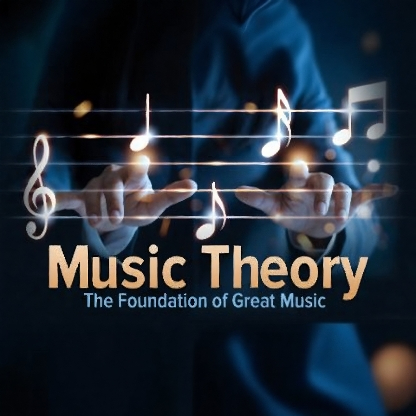
Music Theory: The Foundation of Great Music
Original price was: $39.99.$6.99Current price is: $6.99.
Learn how to read music and understand musical scores through a step-by-step system that makes music theory accessible to anyone.
Music Theory: The Foundation of Great Music
Learn how to read music and understand musical scores through a step-by-step system that makes music theory accessible to anyone.
Overview
Course No. 80060
This 18-lesson course unlocks the inner workings of Western tonal music, helping you:
- Read and interpret musical notation like a professional
- Understand core concepts including tonality, rhythm, harmony, and counterpoint
- Recognize musical structures that create meaning and emotion
- Apply theory knowledge to both classical and contemporary music
What You’ll Master:
✓ Reading staff notation and clefs
✓ Building major/minor scales and chords
✓ Comprehending harmonic progressions
✓ Analyzing musical phrases and forms
✓ Working with lead sheets for jazz/pop
Video Lectures
Section 1: Fundamentals
01: Learning the Language of Music (23 min)
Discover musical expression through Rimsky-Korsakov’s Easter Overture
02: Staff, Clefs, and Notes (23 min)
Master pitch notation on treble and bass clefs
03: Major Scales (28 min)
Construct scales using whole/half step patterns
04: Intervals (26 min)
Measure distances between pitches and their expressive qualities
Section 2: Rhythm & Notation
05: Circle of Fifths (25 min)
Navigate key relationships visually
06: Meter Basics (28 min)
Understand beat organization and time signatures
07: Simple vs. Compound Meters (25 min)
Compare Schumann, Haydn, and Bach rhythms
08: Performing Rhythm (20 min)
Practice downbeats, swing, and iconic patterns
Section 3: Harmony & Structure
09: Minor Keys (24 min)
Transform major scales into minor variants
10: Expression Markings (26 min)
Decode dynamics, articulation, and tempo
11: Counterpoint (33 min)
Compose two-voice melodies using strict rules
12-13: Triads & Seventh Chords (22 min / 21 min)
Build essential harmonic structures
14: Harmonic Progressions (22 min)
Track tonic → predominant → dominant motion
Section 4: Musical Form
15: Phrases & Cadences (23 min)
Identify musical “sentences” and their punctuation
16: Hypermeter (22 min)
Perceive larger rhythmic structures
17: Lead Sheets (31 min)
Apply theory to jazz/pop improvisation
18: Theory in Action (28 min)
Analyze Clara Schumann’s “Three Romances”
Related products