Skip to content
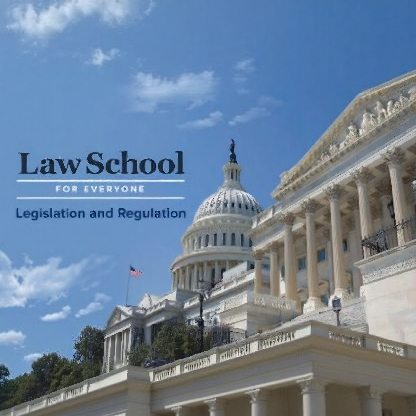
Law School for Everyone: Legislation and Regulation
Original price was: $29.99.$6.99Current price is: $6.99.
Join an award-winning law professor for an eye-opening look at how laws in America are legislated and regulated.
Overview
Join an award-winning law professor for an eye-opening look at how laws in America are legislated and regulated.
A relatively recent addition to more traditional law school topics like torts and contracts, legislation and regulation have become more and more of a mainstay in some of the country’s top law schools. Over the course of 12 nuanced and balanced lectures, examine a host of topics including the nature of regulation, the merits of lawmaking by legislation, the challenge of interpreting statutes, and the role of federal agencies in our legal system. Along the way, confront intriguing—and controversial—questions about the letter versus the spirit of the law, how much authority independent federal agencies should have, and when a court or the president should step in to impose their own interpretations. Also, get introductions to concepts like the intelligible principle (the standard, set by Congress, designed to guide and limit an agency’s authority) and hard-look reviews (court-conducted reviews designed to focus on the substance of agency decision making). Given the increasingly prominent role of legislation and regulation in today’s national discourse, it’s critical for law students and everyday leaders alike to understand how these forms of law govern countless aspects of our lives—including everything from workplace safety to the speed of your internet connection. These lectures are a fascinating introduction to how we, as citizens, can make sense of the law so we can comply with it—or challenge it when necessary.
Course Structure
01: Making Sense of Legislation and Regulation
Statutes, unlike judicial opinions, tend to be brief—yet they’re packed with meaning. Using a deceptively straightforward law about the use of vehicles in a public park, get an introduction to interpreting legislation and regulation. Should a statute’s plain meaning govern? Should we rely on what can be discerned about the statute’s intent? Or should we give effect instead to what seems to be the spirit of the law?
Duration: 31 min
02: Regulation by Statute and by Common Law
What’s distinctive about legislation as a form of regulation? In this lecture, examine how courts applied common-law tort and contract principles in order to regulate private behavior and choices. As you’ll discover through an in-depth look at environmental regulation and incentives for car manufacturers, things are rarely—if ever—simple.
Duration: 31 min
03: Legislation and the Administrative State
Compared to most other Western democracies, it’s much more difficult to pass legislation in the United States at the federal level. Here, Professor Smith uses the Civil Rights Act of 1964 to unpack how the unique features of the U.S. legislative process affect judicial interpretation of statutes.
Duration: 33 min
04: Touchstones of Statutory Interpretation
At the heart of statutory interpretation: the ability to read a legal text. Learn to do just that by thinking about how less formal kinds of interpretation in everyday life can help you interpret legal texts, and discover how 1892’s Holy Trinity Church v. United States highlights the differences and similarities between interpreting legal and non-legal texts.
Duration: 29 min
05: The Letter versus the Spirit of the Law
A central problem related to legislation and regulation is the famous conflict between the letter and the spirit of the law. How do we reconcile the words of a statute with the legislature’s apparent purpose? Study the famous 1889 case Riggs v. Palmer and 1967’s Age Discrimination in Employment Act, and join the debate for yourself.
Duration: 30 min
06: When Is Statutory Meaning Plain?
Consider just how robust our commitment to the plain meaning of statutes should be. Cases like Tennessee Valley Authority v. Hill and West Virginia University Hospitals v. Casey illuminate whether departures from the letter of the law in order to enforce the law’s spirit should be exceptions or the rule.
Duration: 30 min
07: Semantic and Substantive Interpretive Rules
Focus on the “canons of construction”: the additional set of background understandings that courts rely on to interpret statutes. McBoyle v. United States, from 1931, helps you grasp the difference between “semantic” canons (generalizations about conventional English language usage) and “substantive” ones (presumptions in favor of a particular set of outcomes).
Duration: 30 min
08: How Do Courts Really Interpret Statutes?
Using the famous case of a man charged with distributing LSD, probe whether the enterprise of statutory interpretation is hopelessly incoherent and unpredictable. Also, ponder whether it’s possible to articulate a theory of statutory interpretation that explains what courts actually do to resolve disputes over the meaning of statutes.
Duration: 32 min
09: Federal Agencies as Regulatory Bodies
Investigate how the U.S. federal government regulates, and the relationship between this regulation and legislation. You’ll focus on how agencies such as the Federal Trade Commission “enforce” federal law—and whether we should permit Congress to give agencies in the executive branch the power to decide important questions of policy.
Duration: 31 min
10: Political Control of Agency Decision Making
What can Congress do when it doesn’t approve of how a federal agency exercises the power Congress gave it? With this lecture, start thinking about how regulation by federal agencies—in hot-button matters such as immigration law and trade—raises critical questions about political control and constitutionality.
Duration: 31 min
11: Judicial Review of Agency Rulings
In the United States, judicial review by the courts is the principal way federal agencies are kept in check. Professor Smith explains two basic forms of review the courts exercise over agency decisions: ensuring that they’re procedurally sound, and ensuring they’re well-reasoned and based on appropriate considerations.
Duration: 32 min
12: Weighing Agency Interpretations of Statutes
Examine Chevron v. NRDC, the seminal case on the weight courts should give to a federal agency’s interpretation of a federal statute. Then, take a closer look at two other cases that offer a sense of how courts approach statutory ambiguity—MCI Telecommunications v. AT&T and FDA v. Brown & Williamson Tobacco. Conclude by considering the complicated interaction among legislatures, courts, and government agencies by which U.S. law and policy are implemented.
Duration: 34 min
Related products


Courses