Skip to content
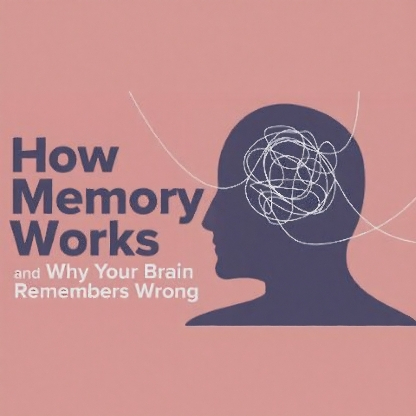
How Memory Works and Why Your Brain Remembers Wrong
Original price was: $29.99.$7.99Current price is: $7.99.
In 12 lectures presented by an expert in developmental psychology, discover why our memories are so often faulty—and why that’s a feature rather than a failure. Overview Course No. 10290.
Course Overview
In 12 lectures presented by an expert in developmental psychology, discover why our memories are so often faulty—and why that’s a feature rather than a failure. Overview Course No. 10290.
“Who are you?” Chances are you’d answer this question by describing the highlights of your personality and life experiences. But if you’d been asked this same question yesterday, you might have responded with a slightly different description. Does that mean you are a particular person today but were a different person yesterday? And what about tomorrow? Welcome to the slippery, shape-shifting nature of memory. As Professor Gabrielle Principe reveals in How Memory Works and Why Your Brain Remembers Wrong, “you” are the conglomeration of the often-unreliable information your brain decides to feed you at any given moment.
Over the course of 12 fascinating lectures, you’ll come to understand why everything you experience in this life is an illusion—nothing more and nothing less than an interpretation of signals received, assembled, and reassembled over and over, and over again, by your brain. This might sound like the plot of a sci-fi thriller or a terrifying novel. But the pliability—and even unreliability—of your memory is no accident. Six hundred million years of evolution have brought you what you have today, the best memory for Homo sapiens. Yes, you hate it when you can’t remember where you put your car keys. But through this course, you’ll come to realize that each of the obvious negatives of your memory has a flip side that supports your ability to survive and thrive.
Course Lectures
01: The Surprising Pliability of Memory
In 2012, six eyewitnesses helped convict Lydell Grant of first-degree murder. But Grant was not guilty of the crime and was eventually exonerated. Was this a conspiracy? Were all six witnesses knowingly lying? Discover the slippery, shape-shifting nature of human memory and how it can fool even the most honest and well-meaning among us.
Duration: 28 min
02: Context: The Connective Tissue of Memory
Our experiences are stored as patterns of electricity. When that same pattern is repeated, it gives us the feeling of the experience again, what we recognize as a memory. Learn how the context of that original experience affects our memory of it, and why context-driven memory is crucial to our survival.
Duration: 32 min
03: Expectation, Perception, and Memory
Is it possible that everything you’ve ever seen, heard, smelled, or tasted is just an illusion? Actually, it’s not only possible—it’s true. Your perceptions are simply the information your brain has decided to give you. Explore how your brain uses your memories to construct the seamless experience you know as your life.
Duration: 29 min
04: Attention: You Remember What You Notice
Have you ever misplaced your phone and spent precious moments of your life trying to find it? Of course—we all have. It simply means you weren’t paying attention when you put your phone down. Learn why attention is called the glue between experience and memory. If you’re not paying attention to that particular action, then it simply doesn’t exist for you. Not in memory. Not anywhere.
Duration: 27 min
05: False Memory: Remembering What Didn’t Happen
Have you ever had a false memory? Chances are your romantic partner thinks you have—or your boss, mother, or child. Because even though you know a certain event happened in a particular way, they remember a completely different scenario. Explore the many different factors that work to impair your memory of any important situation.
Duration: 30 min
06: How Biases Distort What We Remember
Dig into the many types of biases that can distort how we remember events, beliefs, and even ourselves. Biases of hindsight, availability, egocentrism, consistency, and more can cause us to edit or rewrite our previous experiences, unknowingly and unconsciously. And what about stereotype bias? You might be surprised to learn that it’s not all negative.
Duration: 31 min
07: The Repressed Memory Wars
Learn about the murder case that launched what’s become known as the “memory wars”—a still-ongoing divide between professionals—and what modern science has to say about the notion of repressed memories. Can a person “remember” an event that can be proven to never have happened? Absolutely. Thanks to the misinformation effect, it happens all the time.
Duration: 31 min
08: Things You’ll Forget and Why
We all forget things all the time, right? What’s wrong with us, and what do these memory lapses say about our character, our trustworthiness, our intelligence? Absolutely nothing, as it turns out. Discover why forgetting is, actually, a vital, adaptive feature of our brain. Get some important tips to help you better deal with its downside.
Duration: 28 min
09: Memories of Emotional Experiences
In addition to our many mundane memories, each of us also has memories of significant emotional experiences, such as the birth of a child or a major global event. Learn about your body’s HPA axis, how it functions in the creation and recovery of intense emotional memories, and its relationship to PTSD and its treatment.
Duration: 29 min
10: Changing Your Memories on Purpose
Previously, you’ve learned that scientists can be successful at implanting false memories. But what if scientists worked with similar memory modification techniques to improve your life, lessen pain, or allow PTSD sufferers to function better? Learn about the fascinating work known as reconsolidation therapy and the related drugs that can affect memory.
Duration: 27 min
11: Memory, Evidence, and the Law
Can children be relied upon to give accurate, truthful reports about events when it comes to legal matters? Some questioning techniques are obviously meant to lead children to a specific conclusion—often with dire results for the alleged perpetrators. But you’ll be surprised to learn how easy it is for adults to influence children’s memories even without intending to.
Duration: 30 min
12: The Virtues of Misremembering
When you consider how constantly memory errors shape and reshape our lives, it seems highly unlikely that these errors are simply a “bug” in the memory system that has evolved over hundreds of millions of years. Explore three ways in which our very flexible and malleable memories help us move forward in our lives better than a photographic memory ever could.
Duration: 29 min
Related products


Courses