Skip to content
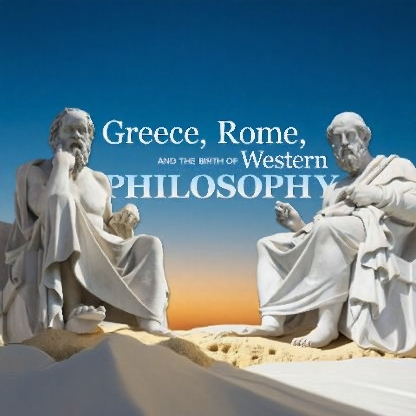
Greece, Rome, and the Birth of Western Philosophy
Original price was: $39.99.$7.99Current price is: $7.99.
From Hesiod to Seneca: Come face-to-face with the philosophical giants of ancient Greece and Rome.
Greece, Rome, and the Birth of Western Philosophy
From Hesiod to Seneca: Come face-to-face with the philosophical giants of ancient Greece and Rome.
Overview
Course No. 60120
This 24-lecture journey explores how ancient thinkers shaped Western thought by examining:
- Foundational ideas about nature, divinity, and human existence
- Key philosophical methods from Socratic dialogue to Aristotelian logic
- Enduring ethical systems including virtue ethics and Stoicism
- Political philosophy that still influences governance today
Course Highlights:
✓ Trace philosophy’s evolution from myth to systematic inquiry
✓ Compare Plato’s idealism with Aristotle’s empirical approach
✓ Discover how Epicureanism and Stoicism addressed life’s big questions
✓ Learn why these ancient ideas remain relevant today
Video Lectures
Section 1: The Pre-Socratics (Lectures 1-6)
01: Why Early Western Thought Is Timeless (27 min)
Meet the philosophers you’ll study and their lasting impact
02: Hesiod’s Challenge (27 min)
How poetry became philosophy in Theogony and Works and Days
03: Thales & Early Thinkers (33 min)
Proto-scientific inquiry meets divine reverence
04: Heraclitus vs. Parmenides (30 min)
The debate over change versus permanence
05: Pluralist Responses (35 min)
Empedocles, Anaxagoras, and Democritus on cosmic order
06: Herodotus’ Historical Philosophy (29 min)
Using the past to seek truth in the present
Section 2: Athenian Golden Age (Lectures 7-12)
07: Thucydides on Democracy (30 min)
Analyzing speech’s power in Athenian politics
08: Plato vs. Sophistry (32 min)
Transforming drama into philosophical dialogue
09: Socrates on Trial (32 min)
Philosophy’s clash with Athenian democracy
10: Plato’s Cave Allegory (29 min)
Responding to Thucydides’ crisis of speech
11: Theory of Forms (31 min)
Plato’s dual realms of perception and ideals
12: Plato’s Scientific Vision (30 min)
Atlantis myth meets cosmic creation in Timaeus
Section 3: Aristotle’s Revolution (Lectures 13-19)
13: Competing Gods (27 min)
Plato’s Craftsman vs. Aristotle’s Unmoved Mover
14: Four Causes (31 min)
Aristotle’s framework for natural phenomena
15: Empirical Research (31 min)
From biology to meteorology – science as purpose
16: Happiness Defined (30 min)
Reason integrated with emotion and desire
17: Virtue Ethics (32 min)
Cultivating character through habitual action
18: The Contemplative Life (31 min)
Technology’s role in human flourishing
19: Politics’ Biological Roots (30 min)
Examining Aristotle’s controversial hierarchies
Section 4: Hellenistic & Roman Thought (Lectures 20-24)
20: Diogenes’ Provocations (31 min)
Philosophy as public performance art
21: Epicurean Simplicity (29 min)
Pleasure through desire reduction
22: Lucretius’ Therapeutic Verse (30 min)
Atomism as antidote to fear
23: Stoic Resilience (29 min)
Virtue as path to tranquility
24: Seneca’s Letters (30 min)
Philosophy as lifelong friendship
Related products


Courses