Skip to content
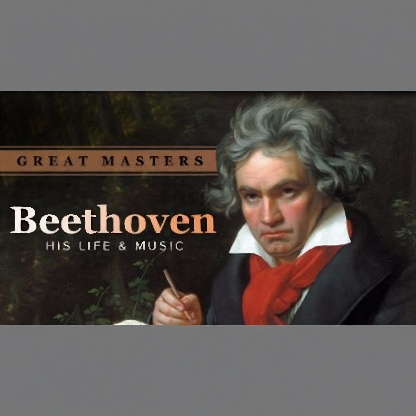
Great Masters: Beethoven—His Life and Music
Original price was: $29.99.$7.99Current price is: $7.99.
Have you ever wondered how the lives of great composers—especially when set against the social, political, and cultural context of their world—influenced their music? After listening to this perceptive series of eight lectures on the life and music of Ludwig van Beethoven, you will likely find that you hear his work in an entirely different way, with your insight informed by new knowledge of how Beethoven was able to create masterpieces from the crises of his life.
Great Masters: Beethoven—His Life and Music
Overview
Course No. 755
Have you ever wondered how the lives of great composers—especially when set against the social, political, and cultural context of their world—influenced their music? After listening to this perceptive series of eight lectures on the life and music of Ludwig van Beethoven, you will likely find that you hear his work in an entirely different way, with your insight informed by new knowledge of how Beethoven was able to create masterpieces from the crises of his life.
You’ll learn about the years of progressive hearing loss—ultimately to produce total deafness—and the understandable agony and rage that such a fate would bring upon a composer. You’ll also learn about his deep depression over the end of his relationship with the woman he calls his Immortal Beloved, his pathological hatred of authority, his persecution complex, and even delusional behaviors.
But you’ll also learn how each of these crises, and many others, served to drive Beethoven inward, to reinvent himself and redeem his suffering through art, creating disruptive works of profound passion and beauty that reinvented the nature of musical expression in the Western world.
Video Lectures
01: The Immortal Beloved
Beethoven’s foremost physical characteristic was his hair; four strands under recent chemical analysis revealed lead poisoning that could account for the abdominal distress, irritability, and depression that Beethoven suffered from for most of his adult life. But other physical, emotional, and spiritual problems were the result of a lifetime of struggle and frustration, which forced him to look inward and reinvent himself and, in so doing, reinvent the nature of musical expression in the Western world.
Duration: 44 min
02: What Comes Down Must Go Up, 1813–1815
In the summer of 1812, Beethoven composed the Symphony no. 8 in F Major, op. 83. On its surface, the symphony seems to be in the Classical style, but it is filled with modern twists and turns. He was depressed over the loss of a relationship and his worsening hearing. But in 1813, he wrote a piece of music commemorating the defeat by Wellington of one of Napoleon’s armies. When it premiered in December of 1813, it garnered Beethoven a new level of popularity.
Duration: 46 min
03: What Goes Up Must Come Down, 1815
Beethoven’s return to fame and fortune was short-lived; this lecture describes the six factors, most notably his increasing deafness, that contributed to his fall from popular grace and his plunge into emotional instability.
Duration: 44 min
04: Beethoven and His Nephew, 1815–1819
Beethoven emerged from his shell during his second decade, through his musical talent and with the help of his teacher and mentor, Christian Gottlob Neefe. The events of these years, however, would influence Beethoven’s outrageous conduct in 1815 in the litigation over custody of his nephew Karl. During these years, Beethoven’s deepest fears and longings were brought to the surface. Events would also serve as a catalyst for Beethoven’s next “rebirth,” in 1819, and the creation of the Ninth Symphony, the Missa Solemnis, the last piano sonatas, and the six late string quartets.
Duration: 48 min
05: Beethoven the Pianist
Aside from the Piano Sonata in B-flat, op. 106, Beethoven wrote little significant music from 1815–1819. By 1820, Beethoven was well into his third compositional period, which encompassed such masterworks as the “Missa Solemnis,” op. 123, and the Symphony no. 9 in D Minor, op. 125. Before this, Beethoven was living in Vienna, outplaying virtually every other pianist in the city in competitions and became the darling of the Viennese aristocracy.
Duration: 44 min
06: Beethoven the Composer, 1792–1802
Beethoven’s Viennese period, 1792–1802, was a time of assimilation, technical growth, and mastery of the existing Viennese classical style. For 18 months, Beethoven devoted himself to the string quartet, composing six. Next, he turned to the symphony, premiering his Symphony no. 1 in C Major in 1800. Seemingly conservative, this symphony is full of witticisms, shocking harmonic events, and unique organic developments. But his hearing loss, which began in 1796, was becoming progressively worse, as was Beethoven’s despair over it. In 1802, he wrote a letter to his brothers that may have provided him a catharsis.
Duration: 46 min
07: The Heroic Ideal
The model for Beethoven’s new self-image was Napoleon Bonaparte, who represented individualism and empowerment. Later disillusioned with Bonaparte, he held on to the sense of the individual struggling and triumphing against fate. Beethoven’s Symphony no. 3 in E-flat Major, op. 55 (the “Eroica”), for example, was revolutionary in its expression of the heights and depths of the artist’s emotions. Beethoven came to be known as a radical modernist who had broken forever with the classical standards of Haydn and Mozart.
Duration: 46 min
08: Two Concerts, 1808 and 1824
With his Fifth and Sixth Symphonies, among other pieces, Beethoven became a legend. More than 15 years later, in May 1824, the Ninth Symphony was premiered to an overwhelming reception. The Ninth, regarded as the most important piece of music composed in the 19th century, embodies Beethoven’s belief that the expressive needs of the artist must transcend the time-honored assumptions of art. In November 1826, Beethoven fell ill with cirrhosis of the liver and died on March 26, 1827. In the end, he had managed a reconciliation with his family and was given an affectionate tribute by the Viennese people.
Duration: 49 min
Related products