Skip to content
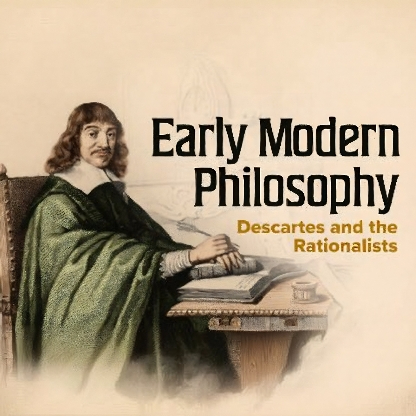
Early Modern Philosophy: Descartes and the Rationalists
Original price was: $24.99.$7.99Current price is: $7.99.
From the 17th to 18th centuries, bold thinkers cast off the authority of ancient traditions and embraced reason as the primary tool for understanding the world. These rationalists, or early modern philosophers, included René Descartes, Baruch Spinoza, and Gottfried Wilhelm Leibniz—visionaries whose answers to profound questions remain relevant today.
Overview Course No. 60110
From the 17th to 18th centuries, bold thinkers cast off the authority of ancient traditions and embraced reason as the primary tool for understanding the world. These rationalists, or early modern philosophers, included René Descartes, Baruch Spinoza, and Gottfried Wilhelm Leibniz—visionaries whose answers to profound questions remain relevant today.
Early Modern Philosophy: Descartes and the Rationalists covers the key philosophers of this period in 12 fascinating, half-hour lectures, presented by award-winning teacher James D. Reid, Professor of Philosophy at Metropolitan State University of Denver.
The rationalists addressed momentous questions such as: What can we know for certain? Are we truly free? Is there a God or a higher power? In addition to Descartes, Spinoza, and Leibniz, this course also covers Princess Elisabeth of Bohemia, Lady Anne Conway, and Nicolas Malebranche, who each contributed unique perspectives.
It is no accident that early modern philosophy developed in tandem with the Scientific Revolution. Together, the two movements laid the foundation for a fully modern world, guided by reason, systematic inquiry, empirical evidence, and a growing secular view of the universe that emphasizes human autonomy. As a result, taking this course is like witnessing the birth of the modern mind.
Course Content
- Philosophy at the Dawn of the Modern Age
Explore the intellectual climate in the 16th and 17th centuries, when early modern philosophy took off. What makes this philosophical movement modern? And what connects it to ancient and medieval philosophy? Professor Reid previews the thinkers covered in the course, and examines their connection to the ongoing Scientific Revolution and the concurrent Reformation that was dividing Christians.
Duration: 31 min
- René Descartes’s Quest for Certainty
A pioneer of early modern philosophy, René Descartes set the goal of building a foundation for knowledge that is absolutely certain. Trace the chain of reasoning in his Meditations on First Philosophy that led him to the self-evident truth of his own thinking existence. From this foundation, he demonstrates the existence of God.
Duration: 36 min
- Descartes’s Method and Motives
Why was Descartes so obsessed with certainty? Delve into The Discourse on the Method, which includes an intellectual autobiography. Follow the revolutionary deductions he reached by applying this method.
Duration: 30 min
- Elisabeth of Bohemia and Cartesian Ethics
In his Discourse, Descartes outlines a provisional moral code, but the full development of his ethical system emerges through his correspondence with Princess Elisabeth of Bohemia. Their colloquy explored happiness, virtue, emotions, and the passions, with a strong emphasis on practical ethics.
Duration: 31 min
- Lady Anne Conway’s Vitalist Metaphysics
Lady Anne Conway, a reclusive English noblewoman and philosopher, developed ideas that bridged metaphysics, ethics, and theology in sharp contrast to Descartes’s system. Drawing on her posthumously published treatise, Dr. Reid summarizes her influential critique of Cartesian dualism.
Duration: 33 min
- Baruch Spinoza on God and Nature
While Descartes argued that mind and body are two distinct substances, Baruch Spinoza proposed that there is only one substance, which he identified as God or Nature.
Duration: 31 min
- Spinoza on Mind and Emotion
Focus on Spinoza’s theory of emotions. Emotions are part of the natural order, arising from encounters with external objects or events.
Duration: 32 min
- Spinoza on Bondage and Freedom
Spinoza’s theory leads to his account of bondage and freedom—actions over which we have no control versus detachment from those emotions that hold us captive.
Duration: 32 min
- Nicolas Malebranche’s Occasionalism
Malebranche developed his own doctrine of occasionalism, integrating Cartesian metaphysics with a vision of divine intervention.
Duration: 26 min
- Gottfried Wilhelm Leibniz on Truth and Being
Known for his unified explanation of reality, Leibniz called his explanatory agents “monads” to account for being, perception, and consciousness.
Duration: 33 min
- Leibniz on Morality and the Problem of Evil
Examine Leibniz’s conclusion that God has created “the best of all possible worlds” and how he accounts for the existence of evil.
Duration: 30 min
- Rationalism Then and Now
Professor Reid discusses how the thinkers presented in the course shed light on today's debates, emphasizing that reasonable people should be free to disagree.
Duration: 30 minRelated products