Skip to content
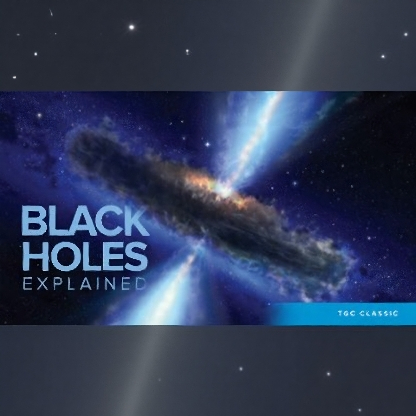
Black Holes Explained
Original price was: $29.99.$6.99Current price is: $6.99.
Examine one of the most exotic objects that exists in the universe in this fascinating course by a top astronomer.
Black Holes Explained
Overview
Examine one of the most exotic objects that exists in the universe in this fascinating course by a top astronomer.
Imagine a region in space where the force of gravity is so strong that nothing—not even light—can escape. A region with physical conditions so extreme that they have not yet been reproduced in any terrestrial laboratory. A region so dense that an object as tiny as a walnut would have the same mass as our entire planet. This phenomenon is a black hole: one of the most exotic, mind-boggling, and profound subjects in astrophysics. Nearly everyone has heard of black holes, but few people outside of complex scientific fields understand their true nature and their implications for our universe.
No movie, novel, or other fictional treatment of black holes matches Professor Filippenko’s absorbing presentation of the actual science behind these amazing objects. Black holes are at the heart of some of the most intriguing phenomena in the universe. Not only that, they are ideal gateways to fundamental and cutting-edge concepts in astronomy.
Course Content
01: A General Introduction to Black Holes
Widely featured in novels, movies, and other media, black holes are not just entertaining plot devices; they’re real. Learn how the idea of black holes was proposed more than two centuries ago, and how more recently Einstein’s general theory of relativity gave a firm theoretical basis for them.
Duration: 35 min
02: The Violent Deaths of Massive Stars
Discover how black holes can form from stars that are much more massive than the sun. After exhausting their nuclear fuel, these behemoths end in a colossal explosion called a supernova, leaving behind a superdense neutron star, or in some cases something even denser: a black hole.
Duration: 30 min
03: Gamma-Ray Bursts—The Birth of Black Holes
Trace the story of gamma-ray bursts. Long a mystery, these intense eruptions of high-energy radiation from random spots in the sky are now thought to be associated with the formation of black holes in distant galaxies. Their visibility from so far away means they are truly titanic explosions.
Duration: 30 min
04: Searching for Stellar-Mass Black Holes
If black holes emit no light, how are they detected? Investigate the different clues that establish strong evidence for black holes. For example, a star orbiting an unseen object that exceeds the 3-solar-mass limit for neutron stars is probably circling a black hole.
Duration: 31 min
05: Monster of the Milky Way and Other Galaxies
This lecture presents the most compelling evidence to date for black holes—found in the core of most galaxies. There, stars and gas clouds typically orbit at high speeds, signaling the presence of a central, supermassive black hole, millions to billions of times the mass of the sun.
Duration: 31 min
06: Quasars—Feasting Supermassive Black Holes
Quasars are another astronomical mystery explained by black holes. Explore the history of these star-like objects that long baffled astronomers, until observers realized they were seeing matter falling into supermassive black holes during the early era of galaxy formation.
Duration: 32 min
07: Gravitational Waves—Ripples in Space-Time
Gravity waves are an unexplored new window for studies of black holes. Learn how these hard-to-detect vibrations are the predicted ripples in the fabric of space-time that should result from violent phenomena such as the merging of two black holes.
Duration: 31 min
08: The Wildest Ride in the Universe
What happens if you fall into a black hole? Take a wild ride into the supermassive black hole at the center of the Milky Way Galaxy with a vivid computer simulation showing the strange effects you would experience before being crushed to incredible density.
Duration: 31 min
09: Shortcuts through the Universe and Beyond?
Mathematically, black holes seem to connect our universe with others through a gateway called an Einstein-Rosen bridge—nicknamed a wormhole by physicist John Wheeler, who also coined the term black hole. See a computer simulation of what passage through a wormhole would be like.
Duration: 32 min
10: Stephen Hawking and Black Hole Evaporation
Learn why black holes may not be completely black. In 1975, physicist Stephen Hawking showed that they can evaporate via a quantum tunneling process, giving off a slow trickle of quantum particles before eventually ending in an explosion of gamma rays.
Duration: 33 min
11: Black Holes and the Holographic Universe
The “no-hair” theorem says that black holes are utterly simple and preserve almost no information about what went into them. Discover why some physicists believe that the supposedly lost information is contained just outside the black hole in a form that resembles a hologram—and that the universe as a whole may display the same property.
Duration: 32 min
12: Black Holes and the Large Hadron Collider
Professor Filippenko closes by looking at the possibility that a new particle accelerator called the Large Hadron Collider will produce microscopic black holes. Discover why there is no danger that they will devour the Earth, and why there is no risk from any known black holes in space.
Duration: 34 min
Related products




Courses