Skip to content
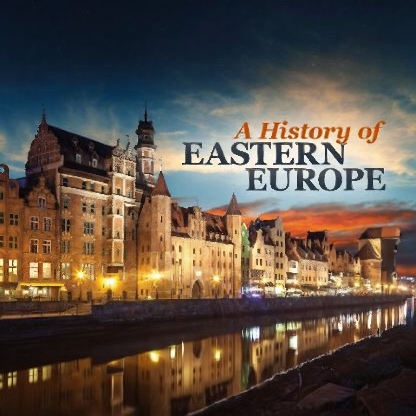
A History of Eastern Europe
Original price was: $49.99.$8.99Current price is: $8.99.
Experience the astounding history of one of the world’s most fascinating regions. This 24‑lecture survey traces roughly a millennium of Eastern European history with emphasis on the modern era: migrations and empire‑building, the rise of nationalism, the devastation of two world wars, Holocaust and postwar population transfers, life under communism, the revolts and dissident cultures that undermined Soviet control, and the tumultuous transitions of the post‑Soviet decades up to present‑day challenges.
Course Overview
Experience the astounding history of one of the world’s most fascinating regions. This 24‑lecture survey traces roughly a millennium of Eastern European history with emphasis on the modern era: migrations and empire‑building, the rise of nationalism, the devastation of two world wars, Holocaust and postwar population transfers, life under communism, the revolts and dissident cultures that undermined Soviet control, and the tumultuous transitions of the post‑Soviet decades up to present‑day challenges.
Course Details
- Course No.: 8364
- Format: 24 recorded lectures (approx. 29–32 minutes each)
- Focus: geography and ethnic diversity, medieval and early modern polities, nationalism and empire, World Wars and Holocaust, Cold War politics and society, revolts and Solidarity, Yugoslav wars, EU/NATO enlargement, and contemporary Ukraine–Russia tensions
Video Lectures (organized)
01: The Other Europe: Deep Roots of Diversity — 30 min
Geographic and cultural overview: why Eastern Europe looks and feels different, and what unites it.
02: Formative Migrations: Mongols to Germans — 31 min
Waves of migration and settlement (Slavs, Vikings, German colonists, Mongols) and their long‑term effects.
03: Clashing Golden Ages, 1389–1772 — 30 min
Key medieval and early modern turning points (Kosovo, Tannenberg), Poland‑Lithuania, and rising empires.
04: The Great Crime of Empires: Poland Divided — 31 min
Partitions of Poland and the geopolitical consequences for Central and Eastern Europe.
05: The Origins of Nationalism, 1815–1863 — 31 min
Romanticism, national movements, revolutions, and the intellectual roots of 19th‑century nationalism.
06: The Age of Empires, 1863–1914 — 30 min
Imperial consolidation (Russia, Austria, Prussia) and ideological currents that shaped the 20th century.
07: Jewish Life in the Shtetl — 30 min
Shtetl society, culture, and religious life—its vibrancy and vulnerability on the eve of the 20th century.
08: World War I: Destruction and Rebirth — 29 min
Eastern front dynamics, collapse of empires, and the emergence of new nation‑states.
09: From Democrats to Dictators, 1918–1939 — 30 min
Border wars, population transfers, democratic experiments, and the rise of authoritarian regimes.
10: Caught between Hitler and Stalin — 29 min
The Molotov‑Ribbentrop pact, dual invasions, and reordering of borders in 1939–1941.
11: World War II: The Unfamiliar Eastern Front — 31 min
Operation Barbarossa, total war, partisans, and Soviet wartime strategies.
12: The Holocaust and the Nazi Racial Empire — 30 min
Genocide across Eastern Europe: implementation, collaboration, resistance, and consequences.
13: Postwar Flight and Expulsion — 30 min
Mass displacements, expulsions of ethnic Germans, refugee crises, and demographic reshaping.
14: Behind the Iron Curtain, 1945–1953 — 31 min
Soviet occupation, imposition of communist regimes, and early Cold War consolidation.
15: Forest Brothers: Baltic Partisan Warfare — 29 min
Guerrilla resistance in Estonia, Latvia, and Lithuania and Soviet countermeasures.
16: Life in Totalitarian Captivity, 1953–1980 — 31 min
Daily life under surveillance states: repression, economy, secret police (Stasi, Securitate), and coping strategies.
17: Power of the Powerless: Revolts and Unrest — 30 min
Hungary 1956, Prague 1968, Polish strikes, samizdat literature, and the emergence of dissident publics.
18: Solidarity in Poland: Wałęsa’s Union — 28 min
Origins, rise, and significance of Solidarity as a mass social movement that challenged Communist rule.
19: Toppling Idols: The Communist Collapse — 31 min
1989 revolutions, fall of the Berlin Wall, and the unraveling of Soviet authority in Eastern Europe.
20: The Turn: The Post‑Soviet 1990s — 30 min
Economic shock, political transition, identity shifts, and the legacies revealed by OSS/Stasi archives.
21: Yugoslav Wars: Milošević and Balkan Strife — 31 min
Breakup of Yugoslavia: ethnic conflict, ethnic cleansing, international intervention, and postwar reconstruction.
22: The New Europe: Joining NATO and the EU — 29 min
Euro‑Atlantic integration, enlargement politics, and Eastern Europe’s evolving relationship to the West and Russia.
23: The Unfolding Ukraine‑Russia Crisis — 32 min
Historical roots, identity cleavages, Crimea and Donbas dynamics, and the geopolitics of Ukrainian sovereignty.
24: Eastern Europe at the Crossroads — 32 min
Synthesis: recurring themes (diversity, empires, borders, memory) and prospects for the region’s political and economic future.
Related products