Skip to content
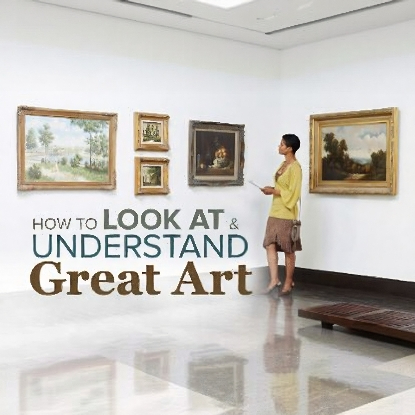
How to Look at and Understand Great Art
Original price was: $69.99.$12.90Current price is: $12.90.
How to Look at and Understand Great Art
Featuring masterpieces from 250+ of the world’s greatest artists, this in-depth guide to the practical skill of viewing art will help you reach new levels of appreciation.
Description:
Train your eye to see what artists are doing—and why it works. From first impressions and focal points to color, line, space, composition, perspective, symbolism, genres, and movements from the Renaissance to Postmodernism, you’ll learn a clear, practical toolkit for looking closely, understanding deeply, and enjoying art more.
01:The Importance of First Impressions
Examine the contexts and environments in which we encounter art and their critical effect on our viewing experience. Consider ways of displaying and framing paintings, as well as key parameters for viewing sculpture. Then, learn the predominant genres of Western art, and the artist’s media, tools, and techniques.
34 min
02:Where Am I? Point of View and Focal Point
Explore how point of view works in painting and sculpture, paying particular attention to differences in angle and spatial relation. Then, continue with focal point, or the artist’s centering of attention on a key area of the work.
30 min
03:Color—Description, Symbol, and More
Uncover core principles of color—value, saturation, analogous and complementary relationships—and see how masterpieces by Seurat, Gauguin, and Van Gogh achieve power and meaning through color.
29 min
04:Line—Description and Expression
Discover line as “descriptive” (depicting reality) or “expressional” (conveying feeling). Study geometric, implied, and directional lines in Picasso, Seurat’s The Circus, and key Modern and Expressionist works.
30 min
05:Space, Shape, Shade, and Shadow
Examine geometric and organic shapes, figure–ground, and mass–space. Explore shading and overlap in Caravaggio and Friedrich, and the compositional power of shape in Matisse’s Dance and Michelangelo’s Creation of Adam.
30 min
06:Seeing the Big Picture—Composition
Define symmetry vs. asymmetry, scale and proportion, and “open” vs. “closed” composition—and how each shapes a viewer’s experience.
30 min
07:The Illusion—Getting the Right Perspective
Trace illusionism in Western art: linear perspective, foreshortening, and atmospheric perspective. See how Cézanne and Van Gogh bend rules, and experience trompe l’oeil and anamorphosis.
29 min
08:Art That Moves Us—Time and Motion
See how artists imply motion and time with directional lines and narrative devices—across Impressionism, Abstract Expressionism, Op art, performance, and kinetic sculpture.
29 min
09:Feeling with Our Eyes—Texture and Light
Consider texture in sculpture (Rodin, Donatello, Bernini) and painterly handling of texture/light (Ingres, Titian, Renoir, Georges de La Tour).
29 min
10:Drawing—Dry, Liquid, and Modern Media
Define why artists draw—from croquis to finished works—and survey metalpoint, charcoal, ink, pastel, pencil, and modern media.
31 min
11:Printmaking—Relief and Intaglio
Compare relief (woodcut, wood engraving, linocut) and intaglio (engraving, etching, mezzotint, aquatint) through studio demos and masters from Dürer to Picasso.
33 min
12:Modern Printmaking—Planographic
Explore planographic methods—lithography, silkscreen, monotype—with Daumier, Degas, Warhol, and Whistler’s Nocturne: The Thames at Battersea.
29 min
13:Sculpture—Salt Cellars to Monuments
Survey relief and in-the-round works from public monuments to assemblage, found objects, and earth art; distinguish subtractive vs. additive methods.
31 min
14:Development of Painting—Tempera and Oils
Follow panel, fresco (buon/secco), oil, and watercolor; color mixing, brushwork, and plein-air techniques.
29 min
15:Modern Painting—Acrylics and Assemblages
Track 20th-century innovations (Stella, Frankenthaler, Pollock), mixed media, and the strengths/uses of oil vs. acrylics.
31 min
16:Subject Matters
Define three levels of iconography; review academic hierarchies of subject; probe meaning across religious/history paintings, still lifes, landscapes, portraits, and genre scenes.
30 min
17:Signs—Symbols, Icons, and Indexes in Art
Unpack symbols, icons, and indexes; see how meanings shift across eras and contexts.
32 min
18:Portraits—How Artists See Others
Study pose, gaze, and spatial placement; Rembrandt’s group portraits and David’s symbolic Napoleon.
32 min
19:Self-Portraits—How Artists See Themselves
Trace self-portraiture from subtle appearances in larger works to full self-revelation and modern variations.
31 min
20:Landscapes—Art of the Great Outdoors
Compare classical foreground/middle/background with Romantic sublime; survey Hudson River School, Luminism, Impressionism, seascapes, and cityscapes.
32 min
21:Putting It All Together
Synthesize color, line, shape, composition, light, symbolism, POV, and focal point through close readings of four diverse masterpieces.
31 min
22:Early Renaissance—Humanism Emergent
Recognize hallmarks of 15th-century classicism and humanism in Italy—focus on body, nature, and earthly life.
28 min
23:Northern Renaissance—Devil in the Details
Define Northern oil painting traits: cool light, rich detail, textiles; and chart the building of the art-historical canon.
31 min
24:High Renaissance—Humanism Perfected
Delve into Raphael, Leonardo, Michelangelo; analyze School of Athens as a High Renaissance ideal.
31 min
25:Mannerism and Baroque—Distortion and Drama
See Mannerism’s distortions and tertiary color (Michelangelo late, Tibaldi, El Greco), then Baroque’s dramatic expansiveness (Caravaggio, Rubens).
31 min
26:Going Baroque—North versus South
Contrast Counter-Reformation spectacle in the South with French classicism and Dutch light/space diversity in the North.
31 min
27:18th-Century Reality and Decorative Rococo
Explore Rococo hedonism (Watteau, Boucher, Fragonard): lovers, leisure, pastoral scenes; graceful curves and color.
29 min
28:Revolutions—Neoclassicism and Romanticism
Compare David’s stoic Neoclassicism with Delacroix’s emotive Romanticism.
32 min
29:From Realism to Impressionism
Track Realism (Millet, Courbet, Manet) to Impressionism (Renoir, Monet, Degas): natural light, the moment, and modern life.
32 min
30:Postimpressionism—Form and Content Re-Viewed
See Cézanne/Seurat restore form; Gauguin/Munch pursue symbol and psyche through increasing abstraction.
31 min
31:Expressionism—Empathy and Emotion
Define Expressionism’s violent color, distortion, sculptural paint, and psychological aims.
32 min
32:Cubism—An Experiment in Form
Unpack Analytic/Synthetic phases, fractured form, and Cubist echoes in later painting and sculpture.
30 min
33:Abstraction/Modernism—New Visual Language
Encounter nonrepresentational art’s philosophy and practice (Kandinsky, Marc, Pollock, de Kooning).
31 min
34:Dada Found Objects/Surreal Doodles and Dreams
Contrast Dada’s anti-art with Surrealism’s dream imagery and automatic drawing.
31 min
35:Postmodernism—Focus on the Viewer
Identify Pop, Op, and Minimalism; note the shift from artist-centered to viewer-interpreted meaning.
29 min
36:Your Next Museum Visit—Do It Yourself!
Get a practical guide to museum-going—making the most of collections and exhibitions—then revisit highlights across eras and movements.
34 min
Related products