Skip to content
How to Draw
Original price was: $69.99.$12.90Current price is: $12.90.
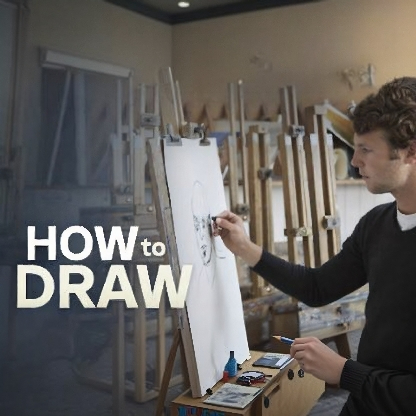
How to Draw
Experience the joy of drawing — a skill anyone can learn — in this brilliantly designed course that teaches you how to draw landscapes, portraits, still lifes, and more.
Description:
This comprehensive course introduces the foundations of drawing, from line and shape to perspective, value, texture, and color. You’ll explore the essential principles that have guided artists for centuries, practice structured exercises, and apply advanced concepts to complete complex projects. By the end, you’ll have developed both technical skills and your own creative vision.
Lessons
01:An Introduction to Drawing
Begin by considering the remarkable history of drawing, a history that has produced knowledge, methodology, and techniques that are readily learnable. Assess common misconceptions about talent and genius; discover how learning to see analytically and abstractly helps us draw; and try your first drawing exercise, retracing what our ancestors drew 80,000 years ago.
33 min
02:Drawing Materials for Line
Investigate the materials you’ll use throughout the course. Learn about graphite pencils, charcoal, brush and ink, and measuring tools. Then set up your work area and learn how to position yourself and your subject relative to your drawing board or easel.
33 min
03:Drawing Fundamentals and First Exercises
Explore essential first exercises and see how skills such as composition, proportion, perspective, value, texture, and color all work together. Gain the foundation needed to approach more complex subjects.
30 min
04:Line and Shape: Line and Aggregate Shape
Study contour lines that describe edges, and construction lines that help build objects. Learn to draw from geometric shapes and combine them into aggregate shapes that unify compositions.
32 min
05:Line and Shape: Volume and Figure-Ground
Investigate cross-contour lines, foreshortening, and their relation to solids. Practice creating 3D still lifes and explore the figure-ground relationship.
33 min
06:Line and Shape: Positive and Negative Shape
Discover the importance of negative shape — the space between objects. Practice drawing both positive and negative shapes to strengthen your compositions.
28 min
07:Composition: The Format and Its Armature
Analyze the underlying structure of rectangles, diagonals, and their effect on perception. Learn how artists use these principles to organize their compositions.
30 min
08:Composition: How Artists Compose
See how artists balance focal areas, focal points, and geometry to create unified compositions. Practice building drawings around these structural ideas.
29 min
09:Line and Shape: Line Attributes and Gesture
Explore nine key attributes of line — from value and width to continuity and texture. Then practice gestural line to quickly capture the essence of subjects.
30 min
10:Composition: Shape and Advanced Strategies
Learn advanced composition strategies such as contrast, repetition, visual “rhyming,” and spatial organization. Experiment with narrative possibilities in your drawings.
30 min
11:Proportion: Alberti’s Velo
Discover Alberti’s velo, a Renaissance gridded tool for proportion. Practice creating foreshortened views and apply this method to interiors and figures.
30 min
12:Proportion: Accurate Proportion and Measure
Learn how to measure angles with a clock face, use standard units, and apply plumb lines to achieve accuracy in proportion.
28 min
13:Creating Volume and Illusionistic Space
Study 12 factors that influence depth perception, including overlap, scale, diagonals, and atmospheric perspective. Practice applying them to your work.
30 min
14:Six Complex Drawing Projects
Apply everything you’ve learned to challenging projects: still lifes, portraits, self-portraits, and figure compositions. Address common pitfalls and solutions.
30 min
15:Linear Perspective: Introduction
Learn one-point perspective and how vanishing points create convincing depth and form. Apply it to simple structures.
33 min
16:Linear Perspective: The Quad
Draw two buildings in perspective, adding interiors and details to create a complete architectural scene.
27 min
17:Linear Perspective: The Gridded Room
Construct a perspectival grid and draw a complete room with measured proportions and interior objects.
28 min
18:Linear Perspective: Ellipses and Pattern
Practice cylinders, spheres, and cones in perspective, and learn to apply perspective to complex patterns and imagined spaces.
31 min
19:Linear Perspective: Advanced Topics
Explore two-point and three-point perspective to render angled and sloped planes. Practice building believable imagined environments.
29 min
20:Value: How Artists Use Value
Discover how tonal palettes affect mood and emotion. Learn nine steps of light and shadow transitions.
29 min
21:Value: Drawing Materials for Value
Review value materials: graphite, charcoal, ink, blending tools, papers, and fixatives. See how materials affect outcomes.
29 min
22:Value: Black and White and a Value Scale
Create black and white compositions and a nine-step value scale. Practice applying tonal contrast in still lifes.
30 min
23:Value: Eight Complex Drawing Projects
Apply value skills in projects from white-on-white still lifes to portraits and color-to-value translations.
29 min
24:Value: Side Light and Cast Shadow
Learn to imagine and draw cast shadows under different perspectives. Practice with simple and compound surfaces.
29 min
25:Value: Oblique Light and Cast Shadow
Study shadows under oblique and artificial light. Draw interiors and invented still lifes with complex shadows.
30 min
26:Texture: Mark Making and Optical Value
Experiment with hatching and mark-making to create optical textures and tonal effects. Develop your own marks.
31 min
27:Texture: How Artists Use Texture
Study master drawings and simulate textures like wood grain or metallic surfaces. Practice blending and erasing methods.
29 min
28:Color: Color Theory and Color and Light
Learn the color wheel, complementary and analogous colors, and how light influences perception of color.
30 min
29:Color: How Artists Use Color
Examine how different palettes influence mood and emotion, from flat to gradated color applications.
31 min
30:Color: Color Drawing Projects
Create pastel-based projects using color to build mood, hierarchy, and light. Explore how walls and surfaces contain complex reflected colors.
31 min
31:The Figure: A Canon of Proportions
Study human figure drawing using head-based proportional systems. Compare male and female figures.
30 min
32:The Figure: The Head, Hands, and Feet
Add detail and volume to figures. Learn methods for heads, hands, and feet.
31 min
33:The Figure: Artistic Anatomy
Explore anatomy, skeletons, and major muscle groups. Practice integrating anatomy into figure drawings.
30 min
34:The Figure: Drawing Projects
Apply anatomy in projects like self-portraits, figures in perspective, and narrative compositions.
34 min
35:Advanced Concepts: Pictorial Space
Trace how artists from antiquity to modern times approached pictorial space. Study traditional and experimental methods.
29 min
36:Advanced Drawing Projects
Finish with advanced projects that combine observation, imagination, and abstraction. Define your themes and cultivate your artistic vision.
32 min
Related products



By Area