Skip to content
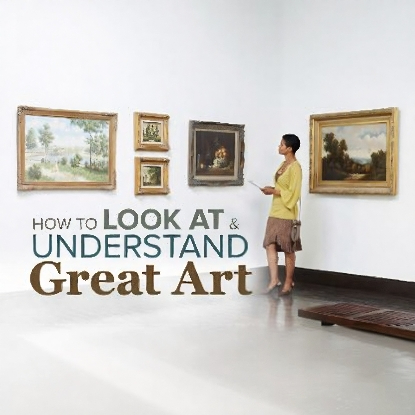
How to Look at and Understand Great Art
Original price was: $69.99.$22.99Current price is: $22.99.
Featuring masterpieces from over 250 of the world’s greatest artists, this in-depth guide to the practical skill of viewing art will help you reach new levels of appreciation.
How to Look at and Understand Great Art
Featuring masterpieces from over 250 of the world’s greatest artists, this in-depth guide to the practical skill of viewing art will help you reach new levels of appreciation.
Overview of Course No. 7640
What does it take to truly know what you’re seeing when you look at art? What technical skills and knowledge are needed to unpack the hidden significance of paintings, sculptures, prints, and more? This course consists of 36 lectures that take you on an in-depth exploration of the practical skill of viewing art through the lenses of line, light, perspective, composition, and other crucial elements of craft and technique.
Award-winning professor and art scholar Dr. Sharon Hirsh provides the specific visual and interpretive knowledge you need to approach great artworks, uncover their deeper meanings, and achieve startling new levels of appreciation. The opening lectures equip you with core technical tools for understanding visual art: color, line, composition, and signs and symbols. You will then apply this technical knowledge to major works in each genre, exploring various types of drawings, the vast spectrum of sculpture, and the important traditions within painting and printmaking. Additional lectures focus on landscapes, portraits, and self-portraits, while also guiding you through the major eras and movements in Western art, from the Renaissance to the present.
Course Structure
1. The Importance of First Impressions
Examine the contexts and environments in which we encounter art and their critical effect on our viewing experience.
Duration: 34 min
2. Where Am I? Point of View and Focal Point
Explore how point of view and focal point work in painting and sculpture, paying attention to differences in angle and spatial relation.
Duration: 30 min
3. Color—Description, Symbol, and More
Uncover the core principles of color in painting, including distinctions of value and saturation, and how major works achieve their power through color.
Duration: 29 min
4. Line—Description and Expression
Discover the properties of line as descriptive or expressional, and study its compelling use in works by Picasso, Seurat, and others.
Duration: 30 min
5. Space, Shape, Shade, and Shadow
Examine geometric and organic shapes in painting and sculpture, exploring the illusionistic use of shading and shadows in works by Caravaggio and Friedrich.
Duration: 30 min
6. Seeing the Big Picture—Composition
Define symmetry and asymmetry in art, studying their effects on the viewer and the distinction between open and closed composition.
Duration: 30 min
7. The Illusion—Getting the Right Perspective
Track the history of illusionism in Western art, grasping principles of linear perspective and foreshortening as they replicate human perception.
Duration: 29 min
8. Art That Moves Us—Time and Motion
Explore how artists evoke motion and the passage of time through narrative devices and strong directional lines, studying approaches in various art movements.
Duration: 29 min
9. Feeling with Our Eyes—Texture and Light
Consider texture in sculpture and how painters capture texture and light on canvas, observing the representation of texture by master painters.
Duration: 29 min
10. Drawing—Dry, Liquid, and Modern Media
Define the various purposes of drawings and study diverse media, focusing on master drawings in metalpoint, charcoal, ink, pastel, and pencil.
Duration: 31 min
11. Printmaking—Relief and Intaglio
Study the expressive means and contrasting techniques of relief and intaglio printmaking, using studio demonstrations to illustrate these methods.
Duration: 33 min
12. Modern Printmaking—Planographic
Explore planographic printmaking techniques, including lithography and silkscreen, through detailed demonstrations and works by Daumier and Warhol.
Duration: 29 min
13. Sculpture—Salt Cellars to Monuments
Investigate the varieties and viewing contexts of relief and in-the-round sculptures, noting the technical distinction between subtractive and additive work.
Duration: 31 min
14. Development of Painting—Tempera and Oils
Trace the history and technique of painting, learning about panel painting, fresco, oil painting, and watercolor techniques.
Duration: 29 min
15. Modern Painting—Acrylics and Assemblages
Explore 20th-century developments in nontraditional materials and methods of application, including techniques of Frank Stella and Jackson Pollock.
Duration: 31 min
16. Subject Matters
Define three levels of iconography in art, studying subject matter and deeper meaning in religious, historical, still life, landscape, and portrait works.
Duration: 30 min
17. Signs—Symbols, Icons, and Indexes in Art
Examine the richness of signs in art, including symbols, icons, and indexes, and how their meanings change over time.
Duration: 32 min
18. Portraits—How Artists See Others
Study the diverse functions and types of portraits, focusing on facial presentation and the subject’s position in relation to the viewer.
Duration: 32 min
19. Self-Portraits—How Artists See Themselves
Follow the progression of self-portraits, noting how they reveal the changing role of the artist across the centuries.
Duration: 31 min
20. Landscapes—Art of the Great Outdoors
Observe the classical division of landscapes into foreground, middle, and background, and how Romantic painters altered these proportions.
Duration: 32 min
21. Putting It All Together
Integrate elements including color, line, shape, and symbolism, using your developed viewing tools to analyze diverse masterpieces.
Duration: 31 min
22. Early Renaissance—Humanism Emergent
Contemplate the Renaissance phenomena of classicism and humanism in 15th-century Italian art, recognizing characteristic subject matter and techniques.
Duration: 28 min
23. Northern Renaissance—Devil in the Details
Define the stylistics of great Northern Renaissance oil painting, focusing on detail, cool light, and fabric depiction.
Duration: 31 min
24. High Renaissance—Humanism Perfected
Delve into masterpieces by Raphael, Leonardo, and Michelangelo, exploring how they embody High Renaissance ideals.
Duration: 31 min
25. Mannerism and Baroque—Distortion and Drama
Explore the hallmarks of Mannerism and Baroque art, including deliberate distortions and the dramatic expansion of classical style.
Duration: 31 min
26. Going Baroque—North versus South
Examine regional variations of Baroque style, noting the influence of the Counter-Reformation and the classical ethos of French Baroque.
Duration: 31 min
27. 18th-Century Reality and Decorative Rococo
Explore the sensuality of Rococo art and its reflection of 18th-century upper-class lifestyle, focusing on the imagery of lovers and social life.
Duration: 29 min
28. Revolutions—Neoclassicism and Romanticism
Discover the contrasting styles of Neoclassicism and Romanticism, referencing works by Jacques-Louis David and Eugène Delacroix.
Duration: 32 min
29. From Realism to Impressionism
Observe Realist ideals in the works of Millet, Courbet, and Manet, then explore the phenomenon of Impressionism through Renoir, Monet, and Degas.
Duration: 32 min
30. Postimpressionism—Form and Content Re-Viewed
Learn how Postimpressionist painters like Cézanne and Seurat sought to regain form, while Symbolists like Gauguin and Munch conveyed deeper meanings.
Duration: 31 min
31. Expressionism—Empathy and Emotion
Explore the bold sensibility of Expressionism, its stylistic distortions, and its goal to provoke empathy in viewers.
Duration: 32 min
32. Cubism—An Experiment in Form
Investigate the visual elements and phases of Cubism, focusing on its geometric fracturing of forms and interlocking meanings.
Duration: 30 min
33. Abstraction/Modernism—New Visual Language
Discover the philosophical underpinnings of abstraction and nonrepresentational art, encountering new languages in the works of Kandinsky and Pollock.
Duration: 31 min
34. Dada Found Objects/Surreal Doodles and Dreams
Contemplate the anti-art spirit of Dadaism and the compelling focus of Surrealism on the subconscious, including dream imagery and automatic drawing.
Duration: 31 min
35. Postmodernism—Focus on the Viewer
Learn to recognize the distinct visions of Pop art, Op art, and minimalism, which shifted the focus from the artist to the viewer’s interpretation.
Duration: 29 min
36. Your Next Museum Visit—Do It Yourself!
Conclude with a guide to making the most of museum visits, considering ways to engage with permanent collections and special exhibitions.
Duration: 34 min
Related products