 Skip to content
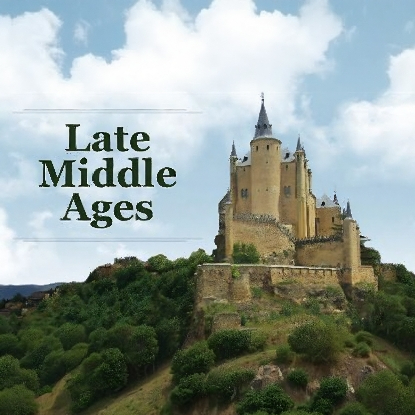
The Late Middle Ages
Original price was: $49.99.$9.99Current price is: $9.99.
The Late Middle Ages—the two centuries from c. 1300 to c. 1500—might seem like a distant era, but students of history are still trying to reach a consensus about how it should be interpreted. Was it an era of calamity or rebirth? Was it still clearly medieval or the period in which humanity took its first decisive steps into modernity?
Overview of the Course
The Late Middle Ages—the two centuries from c. 1300 to c. 1500—might seem like a distant era, but students of history are still trying to reach a consensus about how it should be interpreted. Was it an era of calamity or rebirth? Was it still clearly medieval or the period in which humanity took its first decisive steps into modernity?
These 24 provocative lectures introduce you to the age’s major events, personalities, and developments, and arm you with the essentials you need to form your own ideas about this age of extremes—an age that, according to Professor Daileader, “experiences disasters and tragedies of such magnitude that those who survive them cannot remember the like, and doubt that subsequent generations will be capable of believing their descriptions.”
You’ll look at the Black Death, the carnage of frequent wars, and the religious turmoil we associate with the Middle Ages. But you’ll also explore the beginning of the intellectual and cultural movement known as Humanism, which planted the seeds of modernity. Humanism’s precepts, which hearkened back to the moral inspiration inherent in classical artistic values, suggest that humans have an enormous capacity for goodness, creativity, and even the achievement of happiness.
However, these were hardly the only forces that tug modern-day historians in multiple directions. The Middle Ages was also a period when the persisting legacy of knights, serfs, and castles coexisted with the cannons and muskets newly made possible by gunpowder. With so many contradictions, it’s no wonder that historians have differed widely on how to judge this era—debating even when it ended and modernity began.
Course Lectures
01: Late Middle Ages—Rebirth, Waning, Calamity?
This lecture introduces the course and its focus on two major questions debated by historians for centuries: Did the 14th and 15th centuries mark the turning point between the medieval and the modern? Was this period a high or a low point in European history?
Duration: 30 min
02: Philip the Fair versus Boniface VIII
You’ll examine the conflict between the king of France and the papacy. The results—a growth of French influence and a weakened papacy—will shape the religious history of 14th-century Europe.
Duration: 30 min
03: Fall of the Templars and the Avignon Papacy
Continued French defiance of papal authority generates a perception of French influence that—even though exaggerated by influential foreign voices such as Petrarch’s—can only diminish the authority of an institution that aspires to universality.
Duration: 30 min
04: The Great Papal Schism
Two unusual papal elections produce two popes, one in Rome and the other in Avignon, with each claiming legitimacy. The resulting split, complete with competing lines of popes, will divide Christian Europe for nearly two generations.
Duration: 31 min
05: The Hundred Years War, Part 1
The political history of 14th-century Europe will be dominated by more than a century of continual conflict between France and England over the latter’s claims to the French throne.
Duration: 30 min
06: The Hundred Years War, Part 2
Although the thrones of the combatants ultimately remain unchanged, the war demonstrates the effectiveness of the longbow against knights and contributes to the emergence of larger, infantry-based armies—a trend that will soon have political and social repercussions.
Duration: 30 min
07: The Black Death, Part 1
With its population at a difficult level to sustain, Europe is ill-equipped to confront the calamity that arrives in 1347. Medical and cultural assumptions of the time are limited, and the population drops by one-third, perhaps by one-half, in four years.
Duration: 31 min
08: The Black Death, Part 2
The consequences of the Black Death and subsequent outbreaks of plague include an increase in geographical mobility and wages and a drop in rents, land values, and food prices. The result is a rising gap between rich and poor, increasing the social tensions that sometimes manifested themselves in revolt.
Duration: 31 min
09: Revolt in Town and Country
The Late Middle Ages witnessed a relatively high number of large-scale revolts, and you’ll examine both rural and urban examples: the Peasants’ Revolt in England of 1381 and the revolt of the Ciompi in Florence in 1378.
Duration: 31 min
10: William Ockham
You’ll learn about the life and works of a man whose theological views and criticisms of the papacy made him a polarizing figure, not only during his own lifetime but for centuries to come.
Duration: 31 min
11: John Wycliffe and the Lollards
Another controversial English Scholastic theologian has an even greater impact than Ockham, inspiring—through his ideas about the church, priesthood, and spiritual authority—the first large-scale heretical movement to emerge in medieval England.
Duration: 30 min
12: Jan Hus and the Hussite Rebellion
The execution of the man willing to defend Wycliffe’s ideas in the Holy Roman Empire touches off a series of revolts known as the Hussite Wars, during which the Hussites become the only medieval heretical group to fight successfully for the establishment of their own church.
Duration: 31 min
13: Witchcraft
Although the 16th and 17th centuries were the great age of European witch hunts, the first European witch trials date to the Late Middle Ages. You’ll discover the fusion of the concepts of heresy and “harmful” magic that set the stage for those witch hunts.
Duration: 30 min
14: Christine de Pizan and Catherine of Siena
You’ll look at the work of two of the late-medieval culture’s most noteworthy women: one perhaps the first self-supporting female author, the other a mystic who was to become one of the first female Doctors of the Church.
Duration: 30 min
15: Gunpowder
The introduction of gunpowder and the weapons for it is one of the most important technological developments in late-medieval Europe, altering the balance of power and, together with other changes in military technology, forcing the medieval nobility to function less as warriors and more as courtiers.
Duration: 31 min
16: The Printing Press
The printing press greatly increases the efficiency with which knowledge is disseminated, making it easier for subsequent generations to build on and surpass the intellectual achievements of their predecessors.
Duration: 30 min
17: Renaissance Humanism, Part 1
This first of two lectures on Humanism looks at the emergence of this strong belief in the inherent goodness, intellectual capability, and dignity of the individual, combined with a profound admiration for Classical literature and art and a desire to revive the literary and artistic values of antiquity.
Duration: 30 min
18: Renaissance Humanism, Part 2
Continuing our discussion of Humanism, you’ll look at its differences from the dominant intellectual method of the time—Scholasticism—and the role Humanist ideas were destined to play in European intellectual life.
Duration: 32 min
19: The Fall of the Byzantine Empire
The eastern half of the Roman Empire outlives the western half by nearly 1,000 years. This lecture traces the fall of that empire, with the resulting migration of Byzantine scholars to Italy, helping to fuel the revival of antiquity’s values then taking place in the West.
Duration: 32 min
20: Ferdinand and Isabella
The marriage of the heir to the throne of Aragon to the heir to the throne of Castile sets the stage for one of the most important political events of the late 15th century: the dynastic unification of most of present-day Spain.
Duration: 32 min
21: The Spanish Inquisition
In 1478, Ferdinand and Isabella establish the Spanish Inquisition. It is a reaction to the large number of Jews converting to Christianity in the aftermath of earlier pogroms and doubts about their sincerity, with Spanish Inquisitors likely playing a role in the decision to expel the Jews in 1492.
Duration: 31 min
22: The Age of Exploration
During the 15th century, Portuguese and Spanish explorers begin to venture down the west coast of Africa and farther out into the Atlantic Ocean, reaching places where no European, to anyone’s knowledge, had ever been before—with enormous economic consequences to Europe.
Duration: 30 min
23: Columbus and the Columbian Exchange
Christopher Columbus’s voyage to the Americas in 1492 marks a turning point not just in European history but in global history. Trading plants, animals, minerals, and diseases between the Americas and Europe quickly changed both continents.
Duration: 30 min
24: When Did the Middle Ages End?
Humanists of the Italian Renaissance came to believe they had brought the Middle Ages to an end, but there are several reasons to dispute that claim, as this closing lecture makes clear.
Duration: 32 min
Related products





By Area
