Skip to content
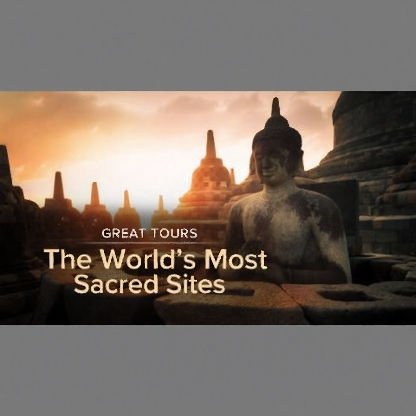
The Great Tours: The World’s Most Sacred Sites
Original price was: $49.99.$9.99Current price is: $9.99.
Overview
Venture across the globe and connect with the power of the sacred as you visit sites dedicated to reaching the divine.
Do human beings have an innate, elemental impulse to declare something sacred—and then feel compelled to connect with it by creating a sacred space? The history of various civilizations says that we do. From ancient times, people realized they lived in a world they could not always control; there had to be something beyond their own lives that controlled their world.
From the Lascaux cave in France, where ancient peoples used the walls as a canvas for their most meaningful sacred images and thoughts, to the Middle East, British Isles, China, Peru, India, Egypt, and more, we see evidence that our ancestors built and used specific spaces and rituals to connect to the sacred. In The Great Tours: The World’s Most Sacred Sites, Dr. Jill Carroll will take you on a journey around the globe and through time to show you some of the most renowned sacred sites in existence today.
What Are Sacred Spaces?
Sacred spaces are those places people have designated as connecting us to something bigger than ourselves, often to our idea of the divine. In The Great Tours: The World’s Most Sacred Sites, you will explore many different types of sacred sites including:
- Natural sites: Indigenous peoples knew the natural world intimately, and many of their sacred sites paid homage to places in the natural world.
- The Built Environment: From the Pyramids at Giza to the architects of the Renaissance to the Great Mosque of Mecca, people have constructed enormously detailed sacred spaces that tell the story of their religion and deities and/or provide a space to encounter the sacred and divine.
- Sacred Complexes: In addition to individual sacred spaces and holy sites, you will also tour sacred complexes—places where multiple elements of divine space and practices meet.
While you will visit dozens of sacred sites on this tour, Dr. Carroll reminds us there are many more we could visit and others we have yet to unearth. All around the world, you will see how humanity has always found a way to create spaces and practices that connect us to something bigger than ourselves.
Course Structure
01: Holy Mountains of Many Faiths
Begin your tour with an exploration of some of the world’s holiest mountains. Learn why Shinto, the indigenous religion of Japan, considers Mount Fuji to be not just a mountain, but a natural kami, a living force worthy of worship. You’ll also explore peaks that are sacred to Buddhism, Hinduism, Bon, Judaism, Confucianism, Chinese folk religions, and more.
Duration: 32 min
02: Hagia Sophia and the Blue Mosque
In Istanbul, you’ll explore the dynamic interaction of the Byzantine and Ottoman Empires by studying two of their great sacred spaces. Discover the powerful engineering and profound beauty of the Hagia Sophia through its incarnations as a church, mosque, museum, and then mosque again. Explore the complex of the Blue Mosque, a stunning architectural achievement that also includes a madrassah, hospital, and the tomb of its sultan, Ahmet.
Duration: 30 min
03: Shinto Shrines of Japan
Shinto has merged over the centuries with Buddhism, Taoism, and Confucianism as they arrived in Japan. The resulting rich belief system reveres and worships the sacred force known as the kami. You’ll explore several of the many thousands of beautiful Shinto shrines throughout the country including the Ise Grand Shrine complex just outside the city of Ise, the Fushimi Inari Shrine in Kyoto, and the “floating” Itsukushima Shrine on Miyajima Island.
Duration: 30 min
04: The Bodhi Tree and the Mahabodhi Temple Complex
Explore the temple at the Mahabodhi Temple Complex near the city of Gaya, India, marking the spot where Siddhartha Gautama (the Buddha) is believed to have attained enlightenment under the Bodhi tree. The oldest existing brick and stone construction in India, the temple was built under Emperor Aśoka, a powerful patron of Buddhism, but was under non-Buddhist control for much of its history. Consequently, while it is one of the holiest sites in Buddhism, you’ll also discover many Hindu elements.
Duration: 28 min
05: Stonehenge and Sites of the Sacred Sun
Built around 5,000 years ago, Stonehenge offers glimpses into the seemingly elemental human impulse to deem something sacred and connect to that by creating a sacred space. Explore Stonehenge in detail and learn about several other solstice-line rock circles dating back to the New Stone Age. You’ll also explore the Pyramids and the giant Sphinx of Egypt, along with more modern monuments on Easter Island and sacred sun-related constructions of the Incas and Native Americans.
Duration: 33 min
06: Varanasi: Holy City of India
The city of Varanasi on the western banks of the Ganges river in northern India is a pilgrimage site for Hindus, Buddhists, Sikhs, and Jains, and is one of the oldest continuously inhabited cities in the world. Explore the Kashi Vishwanath “Golden” Temple, the Dhamek Stupa compound, the Shreyanshnath Jain Temple, and the many ghats along the Ganges—with a focus on the Manikarnika Ghat where hundreds of bodies are cremated every day in hopes for a favorable rebirth.
Duration: 30 min
07: St. Peter’s Basilica: The Heart of Vatican City
At the spiritual and architectural center of Vatican City is St. Peter’s Basilica, the sacred space built over the burial location of St. Peter, one of Jesus’ disciples and the first pope. Learn how the sanctity of the basilica and the Vatican complex is deeply tied to the history of the papacy itself as well as to the painter, sculptor, and architect Michelangelo. In addition, you’ll discover the sometimes-surprising history of all that lies in layers underneath that spectacular example of Renaissance architecture.
Duration: 27 min
08: Temple Mount and Dome of the Rock
In the city of Jerusalem today, you’ll see a gleaming golden dome visible from miles away. This is the Dome of the Rock, located on top of the Temple Mount, a sacred site for Jews, Christians, and Muslims. Explore the site where Abraham was tested by God to sacrifice his son and where the First and Second Temples were built, a site where Jesus taught and worshipped, and the place from which Muhammad ascended to heaven before returning to Earth as a prophet.
Duration: 28 min
09: Pilgrimage to Greater Mecca
The annual Islamic pilgrimage to Greater Mecca, or the hajj, has become one of the largest religious community rituals in the world. Making the hajj once in a lifetime—specifically for those who are physically and financially able—is one of the five pillars of Islam and brings millions of Muslims to Mecca every year. Explore the Great Mosque of Mecca and the Kaaba shrine at its very center, as well as the roundtrip pilgrimage from Mecca to the Plain of Arafat and back.
Duration: 27 min
10: Sacred Caves around the World
A cave is a natural sacred space, a preserve of quiet darkness away from everyday life. You’ll explore the Longmen Cave complex in China where more than 2,300 individual caves hold tens of thousands of statues of the Buddha, then to Sri Lanka where Buddhist monks carved by hand the five sanctuaries of the Dambulla Cave complex, to Crete where the ancient Minoans used local caves for religious purposes, and to the Cappadocia area in eastern Turkey where people have lived and worshipped in clusters of caves for millennia.
Duration: 30 min
11: Touring the Hilltop Temples of Palitana
Rising from the lowlands of Gujarat, India, you’ll see two hilltops with a valley in between. This is Palitana, home to an ancient complex of 1,000 temples and one of the holiest sites in Jainism, a religion native to India. This relatively small, but ancient religion has a strong influence in Indian spiritual culture, especially in its commitment to ahimsa, nonviolence. Discover how the Jain beliefs become visible when you visit the Palitana, particularly at the Adishwar and Chaumukh Temples.
Duration: 27 min
12: The Art and Architecture of Christian Churches
As you tour three very different churches, you’ll discover firsthand that there is no single design required of Christian sacred spaces. You’ll explore in detail St. Basil the Blessed Cathedral in Moscow, Notre-Dame Cathedral in Paris, and the First Baptist Church in Providence, as you learn that Christianity, the largest religion in the history of the world, is not monolithic. Rather, the various communities that gather to worship Jesus bring their unique histories and sensibilities to every aspect of church building.
Duration: 32 min
13: Córdoba’s Mosque-Cathedral
Is that a minaret or a bell tower? Is it a mosque? Or is it a cathedral? This spectacular building, this landmark that is one of the most recognizable features of Córdoba’s skyline, has been both. Today, it is officially known as the Cathedral of Our Lady of the Assumption, but it certainly didn’t start out that way. Discover the fascinating history of this sacred space with its surprising fusion of Muslim and Christian materials, styles, and motifs that can be found nowhere else but in Córdoba.
Duration: 27 min
14: The Living Waters of Sacred Rivers
For the Māori indigenous people of New Zealand, the Whanganui River always has been an indivisible living entity that holds mauri, the life force, and is permanently intertwined with their own lives and those of their ancestors. To protect it, the holy but environmentally degraded river was designated a legal person in 2017. Explore the powerful and sacred relationship between the Whanganui and its people, as well as the sacred qualities of the Jordan River in the Middle East, the Ganges River in India, and the Osun River in Nigeria.
Duration: 28 min
15: Hindu Temples and the Many Faces of the Divine
Explore the potentially confusing polytheistic, monotheistic, and monistic nature of one of the oldest living religions on Earth, Hinduism. The numerous Hindu gods are many faces of the one divine—reflections of the numerous forces we all encounter in life from the nourishing to the destructive—and temples devoted to their worship mirror the gods’ complexity and variety. Discover the rich texture of Hinduism by exploring in detail three temples and temple complexes in India, as well as the Prambanan Temple Compound in Java.
Duration: 31 min
16: The Golden Temple of Amritsar
The Golden Temple, also known as the Abode of God, in Amritsar, India, is the holiest shrine in the Sikh religion. It was Buddha who first identified the location as a perfect place to meditate, and among the many, many spiritual seekers who came to the site after Buddha was Nanak, the founder of Sikhism. Learn about the Sikh beliefs and traditions by exploring the temple, including the particular blend of Hindu and Islamic features that make up both the architectural style and purpose of the temple complex—and the religion itself.
Duration: 30 min
17: Indigenous Holy Sites across the Globe
All over the world, indigenous people continue to live their spiritual practices despite the cultural devastation of colonialism and threats of modern life. Explore the beauty of five natural features that have been imbued with the holy through the stories and traditions of indigenous people. From rock features in Australia and the US to lush forestland in northern Ghana, learn what makes these areas sacred to the people who have called these areas home for centuries.
Duration: 30 min
18: Bhutan Monasteries
The country of Bhutan in the eastern Himalayas claims to be the most Buddhist country in the world. Explore this unique country with so many Buddhist stupas, shrines, temples, and monasteries that draw people from all over the world. Not only are the monasteries sacred sites for the temples on their grounds, but they were visited by important Buddhist sages and saints in centuries past. Among others, you will discover the beauty of Paro Taktsang, commonly known as the Tiger’s Nest monastery, and Kurjey Lhaklang, which connects Bhutan’s spiritual and political history.
Duration: 26 min
19: Ancient and Modern Synagogues
After the destruction of the Second Temple in Jerusalem by the Romans in 70 CE—and the subsequent dispersal of the Jewish people across the known world—the synagogue became the religion’s new sacred space. While all synagogues contain several common features, these physical spaces are influenced by myriad artistic, cultural, and architectural traditions, as you will see on your tour. Discover the beauty and unique sensibilities of synagogues around the world including Tempio Maggiore in Italy, Dohány Street Synagogue in Hungary, and Temple Emanu-El in New York City.
Duration: 31 min
20: Churches Marking the Life of Jesus
Tour three of the most remarkable Holy Land sites for Christians, places related to the birth, crucifixion, entombment, and resurrection of Jesus. Explore the Church of the Annunciation in Nazareth, the Church of the Nativity in Bethlehem, and the Church of the Holy Sepulchre in Old Jerusalem. In addition to discovering the beauty and complexity of the physical buildings, you’ll learn about the historical and modern political conflicts that have affected these sites and their availability to the public.
Duration: 28 min
21: Muslim Burial Sites
In the effort to avoid idolatry, Islamic custom does not include elaborate burial practices, nor does it consider tombs to be sacred. The exceptions are the several sacred sites you will visit on this tour, including Muhammad’s tomb in the Green Dome Mosque in Saudi Arabia; the Imam Ali Mosque and Imam Husayn Shrine, both in Iraq; and the tomb of the Sufi poet and mystic Rumi in Turkey. You’ll not only explore these sacred physical spaces, but also learn about the life of Muhammad and his family, as well as different Islamic practices.
Duration: 29 min
22: Three Sites of Sacred Sacrifice
The Aztecs, a powerful Mesoamerican people of current-day Mexico, and the Nabateans, a nomadic group of current Jordan, were polytheistic peoples whose religions involved a practice that might be considered barbaric today—ritualized blood sacrifice including, at least for the Aztecs, human sacrifice. As you explore in detail archaeological findings at Templo Mayor and The Pyramids of Teotihuacan in Mexico City, and the High Place of Sacrifice in Petra, Jordan, you’ll learn that brutality was never the point. The goal was always to appease the gods.
Duration: 31 min
23: Mormon Temples in America
Is there a religion that could be considered quintessentially American? Yes, and it is Mormonism—founded in the United States and rooted in themes of independence, self-sufficiency, family values, and the importance of community. Learn about this modern religion as you explore The Salt Lake Tabernacle in Utah, the Kirtland Temple in Ohio, the Nauvoo Temple in Illinois, and Temple Square in Salt Lake City.
Duration: 28 min
24: Baha’i Gardens and Temples
Baha’i is one of the newest world religions, and yet its most important sacred sites stand in Acre and Haifa, Israeli cities with ancient histories that include many much older religions. As you tour the Shrine to Baha’ullah in Acre and the Shrine of the Báb and Baha’i World Center in Haifa, you will discover why this monotheistic religion has temples and believers throughout the world, and why their sacred sites are always connected to the natural world around them—and to the number nine.
Duration: 33 min
Related products