 Skip to content
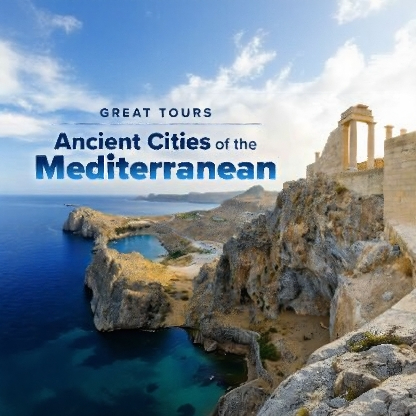
Great Tours: Ancient Cities of the Mediterranean
Original price was: $49.99.$9.99Current price is: $9.99.
Marvel at the glorious cities of the ancient Mediterranean—their wonders of architecture, art, engineering, culture, and history—in this fascinating video tour of the great urban centers of a world-shaping region.
Overview
Marvel at the glorious cities of the ancient Mediterranean—their wonders of architecture, art, engineering, culture, and history—in this fascinating video tour of the great urban centers of a world-shaping region.
The Mediterranean is one of the great wellsprings of human civilization. Central to the region’s history are the splendorous cities that flowered around the region—bases of power that saw innovation, commerce, expansion, and the building of great empires. Many of these cities have become icons of the ancient world, and exemplars of the cultures, conquests, and ways of life that have built western civilization.
In these 24 lavishly illustrated lectures, Dr. Arya takes you to a rich range of superlative cities across the Mediterranean—a thrilling panorama of the great and historically pivotal urban centers of the ancient world, such as:
- Rome: In two lectures on the awe-inspiring world of ancient Rome, take in the grandeur of the city that was the beating heart of a vast empire.
- Jerusalem: Find how this landlocked metropolis was deeply connected to Mediterranean trade routes, making it a major center of commerce as well as of culture.
- Ephesus: In today’s Turkey, one of the most magnificent Greco-Roman cities of the ancient Mediterranean, and a dazzling archaeological site to visit today.
- Alexandria: Founded by Alexander the Great on the shores of Egypt; witness its rise under the Ptolemaic pharaohs as a capital of learning and scholarship.
- Constantinople: Discover this incredible city as Byzantium, under the Greeks, and then as Constantinople under Roman rule. Travel its fabulous urban landscape in the time of the Roman emperors.
In addition to the most renowned urban complexes of the region, you’ll explore a spectrum of extraordinary cities that are less familiar, but no less fascinating, such as Aquileia in Croatia, Sidon in Lebanon, and Timgad in Algeria, as well as the astonishing feats of engineering and glorious works of art of the ancient Mediterranean peoples.
In this sumptuous video tour, you’ll discover some of history’s greatest marvels and most fascinating cultures, at the fountainhead of Western civilization.
Course Structure
01: The Phoenicians: Byblos, Sidon, and Tyre
Begin your Mediterranean journey with the Phoenicians, the great seafarers of antiquity. Gauge their innovations in shipbuilding, trade, writing, and colonization. Visualize the golden age of the Phoenicians through their key city-states of Byblos, which flourished through its resources of timber; Sidon, city of commerce, science, and art; and Tyre, a Sidonian colony and, later, a fierce rival of Sidon.
Duration: 29 min
02: Crete, Knossos, and the Minoans
On the Greek island of Crete, encounter the great Minoan civilization, renowned for its ruined cities, art, wide-ranging commerce, and the myths of King Minos, Theseus, and the Minotaur. Tour the extraordinary palace complex of Knossos, believed by early archaeologist Arthur Evans to be the site of the Labyrinth of the Minotaur legend, and explore its corridors, piazzas, and mysterious murals.
Duration: 29 min
03: Athens, Piraeus, and the Rise of Greece
Take the measure of Athens, one of the most resplendent and culturally significant cities of the ancient world. Track the origins and the rise of the city, and its political and administrative system, as it became a major commercial and naval power. Visit the great sites of Athens’s golden age, from the Acropolis to the port of Piraeus, the hub of the city’s naval and mercantile life.
Duration: 30 min
04: Magna Graecia: Taras and Syracuse
From the 8th century BCE, Greek city-states established colonies, beginning in the region known as Magna Graecia. Stop first at the Italian colony of Taras and learn of its wealth and sophistication. Visit the magnificent ancient temples of Poseidonia and Akragas and explore the dramatic history and majestic monuments of Syracuse, the greatest and most beautiful of the Greeks’ Sicilian colonies.
Duration: 29 min
05: Republican Rome: Rise of a Naval Power
Here, trace how the landlocked Romans linked themselves with the Mediterranean, establishing a powerful maritime empire. Envision the founding of Rome, and the Punic Wars, through which Rome built its naval forces and skill with oared warships in spectacular sea battles. Witness Rome’s annexation of huge territories, and the wealth reflected in its architecture and huge commercial centers.
Duration: 28 min
06: Imperial Rome and Ostia Antica
Grasp the critical importance to ancient Rome of its food supply, and the massive logistics of grain shipments into the burgeoning city. With the wealth of its Mediterranean empire, chart the physical transformation of Rome in the Imperial era. Visit the imposing monuments and grand urban projects of the emperors and tour the great port and commercial complex of Ostia Antica.
Duration: 26 min
07: Sacred Cities: Delphi, Delos, and Olympia
On the Greek peninsula, discover how Delphi evolved as a locus of religious pilgrimage. Study the intriguing practices surrounding the Oracle of Delphi, and the majestic structures of the complex. Then visit the island sanctuary of Delos, a place of pilgrimage, politics, and commerce. Finally, take a deep look at Olympia, site of the famed athletic games, melding sport and religion.
Duration: 30 min
08: Asia Minor: Miletus and Pergamon
The Greco-Anatolian societies of Asia Minor were home to some of the most magnificent cities of the ancient Mediterranean. Observe how a cultural synthesis took place between Anatolians and Greek settlers, revealed in the history and glorious monuments of Miletus. Then, take in the monumental architecture and superlative art treasures of Pergamon, another city that rose to glory in this period.
Duration: 29 min
09: Ephesus and the Hellenic Golden Age
Ephesus was one of the most illustrious and renowned cities of the Mediterranean. Follow the city’s rise, as it became a major center of trade, and one of the cultural hearts of the Greek world, in learning and the arts. Walk through the city and discover its great Roman-era buildings, from its marine bath complex, temples, and theater to its State Agora and the famed Library of Celsus.
Duration: 28 min
10: The Rise and Fall of Carthage
Ancient Carthage was a North African seaborne empire that ruled over vast areas of the Mediterranean. Delve into its history as a maritime and mercantile power and a formidable rival of Rome. Visit what remains of Carthage in its prime, its sacred sanctuary and necropolis, and its massive Antonine Baths. Mark the empire’s ultimate defeat by Rome, and its rebirth as a preeminent Roman city.
Duration: 30 min
11: Iberia: Gadir, Carthago Nova, and Tarraco
Uncover the history of ancient Iberia (Spain), as a major supplier of metals and other prized goods to the greater Mediterranean. Track the rise of Gadir as an opulent colony of Phoenicia, Carthage, and finally Rome. Relive the heyday of Carthago Nova, with its great wealth from silver and prominence under the Romans. Then, visit the UNESCO-protected Tarraco, and its impressive Roman-era ruins.
Duration: 28 min
12: Alexandria and Ptolemaic Egypt
Marvel at the city of Alexandria, arguably the greatest cultural center of the ancient Mediterranean. Witness its founding by Alexander, its growth as a peerless hub of learning, and its rule by generations of Greek Ptolemies (pharaohs). Travel through the city at its height, and take a detailed look at its legendary monuments, such as the Pharos (Lighthouse) and the great Library of Alexandria.
Duration: 30 min
13: Cyrene, Leptis Magna, and Ancient Libya
Among the remarkable and intact ancient cities of Libya, encounter Cyrene, founded by the Greeks, and wealthy from its exports of the local plant silphium. Learn about its lavish monuments, proclaiming the city’s prosperity, and its later rule by Egypt and Rome. Then, visit the stunning and richly decorated ruins of Leptis Magna, which prospered on inland trade under Rome.
Duration: 29 min
14: Epirus and the Gateways to Greece
In historic lands now within Albania and Greece, explore the dramatic history of the Kingdom of Epirus, and the great cities of Dyrrachium, Apollonia, Nicopolis, and Butrint, all containing extraordinary gems of antiquity. Chart the route of the Via Egnatia, an epochal road connecting Rome to the Greek world. Grasp this region’s role in the events marking the end of the Roman republic.
Duration: 28 min
15: Earliest Trade: Sardinia, Corsica, and Malta
The islands of Sardinia, Corsica, and Malta were home to the first great cities or settlements of the Mediterranean. Learn about their turbulent history as trading centers and military outposts under the Phoenicians, Carthaginians, and Romans. Also discover the early Nuragic civilization of Sardinia, the remarkable prehistoric monuments of Corsica, and the megalithic temples of Malta.
Duration: 28 min
16: Massalia, Narbo, and Southern Gaul
The territories of Gaul (France) figured significantly in the Roman world. Learn the history of the great port cities of Massalia and Narbo and their roles in Roman commerce and politics. Then, visit spectacular Roman ruins at the urban centers of Nemausus, Arelate, and Arausio. Observe how these cities became extensions of Rome, with architecture and cultural amenities replicating the capital.
Duration: 29 min
17: Innovative Islands: Rhodes, Samos, and Kos
The Grecian islands of Rhodes, Kos, and Samos were renowned in antiquity as centers of learning and ingenuity. Stop first at the trade capital of Rhodes, and witness its extraordinary feats of architecture and art, among them the famed Colossus. Visit Kos, a center of ancient healing and medicine, and finally Samos, which produced great figures in mathematics, philosophy, and astronomy.
Duration: 28 min
18: Jerusalem, Petra, and the Desert Trade
Learn how the trade networks of the Phoenicians, the Philistines, and the Mediterranean Jewish diaspora positioned Jerusalem as a major crossroads of commerce and culture. Travel through the city at its height under king Herod the Great and visualize his monumental building projects. Then, encounter the Nabateans, whose stunning capital at Petra connected the Mediterranean to the Near East.
Duration: 29 min
19: Antioch and the Journeys of Paul
In Antioch, Paul launched his great missions of conversion, laying the foundations for the spread of Christianity. Delve into the rich history of Antioch, from its rise as a “free,” autonomous city to its eminence under Rome, and learn what made it the most important city in early Christianity after Jerusalem. Along Paul’s missionary journeys, visit the great cities of Perga and Corinth.
Duration: 30 min
20: Desert Cities of Numidia and Mauretania
The lands of Numidia and Mauretania, sprawling across coastal North Africa, arose as substantial Berber societies, containing many great ancient cities. Observe how they became prominent regions of the Roman Empire, and travel into their sophisticated and cosmopolitan urban cultures at cities such as Caesarea Mauretaniae, Lambaesis, and the World Heritage Sites of Tipasa, Djemila, and Timgad.
Duration: 28 min
21: Aquileia and the Dalmatian Coast
Unpack the history of the peoples of the Adriatic and Dalmatian coasts, and the cultures that held sway in the region before its conquest by Rome. Tour extraordinary Roman ruins in the city of Pola; the island of Brijuni; and take in the rich architectural treasures and UNESCO-designated basilica complex of Aquileia, which became one of the wealthiest and largest cities of the late Roman Empire.
Duration: 28 min
22: Constantinople, Straddling Europe and Asia
Trace the founding of this iconic city as Byzantium under the Greeks, its rise as a strategic crossroads of trade, and its conquest by Rome, becoming the Empire’s new capital and the center of political, economic, and cultural life of the Eastern Mediterranean. Discover the glories of the city and the dazzling building projects under the emperors Constantine, Theodosius, and Justinian.
Duration: 30 min
23: Ravenna and the Rise of Christianity
Chart this coastal city’s path to becoming capital of the Western Roman Empire, then of Byzantine Italy, and an epicenter of Christianity. Tour its great Christian monuments of the Roman period, highlighting the stunning interiors of the Mausoleum and Baptistry of Neone. Under Ostrogothic and Byzantine rule, visit the city’s great basilicas, and explore the imagery of their breathtaking mosaics.
Duration: 29 min
24: Thessaloníki and the End of Antiquity
Conclude with a look at the chaotic transition between antiquity and the Middle Ages, through the lens of the great city of Thessaloníki (Greece). Observe how the city prospered during this period, from its founding by the Macedonians to its transformation into a Roman capital and a Byzantine Christian metropolis. Enjoy its superb treasures of Roman and Byzantine art and architecture.
Duration: 37 min
Related products






By Area

