Skip to content
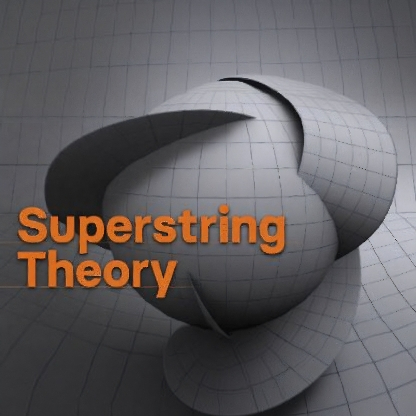
Superstring Theory: The DNA of Reality
Original price was: $29.99.$6.99Current price is: $6.99.
One of the most exciting scientific adventures of all time is the search for the ultimate nature of physical reality, a hunt that in the past century has yielded such breakthroughs as Einstein’s theory of relativity and quantum mechanics—two theories that radically altered our picture of space, time, gravity, and the fundamental building blocks of matter.
Overview
One of the most exciting scientific adventures of all time is the search for the ultimate nature of physical reality, a hunt that in the past century has yielded such breakthroughs as Einstein’s theory of relativity and quantum mechanics—two theories that radically altered our picture of space, time, gravity, and the fundamental building blocks of matter.
Prepare to be intrigued, enlightened, and amazed with these 24 lectures that introduce you to the essence of string theory: that the smallest, most fundamental objects in the universe are not little balls knocking around like billiards but supermicroscopic filaments whose different vibrational modes produce the multitude of particles observed in laboratories.
From there, you’ll launch into in-depth examinations of concepts and ideas that are sometimes baffling but always invigorating and educational, including dark matter, designer atoms, sizzling black holes, and Einstein’s hypotenuse. If you’ve ever wanted to know what string theory is all about; or what theoretical physicists discuss over dinner; or how mathematical ideas guide our exploration of inconceivably tiny realms; or if you’ve ever wanted a glimpse of cutting-edge ideas about the fundamental structure of reality—then let Professor Gates be your guide into the amazing world of strings.
Course Outline
01: The Macro/Micro/Mathematical Connection
Professor Gates opens with a survey of the goals of the series and introduces the concept of strings, which are incredibly tiny objects that may be the most fundamental objects in the universe. String theory is not yet experimental physics; it is theoretical physics, based on sophisticated mathematical ideas.
Duration: 34 min
02: Who Is Afraid of Music?
Mathematics will play an important role in this course because string theory is purely mathematical. Instead of studying equations, you will explore the mathematics of strings through computer images and animations, comparable to the music generated by notes on a musical score.
Duration: 31 min
03: Apropos Einstein’s Perfect Brainstorm Year
This lecture explores Einstein’s general theory of relativity, which led to a new understanding of gravity and sparked Einstein’s quest for a “theory of everything.” Building a mathematical theory of everything is like confronting a complicated toy on Christmas Eve, whose box states, “some assembly required.”
Duration: 31 min
04: Honey, I Shrunk to the Quantum World—Part I
In the first of two lectures on the quantum world, you start at the level of the atom and dig deeper, discovering leptons (electron-like objects), nuclear matter (protons, neutrons), quarks (subnuclear matter), and force carriers (photons, gluons, W and Z bosons, and gravitons).
Duration: 30 min
05: Honey, I Shrunk to the Quantum World—Part II
You investigate more properties of the quantum world, including spin, the Pauli exclusion principle, quantization, vacuum polarization, and quantum tunneling. You are also introduced to the Higgs boson, sometimes called the “God particle” for its apparent role in imparting mass to other particles.
Duration: 31 min
06: Dr. Hawking’s Dilemma
Any object that possesses a temperature above absolute zero must give off thermal radiation. But how is this possible with a black hole, which is so massive that not even light can escape from it? In 1975, Stephen Hawking forced a crisis in theoretical physics with a stunning theory addressing this problem.
Duration: 30 min
07: I’d Like to See a Cosmos Sing in Perfect Harmony
In trying to explain black holes in a way consistent with Hawking’s 1975 theory, scientists had to combine two pillars of physics—quantum theory and general relativity. The resulting mathematics predicted a surprising form of matter: strings.
Duration: 30 min
08: Einstein’s Hypotenuse and Strings—Part I
String theory may involve extra dimensions beyond the familiar three of space plus one of time. But how are physicists able to think about extra dimensions? The Pythagorean theorem provides a model, showing that it’s possible to calculate the properties of objects in higher dimensions without having to visualize them.
Duration: 29 min
09: Einstein’s Hypotenuse and Strings—Part II
Einstein incorporated the fourth dimension of time into the Pythagorean theorem and came up with an idea known as the Einstein hypotenuse. This led to the famous equation E = mc², which can be interpreted as a statement about areas in a four-dimensional world.
Duration: 30 min
10: Tying Up the Tachyon Monster with Spinning Strings
This lecture explores the phenomenon of spin, which is ubiquitous in the quantum world. A new generation of spinning strings solved the problem and also dealt with the tachyon threat.
Duration: 32 min
11: The Invasion of the Anti-Commuting Numbers
Starting with the frustum (a truncated pyramid) on the back of a dollar bill, you explore some intriguing properties of numbers, including anti-commuting Grassman numbers. Anticommutivity is useful in quantum mechanics and manages to banish the tachyon from certain versions of string theory.
Duration: 31 min
12: It’s a Bird—A Plane—No, It’s Superstring!
In 1977, three physicists—Gliozzi, Sherk, and Olive—observed that it is supersymmetry (the equality of bosons and fermions) that kills the tachyon monster. Supersymmetry is the child of string theory and the parent of superstrings.
Duration: 30 min
13: Gauge Theory—A Brief Return to the Real World
While working on supersymmetry around 1982, physicists Schwarz and Green found a solution that required 496 charges, implying a world in which there are 32 possible ways to rotate. The resulting string was called the SO(32) superstring, the world’s first unified field theory.
Duration: 30 min
14: Princeton String Quartet Concerti—Part I
Circular polarization of light possesses a mathematical property useful in superstring theory. Standing waves, left-moving waves, and right-moving waves are introduced in this lecture.
Duration: 30 min
15: Princeton String Quartet Concerti—Part II
The initial work of the “Princeton String Quartet” led to two strings from different dimensions: a left-moving superstring and the old bosonic right-moving string. This lecture explores a new description of the heterotic string that produces the magic number 496.
Duration: 29 min
16: Extra Dimensions—Ether-like or Quark-like?
It is often said that string theory requires extra dimensions, but that’s not quite true. The mathematics of the heterotic string can be interpreted with extra dimensions or without.
Duration: 31 min
17: The Fundamental Forces Strung Out
This lecture shows how superstring theory provides mathematical support for Hawking’s theory of black-hole radiation. Observational proof of string theory may come from looking at the universe itself.
Duration: 30 min
18: Do-See-Do and Swing Your Superpartner—Part I
Why does the universe observe a dichotomy, in which beams of matter obey the Pauli exclusion principle but beams of energy do not? This lecture looks at evidence for supersymmetry that points to the existence of superpartners for ordinary matter.
Duration: 30 min
19: Do-See-Do and Swing Your Superpartner—Part II
Supersymmetry implies that every known matter particle has a superpartner that has yet to be observed in the laboratory. This lecture covers a technique for detecting them.
Duration: 30 min
20: A Superpartner for Dr. Einstein’s Graviton
Can physicists find a consistent way to introduce mass to the superpartners so that they become very heavy while ordinary matter remains very light? The Higgs mechanism may offer an explanation for the mysterious dark matter.
Duration: 30 min
21: Can 4D Forces (without Gravity) Love Strings?
This lecture follows current attempts to use concepts from string theory to understand the forces and structures of matter inside the proton and neutron.
Duration: 30 min
22: If You Knew SUSY
In this lecture, you study an unusual aspect of SUSY, superspace, and learn how it accounts for the five types of superstrings.
Duration: 31 min
23: Can I Have that Extra Dimension in the Window?
This lecture investigates a possible solution in 11-dimensional supergravity, which may be part of a larger and even more mysterious construct, M-theory.
Duration: 30 min
24: Is String Theory the Theory of Our Universe?
Professor Gates closes with a review of the current state of the field and looks at some denizens of the world of supersymmetry that he and his colleagues have recently identified.
Duration: 31 min
Related products