Skip to content
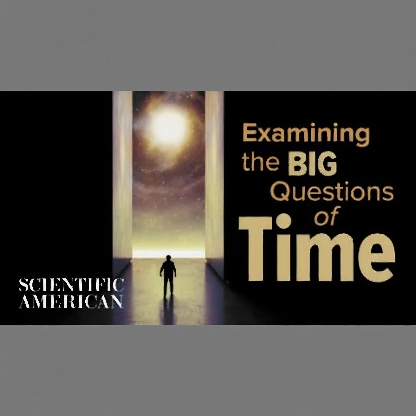
Examining the Big Questions of Time
Original price was: $24.99.$7.99Current price is: $7.99.
Produced in partnership with Scientific American, this course explores humanity’s deepest inquiries about time—from quantum physics to neuroscience. Guided by Editor-in-Chief Laura Helmuth, you’ll challenge assumptions about temporal existence and journey to the frontiers of spacetime.
Overview
Course No. 10160
Produced in partnership with Scientific American, this course explores humanity’s deepest inquiries about time—from quantum physics to neuroscience. Guided by Editor-in-Chief Laura Helmuth, you’ll challenge assumptions about temporal existence and journey to the frontiers of spacetime.
Course Description
How much do we truly understand about time’s nature? While we measure it with atomic precision, fundamental questions remain: Is time real or illusory? Could it flow backward? What existed before the Big Bang? Through thought experiments and cutting-edge science, this 12-lecture series examines:
Key Themes:
- Einstein’s relativity vs. Newton’s absolute time
- Quantum mechanics’ radical temporal implications
- Biological clocks and the neuroscience of “mind time”
- Future possibilities: wormholes, time’s end, and multiverses
Video Lectures
Section 1: The Nature of Time
- A Matter of Time (27 min)
From attoseconds to cosmic epochs—how science measures time.
- The Myth of the Beginning of Time (30 min)
Challenging the Big Bang as time’s absolute start.
- That Mysterious Flow (21 min)
Why the “present moment” eludes physical definition.
- Is Time an Illusion? (31 min)
Philosophical and physical perspectives on time’s reality.
Section 2: Time in Physics
- Time Travel and the Twin Paradox (23 min)
Einstein’s relativity proven—and its GPS applications.
- Inconstant Constants (25 min)
Could fundamental laws vary across multiverses?
- Atoms of Space and Time (29 min)
Quantum gravity and the granularity of spacetime.
- Could Time End? (25 min)
Theoretical limits to temporal existence.
Section 3: Measuring Time
- A Chronicle of Timekeeping (29 min)
From Egyptian sundials to atomic clocks.
- Atomic Clocks (27 min)
*Precision timing’s role in relativity and technology.*
Section 4: Biological Time
- Times of Our Lives (28 min)
*Circadian rhythms and cellular clocks.*
- Remembering When (21 min)
*How the brain constructs "mind time" and memory.* Related products


By Area