 Skip to content
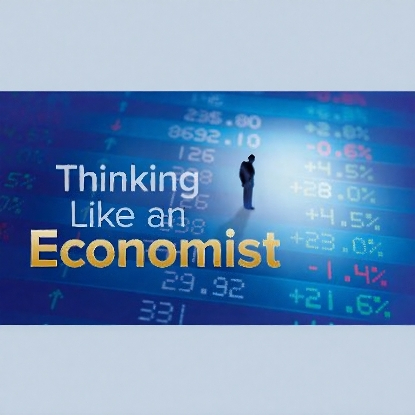
Thinking like an Economist: A Guide to Rational Decision Making
Original price was: $29.99.$6.99Current price is: $6.99.
Learn how to make smarter economic decisions in your professional and personal life by using the same practical principles and analytical tools employed by top economists.
Thinking like an Economist: A Guide to Rational Decision Making
Learn how to make smarter economic decisions in your professional and personal life by using the same practical principles and analytical tools employed by top economists.
Overview Course No. 5511
Economic forces are everywhere around you. But that doesn’t mean you need to passively accept whatever outcome those forces might press upon you. Instead, with these 12 fast-moving and crystal clear lectures, you can learn how to use a small handful of basic nuts-and-bolts principles to turn those same forces to your own advantage.
Professor Randall Bartlett of Smith College first introduces some of the fundamental principles and concepts that shape the lenses through which economists view the world. He then shows you how to use these simple analytical tools to understand what you see through those lenses. By learning to identify the many varied situations in which economics affects your life and how to wield the tools that can help you make the wisest choices in those situations, you’ll enhance not only your understanding of daily life but your own success in living it.
Packed with case studies, helpful strategies, economic insights, and more, this series will equip you with a reliable toolkit for thinking more like an everyday economist and approach the issues in your own life with a more educated, seasoned eye. And after taking this course, things really will look very different. You’ll see how basic economic ideas like incentives, risks, rewards, and rationality are not just the province of professional economists, government policymakers, or your local bank’s loan officer, but instead lie at the root of nearly every decision you must make in your daily life.
Course Structure
01: The Economist’s Tool Kit-6 Principles
Assemble the intellectual tool kit that will be used throughout the course to help you see the world from an economist’s perspective. The first tools in your kit are six principles of human behavior accepted by nearly all economists as fundamental.
Duration: 30 min
02: The Economist’s Tool Kit-3 Core Concepts
Complete your tool kit for economic thinking with three key concepts. Learn what an economist means by rational decision making; how marginal analysis is used to solve complex problems; and how you combine these first two concepts to understand optimization.
Duration: 30 min
03: The Myth of “True Value”
Put your new tools to work by examining a central conclusion in economic thinking: that rational individual choices can—even though they might not always—produce socially efficient results, where no person can be made better off without harming another.
Duration: 30 min
04: Incentives and Optimal Choice
How do economists think about the rights and rules that govern human interactions? Using real-life examples and classic problems like the Prisoner’s Dilemma, plunge into questions of ownership, trade, and compensation and how ideas like incentives and responsibilities are intimately connected to them.
Duration: 31 min
05: False Incentives, Real Harm
Two case studies involving tragic fires help you grasp two classic economic situations—the Tragedy of the Commons and the difficulties of providing a public good. Then, apply what you have learned to see how an economist would think about the even larger problem of global climate change.
Duration: 33 min
06: The Economics of Ignorance
In the first of three lectures examining how economists approach situations where information is incomplete, imperfect, or inaccurate, learn that there can indeed be an optimal level of ignorance. Also, explore some cost-efficient ways to reduce uncertainty.
Duration: 30 min
07: Playing the Odds-Reason in a Risky World
People can strategically use information—selectively controlling, hiding, or subsidizing it—to influence the decisions of others. Examine concepts like the informational blind date and information asymmetry and see how they can lead to consequences like adverse selection and even the 2008 financial crisis.
Duration: 32 min
08: The Economics of Information
Safety, like everything, has a cost; at some point, being a little safer costs more than it is worth. By studying how economists evaluate risk, learn how the concept of expected value permits rational decision making in situations with risk, but also brings its own set of dangers.
Duration: 30 min
09: A Matter of Time-Predicting Future Values
Time can be one of the most important factors in economic thought; when events occur matters. This lecture looks at how economists deal with this critical factor, introducing you to concepts such as nominal versus real value and present versus future value.
Duration: 31 min
10: Think Again-Evaluating Risk in Purchasing
Apply several of the new tools you’ve been working with to learn how an economist might confront one complex choice you have likely faced yourself: whether to purchase that extended warranty on an expensive consumer item like a big-screen television.
Duration: 31 min
11: Behavioral Economics-What Are We Thinking?
Despite the predictive power of conventional economic presumptions about fundamental rationality, behavioral economists are showing that we sometimes do things that indeed seem irrational. Delve into several examples of this and possible means of overcoming these behaviors.
Duration: 32 min
12: Acting like an Economist
Apply what you’ve learned by thinking like an economist about three different issues: doing a cost-benefit analysis of crime from a criminal’s perspective; altering our own structure of incentives to motivate healthier behaviors; and finding policy solutions to traffic congestion and its resulting pollution.
Duration: 34 min
Related products





By Area