Skip to content
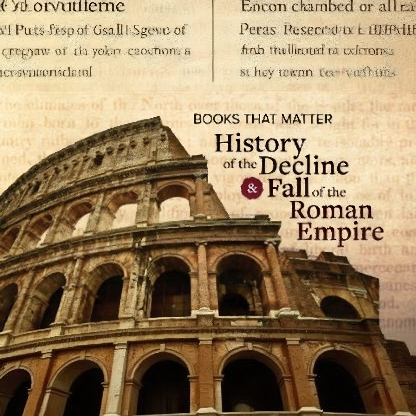
Books That Matter: The History of the Decline and Fall of the Roman Empire
Original price was: $49.99.$9.99Current price is: $9.99.
Published in six volumes between 1776 and 1781, The History of the Decline and Fall of the Roman Empire — for all its renown — can be intimidating.
Books That Matter: The History of the Decline and Fall of the Roman Empire
Overview
Course No. 3450
Published in six volumes between 1776 and 1781, The History of the Decline and Fall of the Roman Empire — for all its renown — can be intimidating. It contains 1.5 million words, an estimated 8,000 footnotes, a cast of 10,000 historical figures, and a timeline of more than 1,000 years. Yet even today, Gibbon’s historical chronicle demands to be read and understood.
These 24 lectures invite you on a riveting examination of this great work as a vast historical chronicle, a compelling masterpiece of literature, a sharp commentary on cultural mores, and a cautionary tale to Enlightenment Europe. In this chapter-by-chapter guide to the Decline and Fall, Professor Damrosch helps you navigate the book’s themes, structure, and lasting influence.
You’ll approach the Decline and Fall book as a written work whose footnotes, periodic style, and historical blind spots reflect the styles and ideologies of the Enlightenment age in which it was written. These lectures offer a richly detailed overview of what Gibbon called “many of the events most interesting in human annals,” including: the reign of the Antonines, the rise of Christianity and Islam, the codification of Roman law, the Crusades, and the dawn of medieval Europe.
Whether you’ve read the Decline and Fall before or whether you’ve always wanted to read it but never knew where to start, Professor Damrosch’s lectures are an authoritative guide to a once-mighty empire – and the great book that became its classic eulogy and epitaph.
Course Lectures
- The Greatness of Gibbon’s Decline and Fall
Ground your understanding of Gibbon’s masterpiece with this helpful introductory lecture. Why was Rome so important to Gibbon and his readers? What makes the periodic style so essential to the Decline and Fall’s accessibility? Why should we want to read it today in the 21st century?
Duration: 32 min - The Making of Gibbon the Historian
Follow Edward Gibbon’s intellectual development: his childhood obsession with reading, his military service, his disappointed love, his social circles, his personal politics, and his life as a “gentleman scholar of leisure.” Your primary source for this biographical study: fragments from Gibbon’s posthumously published Memoirs.
Duration: 29 min - The Empire at Its Beginning
Before plunging into the Decline and Fall, which starts in the second century A.D., you need a little background in early Roman history. Review the Empire’s important provinces, the excessive influence of the Roman military, the emergence of imperial dictatorship, and other facts Gibbon’s original readers took for granted.
Duration: 30 min - The Theory and Practice of History
Explore how Gibbon understood the role of the historian; consider what he thought of Hume, Voltaire, and other Enlightenment writers; and discover how he revolutionized the use of extensive documentation in his work.
Duration: 29 min - The Golden Age of the Antonines
Meet the Antonines: the subject of the first three chapters of the Decline and Fall. From Nerva to Hadrian to Marcus Aurelius, these “five good emperors” ruled “the only period of history in which the happiness of a great people was the sole object of government.”
Duration: 30 min - The Hidden Poison Begins to Work
After the peace of the Antonines, things quickly began to fall apart. Describing the horrific reigns of emperors like Commodus, Caracalla, and Elagabalus, Gibbon illustrates the “hidden poison” by which one-man rule produced a vicious cycle of incompetent, power-corrupt emperors.
Duration: 30 min - Diocletian and the Triumph of Constantine
Get a close reading of Chapters 8 to 14 of Gibbon’s masterpiece. Follow the first assaults of the barbarians who would eventually bring the Empire to its knees: the Goths. Also, meet two emperors who would radically reshape the structure of the Roman Empire: Diocletian and Constantine.
Duration: 31 min - Enlightenment Skepticism
Consider just how dangerous Gibbon’s sociological treatment of Christianity in Chapters 14 and 15 seemed to most of his readers. Rather than focusing on divine providence, the Decline and Fall documents the human causes behind Christianity’s evolution into the dominant ideology of the ancient world.
Duration: 32 min - The Rise of Christianity
Continue your look at Chapters 14 and 15 of the Decline and Fall. Gibbon takes up five causes for Christianity’s success, including proselytizing zeal and the promise of a future life in heaven.
Duration: 30 min - Constantine and Athanasius
Chapter 17 is the major turning point in the Decline and Fall. What are Gibbon’s thoughts on the transferring of the capital to Constantinople, and on Constantine’s famous vision of the cross?
Duration: 31 min - Julian and the Return to Paganism
Study Chapters 22 to 24, which are devoted to this last dying gasp of paganism-struck down by Julian’s death.
Duration: 30 min - Barbarian Advances and Theodosius
Topics covered include increased barbarian threats and the “chaste and temperate” rule of Theodosius.
Duration: 31 min - East and West Divided
Learn how to navigate Chapters 29 to 33, which examine the sack of Rome in 410 A.D.
Duration: 31 min - Huns and Vandals
Professor Damrosch guides you through successive waves of barbarian invaders, notably the Huns and their leader Attila.
Duration: 30 min - Theodoric and Justinian
The first was a Gothic king; the second, Rome’s eastern emperor.
Duration: 31 min - The Breakup of the Empire
How did Byzantium persist for another nine centuries?
Duration: 31 min - The Byzantine Empire and Charlemagne
Cover the historical moments like the reign of Charlemagne and the Comnenian dynasty.
Duration: 29 min - The Rise of Islam
Emphasizes how Islam arrived at a fortunate historical moment.
Duration: 30 min - The Byzantine Empire in the 10th Century
Survey the ever-shrinking form of the Byzantine Empire.
Duration: 32 min - The Crusades
Focus on how religion was used to rationalize European military aggression.
Duration: 33 min - Genghis Khan and Tamerlane
Unpack the role of Genghis Khan in history, including the discovery of gunpowder.
Duration: 30 min - The Fall of Constantinople
Topics include Mahomet the Second’s capture of Constantinople.
Duration: 31 min - The End of Gibbon’s Work
How did Gibbon keep the Decline and Fall from simply petering out?
Duration: 29 min - Decline and Fall in Modern Perspective
Reflect on the Decline and Fall in the 21st century.
Duration: 33 min
Related products