Skip to content
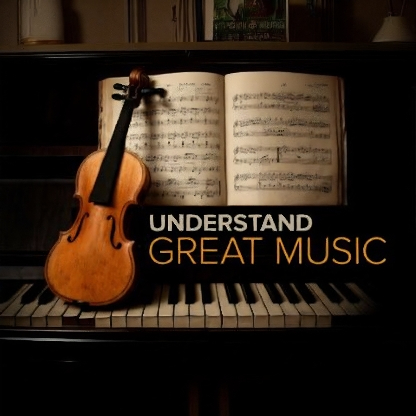
How to Listen to and Understand Great Music, 3rd Edition
Original price was: $99.99.$29.99Current price is: $29.99.
Forever change the way you listen to music with this outstanding course that explores the history, composition, and sublime accomplishments of Western concert music.
Overview
Forever change the way you listen to music with this outstanding course that explores the history, composition, and sublime accomplishments of Western concert music.
Great music is a language unto its own, a means of communication of unmatched beauty and genius. And it has an undeniable power to move us in ways that enrich our lives – provided it is understood. If you have ever longed to appreciate great concert music, to learn its glorious language and share in its sublime pleasures, the way is now open to you, through this series of 48 wonderful lectures designed to make music accessible to everyone who yearns to know it, regardless of prior training or knowledge.
It’s a lecture series that will enable you to first grasp music’s forms, techniques, and terms – the grammatical elements that make you fluent in its language – and then use that newfound fluency to finally hear and understand what the greatest composers in history are actually saying to us. And as you learn the gifts given us by nearly every major composer, you’ll come to know there is one we share with each of them – a common humanity that lets us finally understand that these were simply people speaking to us, sharing their passion and wanting desperately to be heard.
Using digitally recorded musical passages to illustrate his points, Professor Greenberg will take you inside magnificent compositions by Bach, Handel, Haydn, Mozart, Beethoven, Chopin, Verdi, Wagner, Brahms, Tchaikovsky, Stravinsky, and more. Even if you have listened to many of these illustrative pieces throughout your life – as so many of us have – you will never hear them the same way again after experiencing these lectures.
List of Video Lectures
- Music as a Mirror
47 min
- Sources: The Ancient World and the Early Church
45 min
- The Middle Ages
44 min
- Introduction to the Renaissance
46 min
- The Renaissance Mass
45 min
- The Madrigal
45 min
- An Introduction to the Baroque Era
45 min
- Style Features of Baroque-era Music
48 min
- National Styles: Italy and Germany
46 min
- Fugue
46 min
- Baroque Opera, Part 1
45 min
- Baroque Opera, Part 2
48 min
- The Oratorio
44 min
- The Lutheran Church Cantata
47 min
- Passacaglia
45 min
- Ritornello Form and the Baroque Concerto
46 min
- The Enlightenment and an Introduction to the Classical Era
45 min
- The Viennese Classical Style, Homophony, and the Cadence
46 min
- Classical-era Form: Theme and Variations
48 min
- Classical-era Form: Minuet and Trio: Baroque Antecedents
44 min
- Classical-era Form: Minuet and Trio Form
47 min
- Classical-era Form: Rondo Form
49 min
- Classical-era Form: Sonata Form, Part 1
43 min
- Classical-era Form: Sonata Form, Part 2
46 min
- Classical-era Form: Sonata Form, Part 3
46 min
- The Symphony: Music for Every Person
43 min
- The Solo Concerto
43 min
- Classical-era Opera: The Rise of Opera Buffa
45 min
- Classical-era Opera, Part 2: Mozart and the Operatic Ensemble
44 min
- The French Revolution and an Introduction to Beethoven
44 min
- Beethoven’s Symphony no. 5 in C Minor, Op. 67, Part 1
45 min
- Beethoven’s Symphony no. 5 in C Minor, Op. 67, Part 2
46 min
- Introduction to Romanticism
44 min
- Formal Challenges and Solutions in Early Romantic Music
46 min
- The Program Symphony: Berlioz’s Symphonie fantastique, Part 1
45 min
- The Program Symphony: Berlioz’s Symphonie fantastique, Part 2
49 min
- 19th-Century Italian Opera: Bel Canto Opera
46 min
- 19th-Century Italian Opera: Giuseppe Verdi
48 min
- 19th-Century German Opera: Nationalism and Experimentation
46 min
- 19th-Century German Opera: Richard Wagner
46 min
- The Concert Overture, Part 1
44 min
- The Concert Overture, Part 2
47 min
- Romantic-era Musical Nationalism
46 min
- Russian Nationalism
46 min
- An Introduction to Early 20th-Century Modernism
44 min
- Early 20th-Century Modernism: Claude Debussy
45 min
- Early 20th-Century Modernism: Igor Stravinsky
45 min
- Early 20th-Century Modernism: Arnold Schönberg
46 min
Related products


By Area