 Skip to content
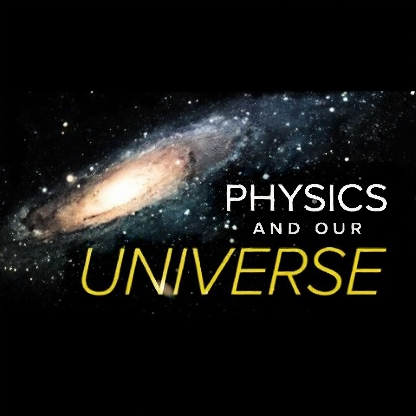
Physics and Our Universe
Original price was: $99.99.$29.99Current price is: $29.99.
An award-winning professor brings physics down to earth from everyday examples to universal principles.
Physics and Our Universe
Course Overview
An award-winning professor brings physics down to earth from everyday examples to universal principles. Physics is the fundamental science that explains how the universe works! With just a grasp of high school algebra, you can begin to explore the fundamentals of physics with lessons illustrated through diagrams, animations, and graphs. The course covers Newtonian mechanics, oscillations and waves, thermodynamics, electricity and magnetism, optics, quantum theory, and much more.
Video Lectures
- The Fundamental Science – 31 min
Introduction to physics and its scope from subatomic to galactic phenomena. - Languages of Physics – 31 min
Explore the specific terminology and fundamental units used in physics. - Describing Motion – 28 min
Learn the concepts of distance, displacement, speed, velocity, and acceleration. - Falling Freely – 30 min
Analyze motion under constant acceleration due to gravity, exploring Newton’s “clockwork universe.” - It’s a 3-D World! – 29 min
Introduction to vectors, enabling the analysis of motion in three dimensions. - Going in Circles – 30 min
Study circular motion and its implications for objects like jet planes. - Causes of Motion – 30 min
Understand the difference between force and motion, based on Galileo and Newton’s laws. - Using Newton’s Laws-1-D Motion – 32 min
Focus on Newton’s second law, exploring gravity and the concept of weight. - Action and Reaction – 30 min
Discover Newton’s third law and explore examples of action and reaction. - Newton’s Laws in 2 and 3 Dimensions – 30 min
Analyze cases of Newton’s laws in two and three-dimensional contexts. - Work and Energy – 31 min
Explore the definitions of work and energy and the principles of conservation of energy. - Using Energy Conservation – 30 min
Learn to apply the conservation of energy principle to various problems. - Gravity – 30 min
Examine the force of gravity and its effects on both objects and orbits. - Systems of Particles – 30 min
Learn about the center of mass and conservation of momentum in particle systems. - Rotational Motion – 33 min
Introduction to rotational analogs of classical motion concepts, focusing on angular momentum. - Keeping Still – 30 min
Explore static equilibrium and conditions for stability in systems like ladders. - Back and Forth-Oscillatory Motion – 32 min
Study oscillations and simple harmonic motion in various systems. - Making Waves – 28 min
Investigate wave properties and phenomena, including the Doppler effect. - Fluid Statics-The Tip of the Iceberg – 30 min
Learn about fluids at rest, pressure dynamics, and buoyancy. - Fluid Dynamics – 31 min
Explore principles of fluid motion, including the Bernoulli effect. - Heat and Temperature – 29 min
Define heat and temperature, investigating their roles in thermodynamics. - Heat Transfer – 31 min
Analyze mechanisms of heat transfer: conduction, convection, and radiation. - Matter and Heat – 30 min
Discover thermal expansion and phase changes in substances with heat flow. - The Ideal Gas – 31 min
Explore the ideal gas law, linking temperature, pressure, and volume. - Heat and Work – 31 min
Focus on the first law of thermodynamics and its applications in engines. - Entropy-The Second Law of Thermodynamics – 31 min
Understand the implications of entropy and its role in physical systems. - Consequences of the Second Law – 31 min
Analyze energy efficiency and its relevance to modern applications. - A Charged World – 32 min
Investigate the properties and behavior of electric charges. - The Electric Field – 31 min
Explore electric fields and Gauss’s law describing electric field lines. - Electric Potential – 31 min
Understand electric potential difference and its implications. - Electric Energy – 29 min
Study stored electric potential energy and capacitance. - Electric Current – 30 min
Learn about electric current, Ohm’s law, and safety tips. - Electric Circuits – 31 min
Analyze circuits including batteries, resistors, and capacitors. - Magnetism – 29 min
Discover the connection between magnetism and electricity. - The Origin of Magnetism – 30 min
Examine the fundamental properties of magnets and magnetic fields. - Electromagnetic Induction – 31 min
Investigate electromagnetic induction and how it generates current. - Applications of Electromagnetic Induction – 29 min
Explore technologies that utilize electromagnetic induction. - Magnetic Energy – 30 min
Study self-inductance in solenoids and the relationship between electricity and magnetism. - AC/DC – 31 min
Learn about direct and alternating current and their properties. - Electromagnetic Waves – 30 min
Explore Maxwell’s insights on electromagnetic fields and light. - Reflection and Refraction – 31 min
Investigate light behavior at boundaries and its applications. - Imaging – 30 min
Discover how lenses and mirrors form images. - Wave Optics – 33 min
Study the wave nature of light and the principles of interference and diffraction. - Cracks in the Classical Picture – 30 min
Understand the limitations of classical physics leading to new theories. - Earth, Ether, Light – 31 min
Review the Michelson-Morley experiment and its implications. - Special Relativity – 30 min
Explore the fundamental principles of Einstein’s special relativity. - Time and Space – 31 min
Delve into time dilation, length contraction, and the twins paradox. - Space-Time and Mass-Energy – 31 min
Understand the merging of space and time and Einstein’s equation E = mc². - General Relativity – 30 min
Discover the principles behind Einstein’s general theory of relativity. - Introducing the Quantum – 30 min
Begin exploring quantum theory and its groundbreaking principles. - Atomic Quandaries – 31 min
Analyze Bohr’s model of the atom and its limitations. - Wave or Particle? – 31 min
Investigate the dual nature of light and matter. - Quantum Mechanics – 32 min
Explore Schrödinger’s equation and its significance. - Atoms – 31 min
Survey atomic structure and quantum mechanics’ role in chemistry. - Molecules and Solids – 31 min
Understand molecular bonding and the implications for solid-state physics. - The Atomic Nucleus – 31 min
Study the makeup of atomic nuclei and radioactivity. - Energy from the Nucleus – 31 min
Investigate nuclear fission and fusion processes. - The Particle Zoo – 30 min
Learn about the standard model of particle physics. - An Evolving Universe – 31 min
Trace cosmological discoveries and the Big Bang theory. - Humble Physics-What We Don’t Know – 32 min
Conclude with the mysteries of dark matter and dark energy.
Related products

Original price was: $79.00.$14.00Current price is: $14.00.
Original price was: $59.00.$12.00Current price is: $12.00.

Original price was: $39.00.$9.00Current price is: $9.00.

Original price was: $18.00.$5.00Current price is: $5.00.
Original price was: $15.00.$4.00Current price is: $4.00.

Original price was: $19.00.$7.00Current price is: $7.00.
Original price was: $16.00.$4.90Current price is: $4.90.

Original price was: $15.00.$4.90Current price is: $4.90.