Skip to content
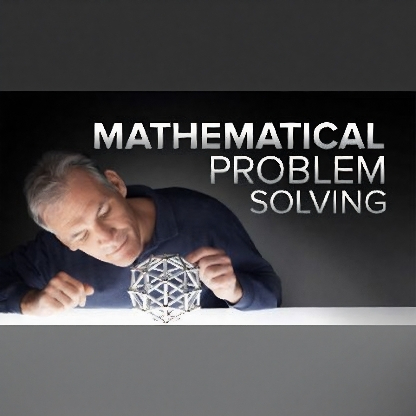
Art and Craft of Mathematical Problem Solving
Original price was: $49.99.$9.99Current price is: $9.99.
Let an award-winning professor and former champion “mathlete” demonstrate how solving math problems can be fun by teaching techniques you can use in many aspects of life.
Art and Craft of Mathematical Problem Solving
Course Description
Let an award-winning professor and former champion “mathlete” demonstrate how solving math problems can be fun by teaching techniques you can use in many aspects of life.
Video Lectures
01: Problems versus Exercises (30 min)
Begin your problem-solving journey with three entertaining problems that teach “wishful thinking” and “get your hands dirty” strategies, comparing math problems to hiking adventures.
02: Strategies and Tactics (29 min)
Learn the difference between strategies, tactics, and tools in problem solving through puzzles like a cryptic census reply and jumping frogs on a number line.
03: The Problem Solver’s Mind-Set (33 min)
Explore psychological aspects of problem solving – concentration, creativity, and confidence – while avoiding overreliance on narrow mathematical tricks through “think outside the box” challenges.
04: Searching for Patterns (29 min)
Develop pattern recognition skills by investigating trapezoidal numbers and Pascal’s triangle, experiencing both successful conjectures and cautionary failures.
05: Closing the Deal – Proofs and Tools (33 min)
Master different proof techniques including deductive proof, proof by contradiction, and algorithmic proof to validate earlier conjectures.
06: Pictures, Recasting, and Points of View (29 min)
Solve word problems through three breakthrough strategies: drawing pictures, changing perspectives, and recasting problems in new forms.
07: The Great Simplifier – Parity (29 min)
Apply parity concepts to wizard puzzles and locker problems, then see how this leads naturally into graph theory applications.
08: The Great Unifier – Symmetry (29 min)
Discover how to impose symmetry where none is obvious, demonstrated through problems like finding the shortest detour to fetch water.
09: Symmetry Wins Games! (31 min)
Develop winning strategies for combinatorial games like “puppies and kittens” by uncovering hidden symmetrical patterns.
10: Contemplate Extreme Values (30 min)
Solve challenging puzzles by focusing on minimal or maximal values in problems – a simple idea with powerful applications.
11: The Culture of Problem Solving (30 min)
Explore the global community of problem solvers, particularly strong in Russia and Eastern Europe, who specialize in non-traditional mathematics.
12: Recasting Integers Geometrically (27 min)
Tackle the famous “chicken nuggets” problem (largest unobtainable combination of 7 and 10) using visual geometric approaches.
13: Recasting Integers with Counting and Series (32 min)
Apply recasting and rule-breaking to classical number theory including Fermat’s Little Theorem and Euler’s proof of infinite primes.
14: The Pigeonhole Tactic (30 min)
Use the pigeonhole principle (n+1 items in n containers) to solve diverse problems and explore Ramsey theory’s patterns in randomness.
15: The Greatest Unifier of All – Invariants (31 min)
Discover how invariants – quantities that remain unchanged – form the most powerful problem-solving tactic, encompassing symmetry and parity.
16: Optimizing 3s and 2s (32 min)
Solve an International Mathematical Olympiad problem about maximizing products with fixed sums using algorithmic proof techniques.
17: Using Physical Intuition (31 min)
Apply developed skills to challenging problems including marble collisions on tracks, Gardner’s airplane puzzle, and laser beam reflections.
18: Geometry and Transformations (31 min)
Solve baffling geometry problems by applying rotations, reflections and other transformations pioneered by Felix Klein.
19: Mathematical Induction (30 min)
Learn when proof by mathematical induction is essential, typically in recursive situations where complex structures build from simple ones.
20: Induction on a Grand Scale (32 min)
Calculate the probability of even numbers in Pascal’s triangle using sophisticated inductive proof techniques.
21: Weird Dice (32 min)
Explore whether differently numbered dice can have the same probability distribution as standard dice through polynomial recasting.
22: Solving Very Hard Problems (30 min)
Apply the pigeonhole principle to find patterns in seemingly random, enormous structures – demonstrating limitless problem-solving potential.
23: Conway’s Infinite Checkers (32 min)
Examine John Conway’s famous checkers problem and learn about mathematical icons Paul Erdős and Évariste Galois.
24: How versus Why (34 min)
Review problem-solving tactics, introduce complex numbers, and advocate for understanding why solutions work, not just how they’re found.
Related products