Skip to content
The Foundations of Western Civilization
Original price was: $89.99.$22.99Current price is: $22.99.
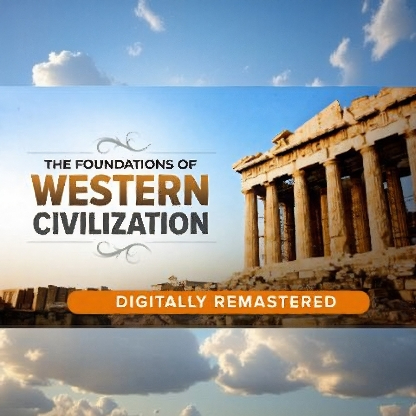
This digitally remastered classic course provides a grand tour of ancient Western civilization from 3000 B.C. to A.D. 1600, taught by an award-winning Notre Dame professor.
The Foundations of Western Civilization
Course Overview
Course No. 370
This digitally remastered classic course provides a grand tour of ancient Western civilization from 3000 B.C. to A.D. 1600, taught by an award-winning Notre Dame professor.
Spanning 48 lectures, you’ll explore:
- The birth of civilization in Mesopotamia and Egypt
- The rise and fall of Greece and Rome
- The medieval transformation of Europe
- The Renaissance and Reformation eras
- Key questions about what defines “Western” identity
Video Lectures
01: “Western,” “Civilization,” and “Foundations” (32 min)
Examine fundamental concepts of Western identity and historical significance.
02: History Begins at Sumer (30 min)
Discover why southern Iraq became a cradle of civilization alongside Egypt.
03: Egypt: The Gift of the Nile (31 min)
Explore how the Nile’s geography shaped Egypt’s unique cultural development.
04: The Hebrews: Small States and Big Ideas (31 min)
Analyze Israel’s religious contributions despite its small size.
05: A Succession of Empires (31 min)
Survey Assyrian, Babylonian, and Persian dominance of the ancient Near East.
06: Wide-Ruling Agamemnon (30 min)
Connect Bronze Age archaeology to Homer’s epic poems.
07: Dark Age and Archaic Greece (31 min)
Investigate Greece’s mysterious “dark age” and subsequent revival.
08: The Greek Polis: Sparta (30 min)
Decode Sparta’s militaristic society and its lasting influence.
09: The Greek Polis: Athens (31 min)
Trace Athens’ path from crisis to democracy to empire.
10: Civic Culture: Architecture and Drama (31 min)
Appreciate Greek public buildings and theater as ideological expressions.
11: The Birth of History (31 min)
Understand how Herodotus and Thucydides invented historical writing.
12: From Greek Religion to Socratic Philosophy (31 min)
Follow the intellectual shift from myth to rational inquiry.
13: Plato and Aristotle (31 min)
Compare these philosophical giants’ enduring worldviews.
14: The Failure of the Polis and the Rise of Alexander (31 min)
Examine why city-states declined and Macedon rose.
15: The Hellenistic World (31 min)
Tour the cosmopolitan Greek-influenced world after Alexander.
16: The Rise of Rome (31 min)
Uncover Rome’s monarchic origins and republican foundations.
17: The Roman Republic: Government and Politics (30 min)
Analyze Rome’s complex constitutional system.
18: Roman Imperialism (30 min)
Chart Rome’s expansion from Italy to world empire.
19: The Culture of the Roman Republic (30 min)
Appreciate Roman literature’s Greek influences and native genius.
20: Rome: From Republic to Empire (30 min)
Witness the turbulent transition from Gracchi to Augustus.
21: The Pax Romana (31 min)
Assess whether Rome’s “golden age” was truly peaceful.
22: Rome’s Golden and Silver Ages (31 min)
Explore imperial culture from Virgil to Tacitus.
23: Jesus and the New Testament (31 min)
Consider Christianity’s unlikely origins in Roman Palestine.
24: The Emergence of a Christian Church (31 min)
Trace early Christian community development.
25: Late Antiquity: Crisis and Response (31 min)
Study Rome’s 3rd-century troubles and Diocletian’s reforms.
26: Barbarians and Emperors (31 min)
Re-examine myths about Rome’s “fall” to invaders.
27: The Emergence of the Catholic Church (32 min)
Follow Christianity’s organizational development post-Constantine.
28: Christian Culture in Late Antiquity (30 min)
Observe how Christianity transformed Roman daily life.
29: Muhammad and Islam (30 min)
Understand Islam’s connections to Western traditions.
30: The Birth of Byzantium (31 min)
Reconstruct Constantine’s vision for his “New Rome.”
31: Barbarian Kingdoms in the West (31 min)
Map Germanic, Celtic and Slavic successor states.
32: The World of Charlemagne (31 min)
Appreciate how one ruler briefly reunited Western Europe.
33: The Carolingian Renaissance (31 min)
Identify Charlemagne’s cultural achievements.
34: The Expansion of Europe (31 min)
Explain Europe’s remarkable post-1000 resurgence.
35: The Chivalrous Society (31 min)
Decode medieval social structures and their omissions.
36: Medieval Political Traditions, I (31 min)
Compare English and French governmental developments.
37: Medieval Political Traditions, II (31 min)
Broaden perspectives beyond Anglo-French centrality.
38: Scholastic Culture (31 min)
Meet brilliant thinkers like Aquinas who shaped universities.
39: Vernacular Culture (31 min)
Celebrate the flowering of literature in native tongues.
40: The Crisis of Renaissance Europe (31 min)
Set the stage for cultural rebirth amid turmoil.
41: The Renaissance Problem (31 min)
Untangle four key paradoxes of this “rebirth.”
42: Renaissance Portraits (31 min)
Engage with luminaries from Boccaccio to Michelangelo.
43: The Northern Renaissance (31 min)
Contrast humanist movements across the Alps.
44: The Protestant Reformation: Martin Luther (31 min)
Begin examining Christianity’s dramatic division.
45: The Protestant Reformation: John Calvin (31 min)
Complete the Reformation picture beyond Luther.
46: Catholic Reforms and “Confessionalization” (31 min)
Track the Counter-Reformation’s institutional responses.
47: Exploration and Empire (30 min)
Ponder Europe’s unlikely global expansion.
48: What Challenges Remain? (33 min)
Reflect on enduring Western patterns at modernity’s threshold.
Related products