Skip to content
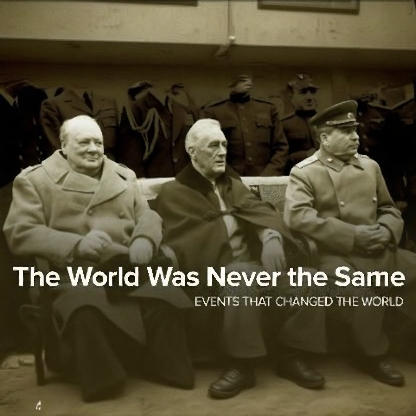
The World Was Never the Same: Events That Changed History
Original price was: $69.99.$14.99Current price is: $14.99.
Get a comprehensive and riveting overview of defining moments that profoundly changed the world. In 36 lectures, Professor J. Rufus Fears examines events chosen for how they fundamentally changed history, how their aftermath reshaped societies, and how their legacies still matter today. The series spans millennia—from Hammurabi’s code to 9/11—exploring political, religious, scientific, cultural, and military turning points.
The World Was Never the Same: Events That Changed History
Course Overview
Get a comprehensive and riveting overview of defining moments that profoundly changed the world. In 36 lectures, Professor J. Rufus Fears examines events chosen for how they fundamentally changed history, how their aftermath reshaped societies, and how their legacies still matter today. The series spans millennia—from Hammurabi’s code to 9/11—exploring political, religious, scientific, cultural, and military turning points.
Course Details
- Course No.: 3890
- Instructor: Professor J. Rufus Fears (University of Oklahoma)
- Format: 36 recorded lectures, each ~29–32 minutes (with a few slightly longer)
- Focus: Landmark events and ideas that transformed civilizations and continue to resonate
Video Lectures (organized)
01: Hammurabi Issues a Code of Law (1750 B.C.) — 32 min
Examine Hammurabi’s code: early legal principles on family law, wages, and victims’ rights that influenced later legal systems.
02: Moses and Monotheism (1220 B.C.) — 30 min
How Moses, the Exodus, and the Ten Commandments shaped monotheism and the foundations of Judaism, Christianity, and Islam.
03: The Enlightenment of the Buddha (526 B.C.) — 30 min
The life and teachings of Siddhartha Gautama and how Buddhism’s ethics and practices affected billions.
04: Confucius Instructs a Nation (553–479 B.C.) — 30 min
Confucius’s philosophy (the Dao/Way) and its deep, enduring influence on Chinese society and governance.
05: Solon — Democracy Begins (594 B.C.) — 30 min
Solon’s reforms in Athens: the origins of balanced democratic ideas and political restructuring in a city-state.
06: Marathon — Democracy Triumphant (490 B.C.) — 29 min
The Battle of Marathon as a defense of nascent Greek democracy against Persian imperial forces.
07: Hippocrates Takes an Oath (430 B.C.) — 30 min
Hippocratic medicine and ethical medicine’s origins amid crises like the Great Plague of Athens.
08: Caesar Crosses the Rubicon (49 B.C.) — 30 min
Caesar’s decisive march that precipitated the end of the Roman Republic and rise of imperial rule.
09: Jesus — The Trial of a Teacher (A.D. 36) — 31 min
The trial and execution of Jesus of Nazareth and the origins of a movement that would become Christianity.
10: Constantine I Wins a Battle (A.D. 312) — 30 min
Constantine’s rise, conversion, and the transformation of Christianity into a state religion.
11: Muhammad Moves to Medina — The Hegira (A.D. 622) — 30 min
Muhammad’s flight to Medina and the beginnings of the Islamic community and polity.
12: Bologna Gets a University (1088) — 31 min
The founding of the University of Bologna and the institutional birth of European higher education.
13: Dante Sees Beatrice (1283) — 30 min
Dante’s inspiration and The Divine Comedy’s role in shaping medieval thought and the Renaissance.
14: Black Death — Pandemics and History (1348) — 30 min
The Black Death’s demographic, economic, and cultural consequences across Europe.
15: Columbus Finds a New World (1492) — 31 min
Columbus’s voyages and the profound global consequences of European contact with the Americas.
16: Michelangelo Accepts a Commission (1508) — 30 min
Michelangelo’s Sistine Chapel commission as a defining moment in Renaissance art and cultural expression.
17: Erasmus — A Book Sets Europe Ablaze (1516) — 30 min
Erasmus’s Greek New Testament, humanism, and the intellectual currents that paved the Reformation.
18: Luther’s New Course Changes History (1517) — 30 min
Martin Luther’s 95 Theses and the spark that ignited the Protestant Reformation.
19: The Defeat of the Spanish Armada (1588) — 30 min
England’s naval victory and the shift in maritime power that enabled global British influence.
20: The Battle of Vienna (1683) — 30 min
Vienna’s defense against the Ottoman siege and its long-term geopolitical implications for Europe and the Near East.
21: The Battle of Lexington (1775) — 30 min
The opening clashes of the American Revolution and the birth of a nation founded on revolutionary ideals.
22: General Pickett Leads a Charge (1863) — 30 min
Gettysburg and the turning point of the American Civil War with consequences for national unity and slavery.
23: Adam Smith (1776) versus Karl Marx (1867) — 31 min
Foundations of modern economic thought: Smith’s capitalism and Marx’s critique—ideas that shaped political economies.
24: Charles Darwin Takes an Ocean Voyage (1831) — 31 min
Darwin’s voyage and the formulation of evolutionary theory that transformed biology and human self-understanding.
25: Louis Pasteur Cures a Child (1885) — 31 min
Pasteur’s germ theory and vaccines: revolutionizing public health and medicine.
26: Two Brothers Take a Flight (1903) — 30 min
The Wright brothers’ first flight and the dawn of aviation with far-reaching social and military effects.
27: The Archduke Makes a State Visit (1914) — 30 min
The assassination of Franz Ferdinand in Sarajevo and the chain of events leading to World War I.
28: One Night in Petrograd (1917) — 30 min
The Bolshevik Revolution and the emergence of the Soviet Union as a major 20th-century force.
29: The Day the Stock Market Crashed (1929) — 30 min
The 1929 crash, the Great Depression, and its global economic and political consequences.
30: Hitler Becomes Chancellor of Germany (1933) — 30 min
Hitler’s rise to power and the origins of Nazi totalitarianism, war, and genocide.
31: Franklin Roosevelt Becomes President (1933) — 30 min
FDR’s inauguration and New Deal leadership in a nation confronting economic collapse.
32: The Atomic Bomb Is Dropped (1945) — 30 min
Hiroshima, the Atomic Age, and the transformation of warfare, diplomacy, and scientific responsibility.
33: Mao Zedong Begins His Long March (1934) — 30 min
Mao’s Long March and the consolidation of Communist power that reshaped 20th-century China.
34: John F. Kennedy Is Assassinated (1963) — 30 min
The assassination of JFK, its national trauma, and ramifications for American politics and culture.
35: Dr. King Leads a March (1963) — 30 min
Martin Luther King Jr.’s “I Have a Dream” moment and its role in the civil rights movement and social change.
36: September 11, 2001 — 32 min
The 9/11 terrorist attacks and the profound geopolitical, security, and cultural shifts that followed.
Related products



By Area