Skip to content
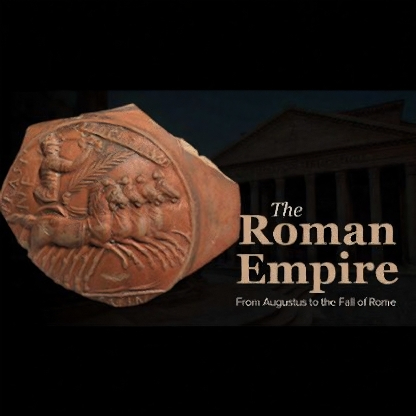
The Roman Empire: From Augustus to The Fall of Rome
Original price was: $49.99.$9.99Current price is: $9.99.
Follow a renowned history professor as he uncovers five hundred years of the Roman Empire. This 24-lecture course (Course No. 3344), taught by Professor Gregory S. Aldrete, traces Rome’s transformation from Augustus’s founding of the principate through the empire’s Golden Age and the crises that led to the collapse of the western half—while also illuminating everyday Roman life, culture, institutions, and legacy.
The Roman Empire: From Augustus to the Fall of Rome
Overview
Follow a renowned history professor as he uncovers five hundred years of the Roman Empire. This 24-lecture course (Course No. 3344), taught by Professor Gregory S. Aldrete, traces Rome’s transformation from Augustus’s founding of the principate through the empire’s Golden Age and the crises that led to the collapse of the western half—while also illuminating everyday Roman life, culture, institutions, and legacy.
Course Details
- Course No.: 3344
- Instructor: Professor Gregory S. Aldrete (University of Wisconsin–Green Bay)
- Format: 24 lectures, ~31–38 minutes each
- Central themes: imperial politics and personalities, urban life and hazards, art and literature, religion and Christianity, military organization and frontier defense, spectacles and social life, economic and administrative pressures, Late Antiquity, and long-term legacy.
Lecture List
- 01: Dawn of the Roman Empire — 35 min
Sets the stage for Rome’s transition from Republic to Empire after Octavian’s victory at Actium and explains how he secured one-man rule.
- 02: Augustus, the First Emperor — 32 min
Portrait of Octavian/Augustus: his personality, political innovations, and how he stabilized Rome without provoking assassination.
- 03: Tiberius and Caligula — 32 min
Examines Augustus’s problematic succession and the troubled reigns of Tiberius and the infamous Caligula.
- 04: Claudius and Nero — 31 min
Covers Claudius’s administrative strengths and Nero’s destructive and self-indulgent rule.
- 05: The Flavian Emperors and Roman Bath Culture — 31 min
Reviews the Flavian dynasty (Vespasian et al.) and the social, civic, and cultural importance of Roman bathing.
- 06: The Five Good Emperors — 33 min
Survey of Trajan, Hadrian, Marcus Aurelius, and others: their governance, military accomplishments, and intellectual contributions.
- 07: Hazards of Life in Ancient Rome: The Five Fs — 31 min
Reveals daily dangers faced by Romans—filth, fire, floods, famine, and famine-related problems—and the reality behind the city’s image.
- 08: Roman Art and Architecture — 32 min
Explores artistic influences, propaganda art under Augustus, and engineering achievements like aqueducts and the Pantheon.
- 09: Roman Literature — 32 min
Looks at major Roman writers (Cicero, Horace, Ovid, Virgil) and the range of literature from rhetoric to history and technical works.
- 10: The Ordinary Roman Speaks: Graffiti — 31 min
Uses Pompeian graffiti to access voices of everyday Romans and broaden understanding beyond elite-written sources.
- 11: Final Words: Burial and Tombstone Epitaphs — 30 min
Studies epitaphs and burial practices to reveal social identities, values, and how Romans commemorated the dead.
- 12: From Commodus to Caracalla — 32 min
Traces the unstable rulers after Marcus Aurelius, including Commodus’s failures and the Severan attempts at restoration.
- 13: The Crisis of the 3rd Century — 31 min
Analyzes the empire’s near-collapse from civil wars, invasions, economic breakdowns, and natural disasters.
- 14: Diocletian and Late 3rd-Century Reforms — 32 min
Explains Diocletian’s reforms—administrative, military, and economic—that temporarily stabilized the empire.
- 15: Early Christianity and the Rise of Constantine — 32 min
Follows Christianity’s growth, Constantine’s conversion, and the religion’s increasing political significance.
- 16: Constantine and His Successors — 32 min
Examines Constantine’s motives, the Council of Nicaea and Arian controversy, founding of Constantinople, and imperial transition.
- 17: Gladiators and Beast Hunts — 32 min
Surveys gladiatorial combat, performers’ lives, and animal spectacles as popular culture and social spectacle.
- 18: Chariot Racing, Spectacles, and Theater — 32 min
Focuses on chariot racing (Circus Maximus), factions, and theatrical entertainments that shaped urban social life.
- 19: The Roman Army — 32 min
Details organization, equipment, recruitment, training, and the army’s central role in Roman society and expansion.
- 20: Barbarians Overwhelm the Western Empire — 31 min
Introduces the waves of invasions (Huns, Visigoths, Vandals, etc.) and how frontier pressures and migrations stressed the empire.
- 21: The Byzantine Empire — 32 min
Surveys the eastern Roman state (Byzantium), its institutions and leaders (e.g., Justinian), and why it endured long after the West fell.
- 22: When and Why Did the Roman Empire Fall? — 32 min
Critically evaluates competing explanations for the fall of Rome and considers timing and complexity of decline.
- 23: Late Antiquity: A New Historical Era — 34 min
Reframes 200–600 CE as an era of transformation and cultural fusion, not merely decline—examining continuity and change.
- 24: Echoes of Rome — 38 min
Concluding reflection on Rome’s legacy—law, language, architecture, institutions—and final voices from everyday Romans.Related products

By Area