Skip to content
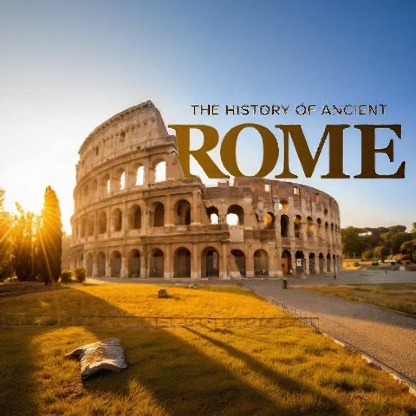
The History of Ancient Rome
Original price was: $89.99.$19.99Current price is: $19.99.
Course No. (The History of Ancient Rome) — Discover the full story of Roman civilization: its origins, institutions, society, military expansion, cultural life, emperors, transformations, and the debates about its “fall.”
The History of Ancient Rome
Overview
Course No. (The History of Ancient Rome) — Discover the full story of Roman civilization: its origins, institutions, society, military expansion, cultural life, emperors, transformations, and the debates about its “fall.”
Course Description
A comprehensive 48-lecture survey of Rome from pre‑Roman Italy through the end of the Western Empire. The course addresses sources and methodology, early peoples (Etruscans, Greeks), the foundation myths and regal period, the Republic’s institutions and internal struggles, Rome’s expansion across Italy and the Mediterranean (including the Punic Wars), the Social and Roman Revolutions (Gracchi, Marius, Sulla, Pompey, Caesar), the rise of Augustus and the Principate, imperial institutions and crises (third‑century instability, Diocletian, Constantine), social and cultural life (family, slavery, cities, entertainment, religion), the Christianization of the empire, and final reflections on the processes conventionally described as the “fall” of the Western Roman Empire.
Instructor
Course presenter (not specified in the description)
Lecture List
- Introduction — What makes ancient Rome important; parameters and scope of the study. (30 min)
- The Sources — Assessing the evidence from the ancient world: strengths and limits. (30 min)
- Pre‑Roman Italy and the Etruscans — Peoples of the peninsula, Greek colonies, Etruscan influence. (30 min)
- The Foundation of Rome — Romulus & Remus, Aeneas traditions, and archaeological evidence. (30 min)
- The Kings of Rome — The traditional kings, Etruscan role, and how later authors used these tales. (30 min)
- Regal Society — Early Roman social structure and politics on the eve of the Republic. (31 min)
- The Beginnings of the Republic — Expulsion of kings (509 BCE) and scholarly views on founding. (30 min)
- The Struggle of the Orders — Patrician‑plebeian conflict (494–287 BCE) and its political outcomes. (31 min)
- Roman Expansion in Italy — Phases of conquest across the peninsula and domestic consequences. (30 min)
- The Roman Confederation in Italy — Administrative system for conquered Italian communities. (30 min)
- The International Scene on the Eve of Roman Expansion — Geopolitical context before 264 BCE. (30 min)
- Carthage and the First Punic War — Carthaginian state, the First Punic War and its aftermath. (30 min)
- The Second Punic (Hannibalic) War — Causes, campaigns (Hannibal), and consequences (218–202 BCE). (30 min)
- Rome in the Eastern Mediterranean — Rome’s rapid rise in the eastern Mediterranean after Hannibal. (30 min)
- Explaining the Rise of the Roman Empire — Polybius, military machine, and reasons for Roman expansion. (30 min)
- “The Captured Conqueror” — Rome and Hellenism; Greek influence on Roman culture. (31 min)
- Governing the Roman Republic, Part I — Senate, magistrates, and core republican mechanisms. (31 min)
- Governing the Roman Republic, Part II — Popular assemblies, juries, and provincial administration. (31 min)
- The Pressures of Empire — How expansion stressed Roman politics and fueled revolutionary pressures. (30 min)
- The Gracchi Brothers — Tiberius and Gaius Gracchus: land reform, conflict, and the revolutionary opening. (30 min)
- Marius and Sulla — Military, political rivalry, and the acceleration of republican breakdown. (30 min)
- “The Royal Rule of Sulla” — Sulla’s dictatorship, legislation, aims, and why his program faltered. (30 min)
- Sulla’s Reforms Undone — Rise of Pompey and Crassus; the collapse of Sulla’s restoration. (30 min)
- Pompey and Crassus — Power politics, Catiline, and the unraveling of Republican order. (30 min)
- The First Triumvirate — Caesar, Pompey, Crassus coalition and the effective end of Republican norms. (31 min)
- Pompey and Caesar — Rivalry after Crassus’s death; road to civil war (49 BCE). (30 min)
- “The Domination of Caesar” — Caesar’s ascent, achievements, and assassination. (31 min)
- Social and Cultural Life in the Late Republic — Literature (Catullus, Cicero), urban poverty, and social context. (31 min)
- Antony and Octavian — Post‑Caesar power struggle between Antony and Octavian. (30 min)
- The Second Triumvirate — Antony, Octavian, Lepidus; their rule, tensions, and political consequences. (30 min)
- Octavian Emerges Supreme — Octavian’s strategies, victory over Antony, and consolidation of power. (30 min)
- The New Order of Augustus — Augustus’s Principate: institutions, ideology, and unresolved problems. (30 min)
- The Imperial Succession — Mechanisms and uncertainties of imperial succession under the Principate. (30 min)
- The Julio‑Claudian Dynasty — Tiberius, Caligula, Claudius, Nero: personalities and sources (Tacitus, Suetonius). (30 min)
- The Emperor in the Roman World — The emperor’s role, power, and practical limits across the empire. (30 min)
- The Third‑Century Crisis — Civil wars, military anarchy, external pressures, and systemic crisis (235–284). (30 min)
- The Shape of Roman Society — Status, law, and social structure in Rome c. 200 BCE–200 CE. (30 min)
- Roman Slavery — Systems, sources of slaves, lived experience, manumission, and the unusual features of Roman slavery. (30 min)
- The Family — Roman concept of family, household structure, and legal/social differences from modern notions. (30 min)
- Women in Roman Society — Roles, influence, and variations across social classes. (30 min)
- An Empire of Cities — Urbanization, city organization, administration, and civic life across the provinces. (30 min)
- Public Entertainment, Part I — Roman baths and chariot racing: leisure, mass spectacle, and civic policy. (30 min)
- Public Entertainment, Part II — Gladiatorial games: origins, training, social meaning, and cultural interpretation. (31 min)
- Roman Paganism — Ritual focus, state cults, divination, and the religious worldview of pagan Rome. (31 min)
- The Rise of Christianity — From persecuted sect to state religion within five centuries. (31 min)
- The Restoration of Order — Reforms of the late third century (270–305): Diocletian and structural changes. (30 min)
- Constantine and the Late Empire — Founding of Constantinople, imperial Christianization, and later developments. (30 min)
- Thoughts on the “Fall” of the Roman Empire — 410 sack, barbarian settlement, 476 CE, and evaluating whether “fall” is appropriate. (31 min)
Related products