Skip to content
History of the Ancient World: A Global Perspective
Original price was: $89.99.$19.99Current price is: $19.99.
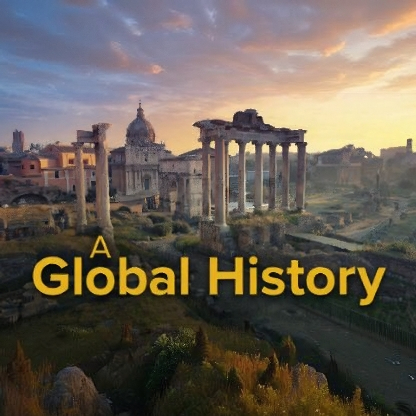
These 48 multidisciplinary lectures offer a global survey of the ancient world, treating civilizations comparatively across religion, philosophy, visual arts, literature, science, and politics. Professor Aldrete examines major cultures—from Mesopotamia, Egypt, Greece, Rome, China, India, Persia, and the Americas—showing how geography, resources, institutions, and ideas shaped each society and how they influenced later history.
Course Overview
These 48 multidisciplinary lectures offer a global survey of the ancient world, treating civilizations comparatively across religion, philosophy, visual arts, literature, science, and politics. Professor Aldrete examines major cultures—from Mesopotamia, Egypt, Greece, Rome, China, India, Persia, and the Americas—showing how geography, resources, institutions, and ideas shaped each society and how they influenced later history.
What you’ll learn
- Comparative frameworks for understanding ancient civilizations
- How religion, philosophy, art, and literature shaped political and social life
- The rise, consolidation, and fall of major states across Eurasia and the Americas
- Cross-cultural comparisons of warfare, administration, technology, and cultural expression
- How the ancient past continues to inform modern institutions and values
Video Lessons
01: Cities, Civilizations, and Sources (33 min)
Course approach, interpretive risks, and the role of evidence and bias in reading archaeological discoveries.
02: From Out of the Mesopotamian Mud (34 min)
Geography and resources shaping Mesopotamian subsistence, religion, state formation, and record-keeping.
03: Cultures of the Ancient Near East (30 min)
Successive empires, legal codes, seafaring, astronomy, mathematics, and the political dynamics of the region.
04: Ancient Egypt—The Gift of the Nile (30 min)
The Nile’s role in Egyptian civilization: agriculture, settlement patterns, and cultural continuity.
05: Pharaohs, Tombs, and Gods (29 min)
Changing funerary practices, views of the afterlife, and contrasts between Egyptian and Mesopotamian worldviews.
06: The Lost Civilization of the Indus Valley (31 min)
Interpreting a literate-less civilization through material remains: urban planning and the limits of archaeological inference.
07: The Vedic Age of Ancient India (31 min)
The textually rich Vedic period: religion, social structures, and what epic and Vedic texts reveal.
08: Mystery Cultures of Early Greece (30 min)
Minoan and Mycenaean worlds, the roots of Greek myth (Minotaur, Atlantis), and the recovery from the Dark Ages.
09: Homer and Indian Poetry (31 min)
How foundational literatures (Homer, Indian epics) shape cultural identity and collective memory.
10: Athens and Experiments in Democracy (32 min)
Origins and practices of Athenian democracy, its surprises, and early political culture.
11: Hoplite Warfare and Sparta (32 min)
Spartan socialization, military innovations, and structural weaknesses that limited Spartan endurance.
12: Civilization Dawns in China—Shang and Zhou (30 min)
Early Chinese state formation and the self-conception of China as the cultural center.
13: Confucius and the Greek Philosophers (32 min)
Comparative look at pragmatic rational inquiry in Confucian and Ionian/Greek philosophical traditions.
14: Mystics, Buddhists, and Zoroastrians (33 min)
Religious innovations and worldviews: Upanishads, Jainism, Buddhism, Daoism, and Zoroastrianism.
15: Persians and Greeks (30 min)
Why Greek city-states survived Persian pressure and how defensive alliances evolved into Athenian dominance.
16: Greek Art and Architecture (30 min)
Principles of Greek sculpture and temple design that shaped Western artistic canons.
17: Greek Tragedy and the Sophists (31 min)
Athens’ theatrical culture and the rise of Sophist and Socratic philosophical currents.
18: The Peloponnesian War and the Trial of Socrates (30 min)
How internecine conflict weakened Greece politically and culturally, culminating in Socrates’ trial.
19: Philip of Macedon—Architect of Empire (29 min)
Philip’s political and military innovations that enabled Macedonian dominance.
20: Alexander the Great Goes East (30 min)
Alexander’s conquests, strategies, and the immediate geopolitical consequences across Eurasia.
21: Unifiers of India—Chandragupta and Asoka (30 min)
The rise of an Indian empire after Alexander’s death and Asoka’s transformative policies and religion.
22: Shi Huangdi—First Emperor of China (33 min)
Unification under Qin: statecraft, legalism, centralization, and the foundations of imperial China.
23: Earliest Historians of Greece and China (31 min)
Herodotus, Thucydides, and Sima Qian: defining history as a discipline and its foundational questions.
24: The Hellenistic World (31 min)
Political turmoil and cultural creativity after Alexander: science, philosophy, and artistic synthesis.
25: The Great Empire of the Han Dynasty (30 min)
Han institutions, administration, and the empire’s long-term social and cultural stability.
26: People of the Toga—Etruscans, Early Rome (31 min)
Rome’s origins, geography, early institutions, and the Etruscan influence on Roman development.
27: The Crucible—Punic Wars, Roman Imperialism (32 min)
Rome’s struggle with Carthage, Hannibal’s threat, and the expansion that forged Roman power.
28: The Death of the Roman Republic (31 min)
Late-Republic tensions, political violence, and the collapse of republican governance.
29: Augustus—Creator of the Roman Empire (31 min)
Octavian’s consolidation of power and the institutional foundations of the Roman Empire.
30: Roman Emperors—Good, Bad, and Crazy (29 min)
Survey of imperial personalities and their impacts on governance and imperial stability.
31: Han and Roman Empires Compared—Geography (30 min)
Comparative geography and how territory shaped administrative and military strategies.
32: Han and Roman Empires Compared—Government (30 min)
Administrative structures, bureaucratic recruitment, and the role of the emperor in each empire.
33: Han and Roman Empires Compared—Problems (29 min)
Shared imperial challenges: succession, integration of conquered peoples, and frontier defense.
34: Early Americas—Resources and Olmecs (30 min)
Origins of American complex societies, resource constraints, and early Mesoamerican cultures like the Olmecs.
35: Pots and Pyramids—Moche and Teotihuacan (33 min)
Regional diversity in the Americas—urbanism, monumental architecture, and artistic production.
36: Blood and Corn—Mayan Civilization (32 min)
Maya achievements in writing, astronomy, and political organization—and how we reconstruct their history.
37: Hunter-Gatherers and Polynesians (30 min)
Non-urban complex societies: cultural sophistication among hunter-gatherers and long-distance Polynesian navigation.
38: The Art and Architecture of Power (29 min)
How rulers used monuments and visual culture to project authority and shape social order.
39: Comparative Armies—Rome, China, Maya (29 min)
Comparative military structures, tactics, and technologies across distinct civilizations.
40: Later Roman Empire—Crisis and Christianity (31 min)
Political, military, and economic crises; recovery; and Christianity’s transformation of imperial identity.
41: The Decline and Fall of the Roman Empire? (29 min)
Debates over timing and causes of Rome’s decline—survey of major theories and evidence.
42: The Byzantine Empire and the Legacy of Rome (29 min)
The eastern Roman state’s continuity, cultural influence, and major personalities shaping medieval legacies.
43: China from Chaos to Order under the Tang (28 min)
Post-Han recovery, reunification, and the rise of the Tang as a model of urbanized, cosmopolitan rule.
44: The Golden Age of Tang Culture (31 min)
Tang artistic, technological, and literary achievements and their influence on East Asia.
45: The Rise and Flourishing of Islam (31 min)
Rapid expansion of Islam, transformations across the Mediterranean and Near East, and long-term cultural impacts.
46: Holy Men and Women—Monasticism and Saints (28 min)
Development of Christian monasticism, influential church fathers, and the cult of saints.
47: Charlemagne—Father of Europe (28 min)
Charlemagne’s conquests, institutional reforms, and cultural legacy in shaping medieval Europe.
48: Endings, Beginnings, What Does It All Mean? (28 min)
Synthesis of course themes, Pirenne’s perspective, and why comparative study of ancient civilizations matters today.
Related products