Skip to content
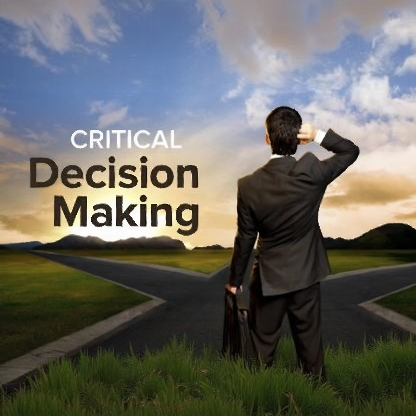
The Art of Critical Decision Making
Original price was: $39.99.$6.90Current price is: $6.90.
Course Description
The Art of Critical Decision Making
Master the skill of decision making with this engaging and practical course taught by an award-winning scholar of leadership, strategy, and organizational behavior. Through real-world case studies and frameworks, you’ll discover why good leaders sometimes make bad choices, how cognitive biases interfere with judgment, and what methods can help you and your team reach better decisions. Learn how to stimulate productive debate, avoid groupthink, balance intuition with analysis, and build effective decision-making processes that can be applied in both professional and personal life.
📑 What You’ll Learn
-
How leaders can avoid common decision-making traps and biases.
-
The role of framing, intuition, and reasoning by analogy in shaping choices.
-
Group decision-making challenges such as groupthink and indecision.
-
Techniques to stimulate creativity, brainstorming, and constructive conflict.
-
Frameworks for procedural justice, small wins, and sense-making in ambiguity.
-
How organizational culture, politics, and power dynamics impact decisions.
-
Tools for asking the right questions, connecting the dots, and seeking problems before they escalate.
🎬 Lessons
01: Making High-Stakes Decisions – Why good leaders sometimes make bad decisions. (32 min)
02: Cognitive Biases – Sunk-cost effect, overconfidence bias, recency effect. (30 min)
03: Avoiding Decision-Making Traps – Anchoring, confirmatory bias, and more. (31 min)
04: Framing—Risk or Opportunity? – How framing influences risk-taking. (31 min)
05: Intuition—Recognizing Patterns – Combining intuition with rational analysis. (32 min)
06: Reasoning by Analogy – The power and pitfalls of analogies. (32 min)
07: Making Sense of Ambiguous Situations – The process of sense-making. (29 min)
08: The Wisdom of Crowds? – When groups outperform individuals—and when they don’t. (32 min)
09: Groupthink—Thinking or Conforming? – Lessons from the Bay of Pigs. (31 min)
10: Deciding How to Decide – Designing better decision processes. (30 min)
11: Stimulating Conflict and Debate – Techniques to encourage diverse perspectives. (30 min)
12: Keeping Conflict Constructive – Managing conflict in teams. (31 min)
13: Creativity and Brainstorming – Lessons from IDEO’s innovation methods. (32 min)
14: The Curious Inability to Decide – Cultures of “yes,” “no,” and “maybe.” (30 min)
15: Procedural Justice – Building consensus after decisions. (31 min)
16: Achieving Closure Through Small Wins – The importance of intermediate agreements. (31 min)
17: Normal Accident Theory – How complex systems can fail. (30 min)
18: Normalizing Deviance – Lessons from the Challenger disaster. (31 min)
19: Allison’s Model—Three Lenses – Exploring the Cuban Missile Crisis. (31 min)
20: Practical Drift – Why organizations break their own rules. (31 min)
21: Ambiguous Threats and the Recovery Window – Lessons from Columbia shuttle accident. (32 min)
22: Connecting the Dots – How failing to integrate information leads to missed threats. (30 min)
23: Seeking Out Problems – Toyota’s proactive problem-seeking approach. (30 min)
24: Asking the Right Questions – Shifting from making decisions to shaping processes. (30 min)
Related products

By Area